
Written by: Dr. Akash Chandawarkar, Board Certified Plastic Surgeon, Mirror Plastic Surgery | Last updated: July 22, 2026
Key Takeaways
- Chin augmentation implants are alloplastic devices placed surgically to increase chin projection and improve lower-face balance, usually in a 45–90 minute outpatient procedure.
- Implant materials such as solid silicone, porous polyethylene, ePTFE, PEEK, and titanium each offer specific tradeoffs in integration, revision complexity, and long-term stability.
- Recovery follows a predictable timeline. Most patients return to desk work within a week and resume full activity by 6–8 weeks, while Tampa’s climate requires extra sun and heat protection.1
- Choosing an experienced, board-certified surgeon who uses stable fixation and sets realistic expectations significantly reduces risks like infection, bone resorption, and displacement.
- Book a consultation with Dr. Akash at Mirror Plastic Surgery for a personalized assessment to determine whether a chin implant matches your anatomy and goals.
Chin Structure, Aging, and Who Benefits Most
The chin is formed by the anterior symphysis of the mandible. The mental nerve exits the mental foramen on each side, roughly below the second premolar, and supplies sensation to the lower lip, chin skin, and anterior gum tissue. Surgeons create the implant pocket below this nerve to avoid injury.
Microgenia, a chin that is proportionally small relative to the nose and midface, can be congenital or acquired. When acquired, age-related bone resorption gradually reduces chin projection, and soft-tissue sagging makes the deficiency more noticeable. Chin implants are placed in patients with a receding chin due to aging or bone deficiency associated with Class II malocclusion. Among these patients, those whose deficit is limited to horizontal projection are generally good implant candidates. Patients with vertical discrepancy, significant asymmetry, or bite problems often need sliding genioplasty or orthognathic surgery instead.
Implant Materials and How They Behave Over Time
Several biocompatible materials are used for chin augmentation. Each has properties that influence how it bonds with tissue, how easy revision will be, and how it behaves over decades.
- Solid silicone elastomer: Biocompatible, highly resistant to degradation, with minimal allergic reaction risk. It remains the most widely used material. A thin fibrous capsule forms around the implant rather than tissue growing into it, which makes revision or removal comparatively straightforward. Non-fixed silicone implants carry a higher bone resorption risk, and rigid fixation lowers that risk.
- Porous polyethylene (HDPE): Fibrous tissue and small blood vessels grow into the porous matrix, providing long-term stabilization and reducing movement risk. This ingrowth also makes removal or revision more technically demanding and increases the risk of injury to surrounding tissues.
- ePTFE (Gore-Tex): Considered safe when placed by experienced surgeons, with implant selection tailored to anatomy, goals, and surgeon preference.
- PEEK and titanium: Used for patient-specific custom implants due to mechanical strength and biocompatibility. Their rigidity limits intraoperative adaptability and makes revision more complex.
Across these materials, systematic reviews report low overall complication rates and high patient satisfaction for silicone, porous polyethylene, and ePTFE.1 The ideal choice depends on the degree of correction needed, the surgeon’s fixation technique, and how strongly the patient values reversibility.
Incision Choices and Step-by-Step Surgical Flow
Two incision approaches are standard for chin implants. The submental approach places a small incision in the natural crease beneath the chin and provides direct visualization of the bone and mental nerve. The intraoral approach places the incision inside the lower lip and leaves no external scar. Evidence syntheses suggest no clear overall difference in total complication rates between intraoral and submental incision approaches, though intraoral incisions carry a comparatively higher infection risk.
The surgical sequence includes anesthesia, incision creation, and careful dissection of a subperiosteal pocket directly over the chin bone. The surgeon then positions the implant symmetrically, secures it with a small titanium screw to prevent displacement, and closes the incision in layers. The entire sequence typically takes 45–90 minutes from incision to closure.
Recovery Timeline in Tampa’s Climate
Recovery from chin implant surgery follows a predictable sequence, and Tampa’s subtropical climate with high humidity and strong sun affects aftercare choices.
- Days 1–3: Most significant discomfort, with tightness, stiffness, numbness, swelling, and bruising that may extend to the jaw area. Keep the head elevated at all times, apply ice packs for the first 48–72 hours, and take prescribed pain medication. Eat soft foods and perform gentle oral rinsing if an intraoral incision was used. Avoid direct sun exposure to the incision, and stay in air-conditioned environments when possible.
- Week 1: Most patients can return to desk work between days 4 and 7 as visible swelling begins to soften. Avoid pressure on the chin, face-down sleeping, and vigorous activity. Avoid lifting more than 5 pounds and any activity that increases heart rate or blood pressure. In Tampa’s heat, limit outdoor time to short, shaded walks to reduce swelling and protect the healing incision from UV exposure.
- Weeks 2–4: Swelling continues to resolve and most normal activities become comfortable, while heavy exercise remains restricted. Residual firmness in the overlying soft tissue is normal and continues to soften. Apply broad-spectrum sunscreen to any external incision when outdoors, and avoid prolonged midday sun.
- Weeks 6–8: The implant has fully integrated with the bone, all swelling has resolved, and the visible outcome is permanent.1 Contact sports and strenuous activity may resume at this stage. Continued sun protection helps the external incision mature to a finer, lighter line.
Risks, Complications, and How Surgeons Reduce Them
Chin implant surgery has a well-characterized risk profile, and clear counseling helps patients recognize early warning signs and respond quickly.
- Infection: Infection rates are generally low. Infections occur more often with intraoral incisions and can be triggered by later dental procedures near the implant site.
- Bone resorption: Bone resorption under silicone chin implants can occur, especially with non-fixed implants. As noted in the material selection discussion, rigid screw fixation reduces this risk substantially.
- Displacement: Implant displacement can occur and may require repositioning. Precise pocket dissection and secure fixation are the main preventive steps.
- Nerve changes: Temporary numbness of the lower lip and chin is common due to proximity of the mental and inferior alveolar nerves, and permanent sensory loss is rare but possible.
- Revision: Some patients require revision surgery, often due to bone resorption or dissatisfaction with size or shape. Surgeon experience, implant fixation, and careful patient selection are the most controllable variables.
Longevity of Chin Implants and Future Revisions
Chin implants made of biocompatible materials such as silicone provide a permanent structural enhancement, with results lasting a lifetime for most patients because the implants are highly durable and resistant to wear.1 Revision or removal is possible but rarely necessary when the initial procedure and implant selection are done correctly.
Later revision may be prompted by significant bone resorption from a non-fixed implant, displacement, infection, or facial aging that changes the balance between the chin and surrounding structures. As the face ages and loses skin elasticity or facial volume, a chin implant may become more noticeable, which can lead to later procedures such as facelifts to maintain a harmonious appearance. Because silicone implants form a fibrous capsule rather than integrating with tissue, removal remains technically feasible throughout the implant’s life, which offers a meaningful advantage over porous polyethylene alternatives.
Chin Implant or Sliding Genioplasty: Matching Procedure to Problem
Both chin implants and sliding genioplasty treat chin deficiency, yet they differ in invasiveness, recovery, reversibility, and the range of corrections they can achieve.
Chin implant placement is the less invasive option. It takes 45–60 minutes, can be performed under local anesthesia with sedation, and involves 1–2 weeks of downtime. The implant can be removed under local anesthesia if needed, which makes it the more reversible choice. It suits patients who need forward projection of up to approximately 6–8 mm without height or rotational adjustment.
Sliding genioplasty involves cutting the chin bone, repositioning it in three dimensions, and securing it with titanium plates and screws under general anesthesia. The procedure typically takes 1–2 hours, with 1–2 weeks of downtime before returning to normal activities and several months for full bone healing. It is the procedure of choice for moderate to severe chin deformities and cases requiring three-dimensional correction, including vertical changes, asymmetry correction, and chin narrowing. Reversing a sliding genioplasty is significantly more complex than removing an implant and usually requires a return to the operating room.
Common Regrets and How to Avoid Them
The most common sources of post-operative dissatisfaction usually stem from decisions made before surgery rather than from surgical execution. The first and most visible mistake is choosing an implant size that is too large for the facial skeleton, which produces an unnatural appearance that becomes more apparent as swelling resolves. A related planning error is combining chin augmentation with too many simultaneous procedures, which can increase complication rates and make it harder to understand which procedure caused a given symptom.
Temporary sensation changes, such as numbness of the lower lip and chin, often surprise patients who did not receive detailed counseling. Temporary numbness typically resolves within 6 to 12 weeks, with permanent nerve damage being rare when the procedure is performed by experienced surgeons. Patients who understand this timeline beforehand usually feel less anxious during recovery.
Choosing a non-fixed implant to shorten operative time is another decision some patients later regret, because unfixed placement carries substantially higher bone resorption rates. A thorough pre-operative consultation that covers implant sizing, fixation method, incision choice, and realistic recovery expectations offers the most reliable way to minimize regret.
Choosing a Chin Augmentation Surgeon in Tampa Bay
Board certification by the American Board of Plastic Surgery is the baseline credential to verify. Helpful additional factors include fellowship training in facial surgery, hospital privileges that provide access to inpatient care if complications arise, and a practice volume that allows genuine focus on each patient.
Dr. Akash at Mirror Plastic Surgery brings a training background that is uncommon in the Tampa Bay region. He completed his medical degree through the Harvard-MIT Division of Health Sciences and Technology, a program designed to train physician-scientists, and graduated from Harvard Medical School with Honors. His surgical skills were developed during a seven-year integrated plastic and reconstructive surgery residency at Johns Hopkins University, followed by an aesthetic surgery fellowship at the Manhattan Eye, Ear and Throat Hospital (MEETH), one of the most competitive programs in the country for facial surgery specialization. He also completed the Stanford University Biodesign Innovation Fellowship, which trains surgeons to evaluate and apply emerging technologies critically. Dr. Akash has been named in America’s Best Plastic Surgeons 2025 by Newsweek for two consecutive years.
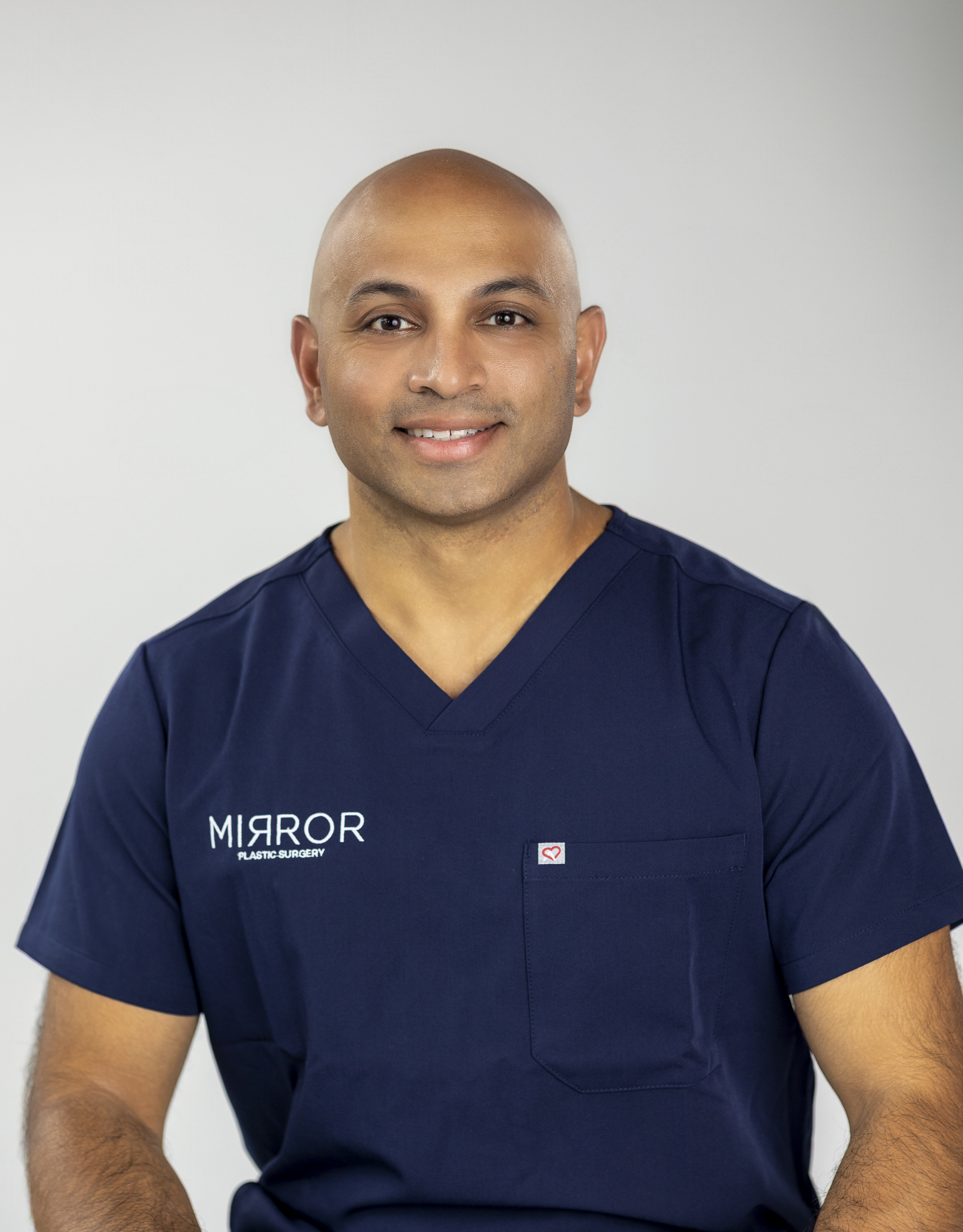
Mirror Plastic Surgery limits surgical volume to one to two procedures per day, which contrasts with high-volume practices that may perform five to ten surgeries daily. This model helps ensure that pre-operative planning, intraoperative attention, and post-operative follow-up are not compressed by scheduling pressure. The practice’s guiding hierarchy, safety first, function second, aesthetics third, applies directly to chin augmentation, so implant fixation method, mental nerve protection, and pocket precision take priority over any purely cosmetic consideration.
Schedule your consultation with Dr. Akash to receive the thorough anatomical assessment and personalized planning described above.
Frequently Asked Questions
Am I a good candidate for a chin implant?
Most adults over 18 in good general health who have a proportionally small or receding chin and realistic expectations are potential candidates. Ideal candidates need primarily forward projection without significant vertical or rotational correction. Patients with bite problems, severe skeletal discrepancy, or active dental infections are typically not candidates for implant-based augmentation alone and may require orthodontic or orthognathic evaluation first. A thorough consultation that includes facial measurements and a review of dental and medical history is necessary to confirm candidacy.
How should I prepare for chin implant surgery?
Preparation typically includes stopping blood-thinning medications and supplements as directed by your surgeon. You also avoid smoking and nicotine products for at least four weeks before surgery because nicotine impairs blood flow and healing. Plan for a responsible adult to drive you home and stay with you for the first night, and stock soft foods for the first week of recovery. Your surgeon will provide specific pre-operative instructions based on your health history and the planned approach.
Will there be a visible scar?
As described in the surgical approach section, you have two options: a submental incision that heals to a nearly imperceptible line in the natural chin crease, or an intraoral incision that leaves no external scar. Both approaches are standard, and the choice depends on surgeon preference, anatomy, and whether other procedures are being performed at the same time. Diligent sun protection of any external incision during the first several months of healing significantly reduces the risk of hyperpigmentation.
Can a chin implant be removed if I change my mind?
Yes. Solid silicone chin implants form a thin fibrous capsule rather than integrating with surrounding tissue, which keeps removal technically straightforward throughout the implant’s life. Removal can often be performed under local anesthesia in an outpatient setting. This reversibility is one of the key advantages of silicone implants over porous polyethylene alternatives, where tissue ingrowth makes removal more complex. If you later decide to pursue sliding genioplasty instead, the implant can be removed and the bone procedure performed as a staged or simultaneous surgery.
How do I evaluate a surgeon’s qualifications for this procedure?
Start by confirming board certification with the American Board of Plastic Surgery, which requires written and oral examinations and ongoing education. Ask whether the surgeon has completed a dedicated aesthetic surgery fellowship with a focus on facial procedures, because residency training alone provides limited exposure to elective chin augmentation. Verify that the surgeon holds hospital privileges, which ensures access to inpatient resources if a complication requires escalation. Review before-and-after photographs of actual patients with anatomy similar to yours, and notice whether the consultation includes a detailed anatomical discussion rather than a brief overview. Volume also matters, and a surgeon who performs one to two carefully planned procedures per day typically provides more individualized attention than one operating at five to ten cases daily.
Conclusion
Chin augmentation with implants is a well-established procedure that can deliver durable lower-face balance for appropriately selected patients. The key decisions, including material choice, fixation method, incision approach, and whether an implant or sliding genioplasty fits better, call for a surgeon with deep anatomical knowledge and a focus on long-term outcomes over convenience. In Tampa Bay, Mirror Plastic Surgery’s concierge model and Dr. Akash’s Harvard-MIT, Johns Hopkins, MEETH, and Stanford training support a standard of care built around safety, function, and evidence-based planning.
Book a consultation with Dr. Akash at Mirror Plastic Surgery in St. Petersburg to begin a thorough, personalized evaluation of your chin anatomy and the options best suited to your goals.
1 Results may vary from person to person. Editorial content, before and after images, and patient testimonials do not constitute a guarantee of specific results.