
Written by: Dr. Akash Chandawarkar, Board Certified Plastic Surgeon, Mirror Plastic Surgery | Last updated: July 23, 2026
Key Takeaways for Chin Fat Grafting
- Chin fat grafting uses your own fat to add projection and restore volume without changing bone or correcting bite problems.
- Standard lipofilling shows significant volume loss by 12 months, while stem-cell-enriched techniques improve graft survival to about 70 percent.1
- Fat grafting suits patients with soft-tissue deficits who want subtle contouring; implants or genioplasty work better for larger skeletal changes.
- Most complications are minor, but rare vascular risks demand expert technique and detailed facial-anatomy knowledge.
- Schedule a personalized consultation at Mirror Plastic Surgery to decide whether fat grafting, an implant, or a combined plan fits your goals.
Step-by-Step Overview of Chin Fat Grafting
- Donor-site selection and harvesting. The surgeon aspirates fat from the inner thigh or lower abdomen using low-pressure syringe aspiration through a small blunt cannula. This approach limits trauma and preserves viable fat cells.
- Processing. Harvested fat is centrifuged and separated into functional fractions. Adipose microvascular composite (AMC) supports structural volume, and stromal vascular fraction gel (SVF-gel) targets superficial skin quality. The surgeon selects each fraction based on the role it needs to play in each layer.
- Deep-plane injection for structural volume. AMC is injected in the supraperiosteal plane of the chin, with depth confirmed by tactile feedback on the periosteum, providing structural reinforcement with greater stiffness than conventional fat.
- Superficial injection for skin quality. SVF-gel is placed in the subcutaneous layer to improve skin texture and quality in the treated area.
- Volume titration. Injection volumes are set during surgery based on the degree of volume loss, skin tension, skeletal support, and gender-specific aesthetic ideals. These technical choices shape how long results last and how natural they appear.
How Long Does Chin Fat Grafting Last?
Resorption is the key factor in fat grafting longevity, and published ranges are wide. Reported fat graft retention rates vary by anatomic site and technique. Fat that integrates into the recipient tissue behaves like stable, permanent soft tissue, while nonintegrated fat is reabsorbed over weeks to months.
Chin-specific data from a 2026 study by Goisis et al. help set expectations. Standard lipofilling for chin retrusion can show decay in angle correction over time, with no significant difference from pre-treatment angles at 1-year follow-up.1 Because angle correction measures chin projection relative to the facial plane, this decay signals that grafted volume is being reabsorbed faster than it stabilizes, so standard lipofilling alone may not maintain chin projection over a full year.
Technique refinements can improve retention in a meaningful way. A systematic review and meta-analysis by Sutar et al. found that adipose-derived stem cell-enriched fat grafting improves graft survival compared with conventional fat grafting, with benefit seen in facial procedures.1 Mean survival is higher in enriched groups than in non-enriched controls.
Pros of chin fat grafting for longevity:
- Uses your own tissue, avoiding implant-related bone resorption risk
- Integrated fat behaves as permanent soft tissue
- Adipose-derived stem cells may improve overlying skin quality
- Results can be refined with secondary sessions
Cons of chin fat grafting for longevity:
- Resorption is unpredictable for each person; general post-lipografting resorption rates range from 20% to 90% over the first year1
- Secondary touch-up sessions are common
- Chin outcomes may be less durable than results in other facial areas
- Stem-cell enrichment improves survival but increases operative time and cost
Fat Grafting vs Chin Implant: How They Compare
This comparison table outlines how fat grafting and silicone chin implants differ across four key dimensions. All figures come from peer-reviewed sources cited inline.
Angle correction decays significantly by 3 months and approaches baseline by 12 months with standard lipofilling (Goisis et al., 2026)Retention at 12 months averages 60.8% in compromised tissue; enriched facial grafts reach about 72.78% survival (Sutar et al., 2026)1Roughly one-third of grafted fat typically does not survive; secondary sessions are commonly needed
| Dimension | Fat Grafting | Silicone Chin Implant | Clinical Implication |
|---|---|---|---|
| Predictability of projection | Implants remain stable for life and do not change with normal aging or weight fluctuation | Implants provide more consistent long-term projection than fat grafting. | |
| Longevity | Permanent once healed; does not resorb | Fat grafting requires realistic expectations of partial volume loss; implants do not resorb. | |
| Touch-up needs | In a retrospective review of 98 patients, 24 had complications including bone resorption (n=9), displacement (n=3), and dissatisfaction (n=7), indicating a meaningful revision burden | Both options can require revision, but revisions differ: volume top-up versus implant repositioning or exchange. | |
| Structural limitations | Provides diffuse soft-tissue volume; cannot correct skeletal deficiency beyond what soft tissue can mask, malocclusion, or asymmetry that needs bone repositioning | Contraindicated for camouflage of severe Class II dentofacial deformities; sliding genioplasty should be performed first in those cases | Neither option replaces orthognathic surgery when skeletal correction is the main need. |
Anatomy-first decision framework: Given the structural constraints outlined above, the choice centers on three variables: how much correction you need, whether the deficit is mainly soft tissue or skeletal, and how you feel about possible revision. Fat grafting works best when the deficit is primarily soft-tissue volume loss, when you want subtle contouring, and when you accept the possibility of a secondary session. A chin implant is more appropriate when moderate forward projection (up to 6–8 mm) is the main goal and your bite and skeletal structure are otherwise normal. Sliding genioplasty is indicated when the required correction exceeds what an implant can achieve, or when height change, rotation, or asymmetry correction is needed.
Risks of Chin Fat Grafting
Chin fat grafting has a different risk profile than implant surgery, with local tissue issues as the most common problems. A systematic review of autologous fat grafting reported complication rates including fat necrosis, oil cysts, and contour irregularities. Most events were minor and managed conservatively, and only a small percentage required major surgical intervention. These figures come from reconstructive breast procedures and offer a directional benchmark for facial work.
Vascular complications are rare but represent the most serious risk category in facial fat injection. One reported case described acute ischemic infarction and permanent monocular blindness after autologous fat injection to the cheeks, nasolabial folds, chin, and mandibular angle; the mechanism involves retrograde embolization of fat into terminal branches of the ophthalmic artery or anastomoses between the external and internal carotid systems when injection pressure exceeds systolic blood pressure. Surgeons reduce this risk by understanding facial vascular anatomy in detail, using blunt cannulas, keeping injection pressure low, and aspirating before injecting. These technique-dependent factors highlight how strongly provider expertise influences safety.
Who Is a Candidate for Chin Fat Transfer?
Candidacy depends on matching your specific anatomic concerns to what chin fat grafting can reliably achieve.
Fat grafting is most appropriate for patients who meet the following criteria:
- Brachyfacial or Class II profile individuals whose chin shape has changed over time and who want rejuvenation and redefinition rather than full skeletal correction
- Patients whose main concern is soft-tissue volume loss rather than structural skeletal deficiency
- Those seeking subtle profile enhancement, precise placement across multiple compartments, and possible skin quality improvement from adipose-derived stem cells
- Patients with enough donor-site fat for harvest
- Non-smokers or those willing to stop smoking well before surgery
Fat grafting is not appropriate for patients who need:
- Correction beyond what soft tissue can mask, typically more than 6–8 mm of forward projection, where a chin implant or sliding genioplasty is indicated
- Correction of occlusion changes, which require dental assessment and possibly orthognathic surgery
- Treatment of severe chin retrusion, facial asymmetry, or vertical imbalance related to jaw alignment or bite function problems
Skin thickness also shapes the treatment plan. Thicker soft tissues may need greater skeletal augmentation to reach the desired projection and contour, which can shift the recommendation toward an implant or genioplasty instead of fat grafting alone.
Chin Fat Grafting Cost Considerations
The total cost of chin fat grafting reflects several procedure-specific variables rather than a single fixed price. Key factors include the complexity of fat processing, the use of standard lipofilling versus stem-cell-enriched or multilayer protocols, the need for general anesthesia versus sedation, operating facility fees, the surgeon’s level of specialization, and whether a secondary touch-up session is likely based on your resorption profile. Stem-cell enrichment techniques carry higher costs and longer operative times than conventional fat grafting, despite similar patient satisfaction scores at 12 months. Each patient at Mirror Plastic Surgery receives a personalized quote during consultation, based on a detailed anatomical assessment and individualized treatment plan.
Schedule a consultation for a transparent, anatomy-based discussion of which technique and investment level align with your specific goals.
Provider Expertise: Why Training Shapes Safety and Results
Chin fat grafting outcomes depend heavily on technique at every step. Harvest pressure, processing method, injection plane, cannula choice, and volume titration all influence graft survival and complication risk. Provider expertise therefore acts as a primary driver of both safety and aesthetic quality.
Dr. Akash, lead surgeon at Mirror Plastic Surgery, trained at several of the most rigorous institutions in academic medicine. He completed his medical degree through the Harvard-MIT Division of Health Sciences and Technology, graduating from Harvard Medical School with Honors, which provided a strong foundation in both clinical medicine and engineering principles. That foundation was refined during a seven-year integrated plastic and reconstructive surgery residency at Johns Hopkins University, where he mastered a broad range of reconstructive techniques. He then completed an aesthetic surgery fellowship at the Manhattan Eye, Ear and Throat Hospital (MEETH), one of the most competitive advanced training programs in cosmetic surgery, to focus specifically on facial aesthetics. His additional Stanford University Biodesign Innovation Fellowship added structured training in identifying unmet clinical needs and evaluating new technologies. Dr. Akash has been recognized as one of America’s Best Plastic Surgeons 2025 by Newsweek for two consecutive years.
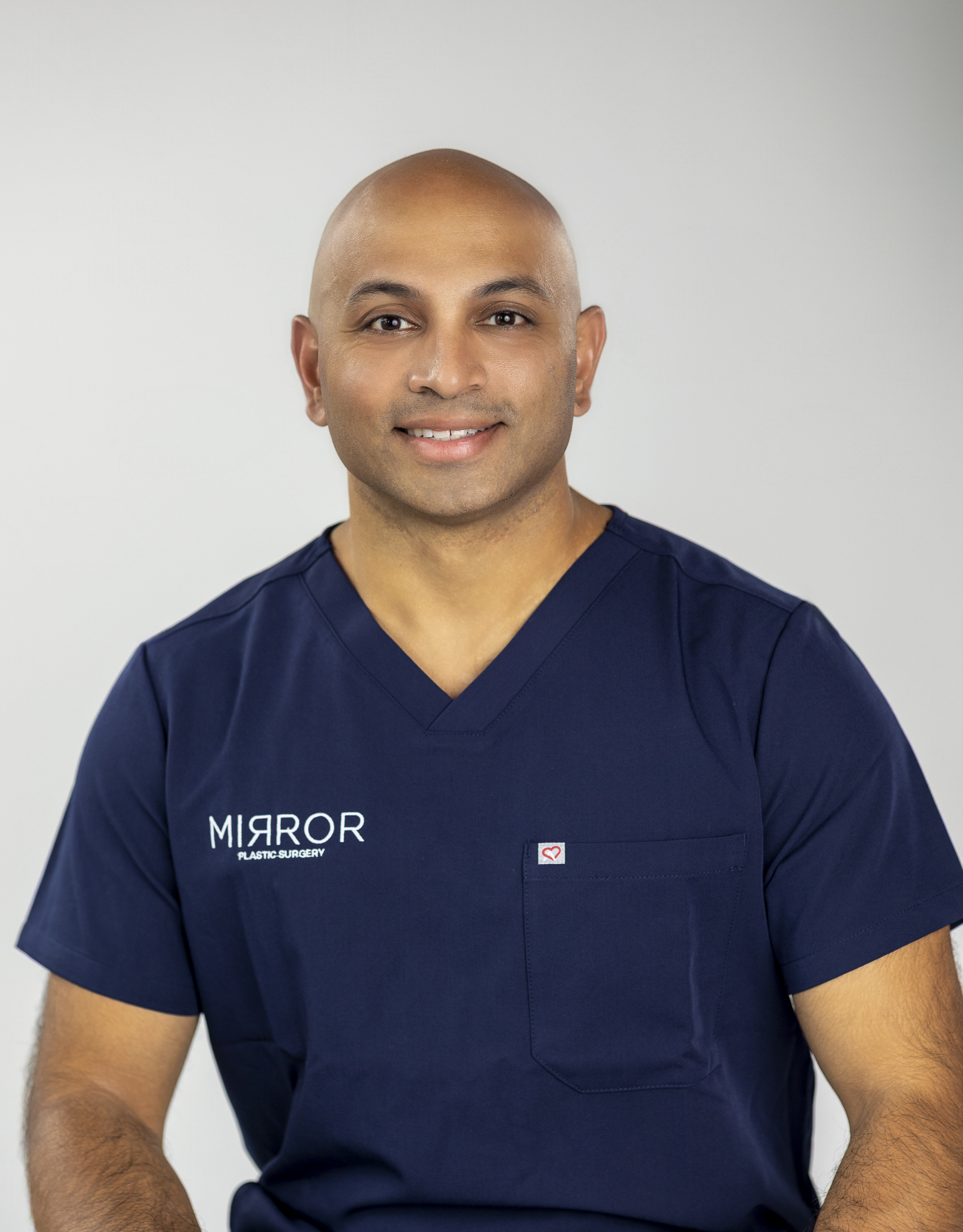
Mirror Plastic Surgery follows a concierge model that limits surgical volume to one to two procedures per day. This approach contrasts with high-volume practices that may perform five to ten surgeries daily. For fat grafting patients, this means the entire clinical team’s attention before, during, and after the procedure centers on a single case. Consultations can last up to an hour, allowing for the anatomy-first assessment needed to decide whether fat grafting, an implant, genioplasty, or a combination offers the best match for each patient.
Dr. Akash serves on the editorial board of the Aesthetic Surgery Journal as Next Generation Editor, has testified before the U.S. Food and Drug Administration on implant safety, and sits on advisory boards for companies developing new technologies in aesthetic medicine. His practice is certified by the American Board of Plastic Surgery, and he maintains hospital privileges for the rare event of a surgical complication.
Book a consultation with Dr. Akash at Mirror Plastic Surgery in St. Petersburg, Florida, to receive an evidence-based, anatomy-first evaluation of your chin augmentation options.
Frequently Asked Questions
How many fat grafting sessions are typically needed for chin augmentation?
Most patients need one primary session, and a secondary touch-up session is common because fat resorption varies. The need for a second procedure depends on how much of the grafted fat integrates successfully, which is influenced by harvesting technique, processing method, injection plane, and individual physiology. Patients should expect that a single session may not deliver the full desired result and that a planned secondary session often forms a normal part of the treatment course rather than signaling failure.
Is chin fat grafting permanent?
Fat that integrates into the recipient tissue is considered permanent and behaves like normal soft tissue. A portion of grafted fat is reabsorbed in the weeks to months after the procedure, and the surviving proportion varies widely across patients and techniques. Published retention rates in facial applications range from about 45 percent with conventional methods to over 72 percent with stem-cell-enriched protocols.1 Weight changes after surgery can also affect retained volume, because integrated fat cells respond to metabolic shifts in the same way as fat elsewhere in the body.
What is the difference between chin fat grafting and a chin implant for someone with a weak chin?
The appropriate choice depends on the nature and magnitude of the deficit, as outlined in the candidacy section above. In brief, fat grafting treats soft-tissue volume loss and provides diffuse, subtle contouring, while a chin implant offers more predictable forward projection for moderate structural retrusion, typically up to 6–8 mm, when the bite is otherwise normal. When the required correction involves skeletal repositioning, height change, or significant asymmetry, sliding genioplasty may be the most suitable option. A thorough anatomical assessment that includes bite, skeletal structure, skin thickness, and overall facial proportions is essential before making a recommendation.
What are the most important safety considerations for chin fat grafting?
The most common complications involve local tissue quality, including fat necrosis, oil cysts, and contour irregularities, and most are minor and managed conservatively. The most serious risk is vascular compromise, which can occur when fat is injected under pressure into or near vessels that connect to the ophthalmic or cerebral circulation. Surgeons reduce this risk by using blunt cannulas, keeping injection pressure low, aspirating before injecting, and maintaining detailed knowledge of facial vascular anatomy. Provider expertise and controlled surgical volume directly affect safety, because a surgeon performing one to two procedures per day with focused attention and full anatomical assessment is better positioned to manage these variables than one working in a high-volume setting.
Does chin fat grafting address a double chin or submental fullness?
Chin fat grafting adds volume to the chin and nearby soft tissue; it does not remove submental fat or tighten loose neck skin. A double chin or submental fullness can result from several causes, including excess submental fat, loose platysmal muscle, redundant skin, or a structurally weak chin that shortens the visible jawline and softens the cervicomental angle. In some patients, improving chin projection sharpens the chin-neck transition without direct neck treatment. In others, neck liposuction, a neck lift, or a combined approach is required. Accurate diagnosis of the underlying anatomy is essential before choosing any treatment for this area.
1 Results may vary from person to person. Editorial content, before and after images, and patient testimonials do not constitute a guarantee of specific results.