
Written by: Dr. Akash Chandawarkar, Board Certified Plastic Surgeon, Mirror Plastic Surgery | Last updated: July 24, 2026
Key Takeaways
- Cheek implants are grouped by anatomical zone: malar, submalar, combined, or custom. Materials such as solid silicone, PEEK, porous polyethylene, and titanium each offer specific benefits for tissue integration and potential removability.
- Published series show solid silicone and PEEK implants functioning well for 15–20 years or longer, creating a long-lasting structural result that differs from the temporary effect of dermal fillers or the variable survival of fat grafting.1
- Complication rates stay low in the hands of experienced surgeons.1 Infection, malposition, and implant edge visibility are reduced through careful sizing, secure fixation, and strict perioperative protocols.
- Most patients return to desk work within one week. Final results appear over three to six months as swelling resolves and the implants settle.1
- Patients who want a one-time structural solution for skeletal cheek deficiency can schedule a personalized consultation at Mirror Plastic Surgery to see whether cheek implants match their anatomy.
Cheek Implant Designs and Materials
Cheek implants are categorized by anatomical zone. Malar implants sit on the upper cheekbone to increase projection. Submalar implants add volume to the lower and mid-cheek. Combined implants address both areas at once. Custom implants are fabricated for patients with facial asymmetry or complex skeletal deficiencies.
Projection is measured in millimeters and chosen to match each patient’s specific malar and submalar anatomy. The goal is balanced midface support rather than a dramatic or artificial change.
Material choice shapes tissue integration, ease of removal, and long-term behavior. Four primary materials are used for custom facial implants: solid silicone, PEEK, porous polyethylene, and titanium. For infraorbital-malar augmentation, surgeons often prefer solid silicone because feathered edges help prevent feeling or seeing the implant through thin eyelid tissue. The table below compares how these materials behave in the body and where each tends to work best.
| Material | Tissue Integration | Removability | Best Use Case |
|---|---|---|---|
| Solid Silicone | Minimal ingrowth, fibrous capsule forms | Easily removable or exchangeable | Standard malar and infraorbital-malar augmentation |
| Porous Polyethylene (Medpor) | Tissue ingrowth for stable fixation | Difficult to remove | Cases requiring maximum positional stability |
| Gore-Tex (ePTFE) | Moderate soft-tissue adherence | Removable with more effort than silicone | Softer contouring needs |
| PEEK | Biocompatible, minimal tissue bonding | Easily removed if needed, MRI-safe | Custom implants requiring precise bone simulation |
Surgeons place implants through intraoral incisions for standalone procedures or through infraorbital incisions when combined with lower facelift or eyelid surgery. Fixation may involve sutures or screws, or rely on a snug pocket, depending on the implant material and the surgeon’s approach.
How Long Do Cheek Implants Last?
Published series document solid silicone facial implants functioning well for 15–20 years and beyond, with no routine replacement when complications are absent.1 Custom PEEK cheek implants are also biocompatible and provide ongoing soft-tissue support that can lessen midface skin laxity compared with having no implant.
This durability contrasts with the main non-surgical options. Dermal fillers last 6–24 months and require regular maintenance. Autologous fat transfer typically preserves 30–80% of grafted fat after the initial resorption phase. For patients with true skeletal hypoplasia of the zygomatic-maxillary complex, implants correct the bony deficit directly instead of adding soft tissue over an unchanged bone structure.
Fixed cheek implants stay in position as facial soft tissues descend with age. Over time, this can contribute to lower eyelid changes or make implant edges more noticeable. Precise sizing and anatomical placement during the first surgery support long-term comfort and appearance.
What Can Go Wrong with Cheek Implants?
A 2025 meta-analysis in the Journal of Plastic, Reconstructive & Aesthetic Surgery reviewed complications of alloplastic facial skeletal implants. Understanding specific risk categories helps patients make informed decisions and appreciate how surgeon experience reduces these risks. The table below summarizes common complications, how often they occur in the literature, and practical strategies to lower those risks.
| Complication | Incidence / Notes | Mitigation Strategy |
|---|---|---|
| Overall complication rate | Examined in 2025 meta-analysis of facial implant complications | Experienced surgeon selection, precise implant sizing |
| Infection | Low incidence in literature, lower rates reported by high-volume specialists | Perioperative antibiotics, intraoral incision hygiene protocols |
| Malposition / Migration | Reduced by secure fixation to zygomatic bone | Rigid fixation to bone, careful subperiosteal pocket dissection |
| Nerve effects (numbness) | Usually temporary when it occurs | Anatomical dissection, infraorbital nerve identification |
| Implant edge visibility / palpability | More common in thin-skinned patients with oversized implants | Conservative sizing, feathered implant edges, custom design |
Infection is the most significant complication of facial implants. Established implant infection often requires removal, although some low-grade infections respond to antibiotics alone. When malposition occurs, revision surgery through the same hidden intraoral or lower eyelid incision can reposition or exchange the implant.
Cheek Implants Compared with Fillers and Fat
The choice between cheek implants, dermal fillers, and fat transfer depends on the underlying problem. Cheek implants give a permanent structural solution for skeletal hypoplasia of the zygomatic-maxillary complex. Fillers and fat grafting mainly address soft-tissue volume, not bone deficiency.
Hyaluronic acid fillers such as Juvéderm Voluma XC and Restylane Lyft are reversible with hyaluronidase, which offers flexibility for patients who want adjustable results. Fat transfer is not easily reversible and can create permanent asymmetry or irregular contours if too much fat survives in superficial layers.
Over time, HA dermal fillers require repeated sessions that add up financially. Cheek implants represent a single structural procedure for patients whose anatomy supports that approach. Pricing at Mirror Plastic Surgery is personalized to each patient’s anatomy and goals and is reviewed during consultation.
Patients who want subtle, adjustable enhancement often start with dermal fillers. Patients who want a one-time structural change frequently choose cheek implants. Surgeons often pair fat grafting with facelift procedures when treating widespread age-related volume loss. According to 2024 ASPS statistics, cheek implants (malar augmentation) totaled 9,130 procedures, reflecting their focused role in treating true skeletal deficiencies rather than routine volume restoration.
Recovery Timeline After Cheek Implant Surgery
Most patients go home the same day after cheek implant surgery and follow a structured recovery plan during the first weeks.
The general recovery progression includes the following stages:
- First 48 hours: Apply cold compresses at intervals, keep the head elevated, and take prescribed medications on schedule to manage swelling and discomfort.
- Days 1–7: About 90% of swelling and bruising improves within the first week.1 Most patients return to desk work or school at this point. Intraoral sutures usually dissolve within about one week.
- Week 2: Avoid bending, lifting, or vigorous exercise. Continue soft or blended foods if incisions are intraoral. Many patients resume light to moderate exercise around this time.
- Weeks 3–6: Cheek implants typically take 4–6 weeks to settle as swelling recedes and midface projection becomes more defined.1
- Months 3–6: Most visible swelling resolves, and temporary numbness from infraorbital nerve irritation usually improves over 2–3 months. Final results are apparent by this stage.1
Patients with intraoral incisions rinse with a prescribed solution after meals to protect the incision site. Ideal candidates are healthy non-smokers at a stable weight with no untreated oral infections, because smoking and active dental issues significantly impair healing and raise complication risk.
Choosing a Surgeon for Cheek Augmentation
Surgeon selection strongly influences both safety and aesthetic outcome in cheek implant surgery. Revisional cheek implant procedures most often occur 1–5 years after the first surgery because of improper implant style, malposition, oversizing, or soft-tissue mismatch. Careful preoperative planning can prevent many of these problems.
The following credentials and capabilities closely relate to a surgeon’s ability to plan effectively and avoid preventable complications:
- Board certification by the American Board of Plastic Surgery
- Hospital privileges, which provide access to hospital-level care in the rare event of a complication
- Fellowship training specifically in facial aesthetic surgery
- 60-minute anatomical consultations that assess the full midface, including malar region, submalar region, and lid-cheek junction
- CT imaging capability for complex or custom implant planning
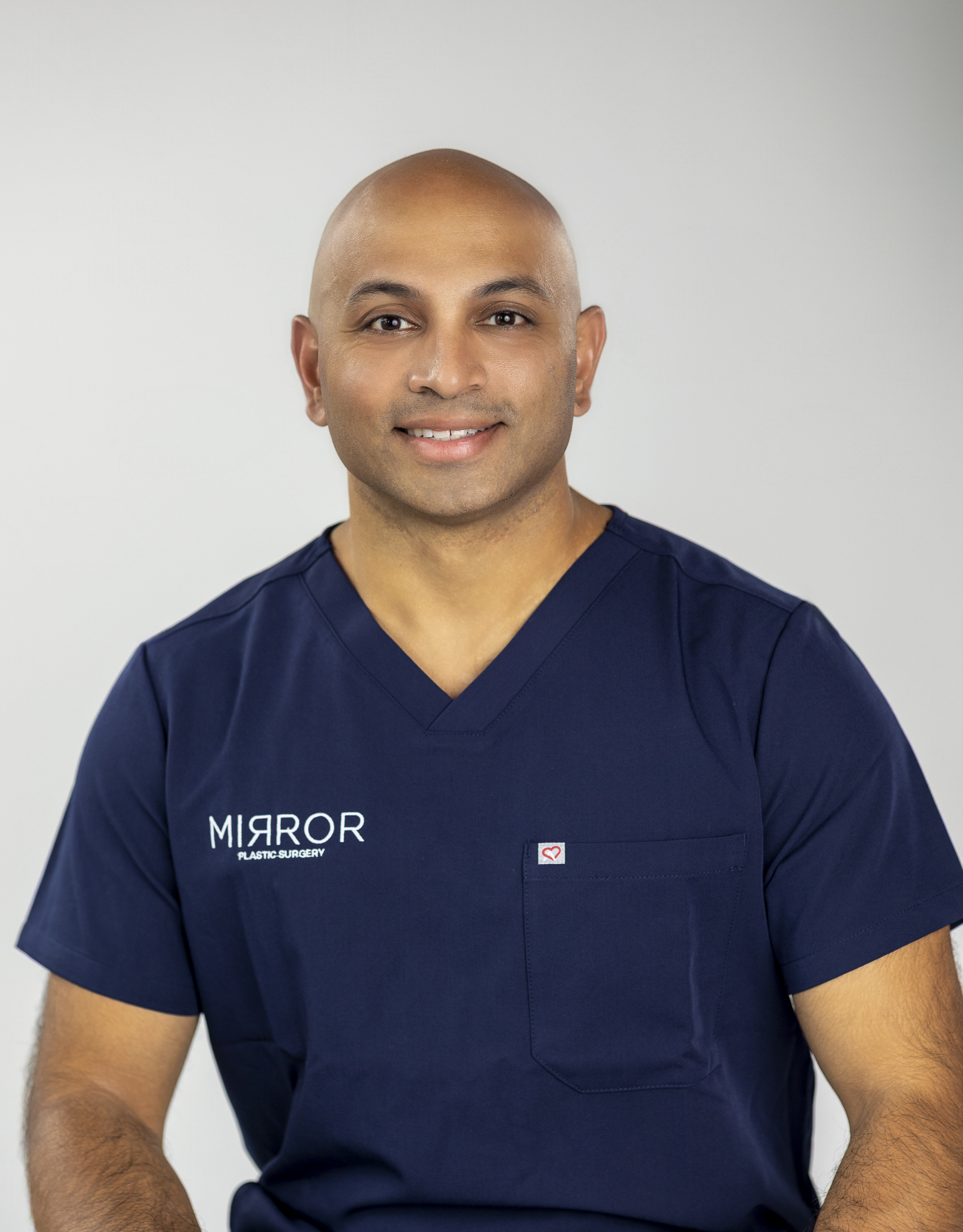
Dr. Akash at Mirror Plastic Surgery meets each of these criteria. A Harvard Medical School graduate (cum laude) from the Harvard-MIT Health Sciences and Technology program, he completed a seven-year integrated plastic and reconstructive surgery residency at Johns Hopkins University and an aesthetic surgery fellowship at the Manhattan Eye, Ear and Throat Hospital (MEETH), one of the most competitive facial aesthetic training programs in the country. As a board-certified plastic surgeon with hospital privileges, Dr. Akash combines deep anatomical expertise with institutional oversight for complex facial implant procedures.
Safety, Function, and Aesthetic Balance at Mirror Plastic Surgery
Mirror Plastic Surgery follows a clear sequence of priorities: safety first, function second, aesthetics third. For cheek augmentation, this means no implant size or style is chosen for visual impact alone. The team evaluates bone structure, soft-tissue envelope, skin quality, and likely aging patterns before recommending any approach.
Two common misconceptions about cheek implants deserve direct clarification. Many patients worry that implants will look unnatural. In practice, visible or palpable edges usually result from oversizing or poor implant selection in thin-skinned patients, not from the concept of implants itself. Proper sizing, feathered edges, and precise subperiosteal placement create results that blend with the surrounding anatomy.
Another misconception is that implants always need removal at a set time. As discussed earlier, these implants require no routine replacement when complications are absent. Mirror Plastic Surgery performs one to two surgeries per day, which allows the entire team to focus on each patient before, during, and after the procedure. This schedule contrasts with high-volume practices that may perform many more surgeries daily.
Each 60-minute consultation includes a detailed anatomical review, an honest comparison of alternatives, and evidence-based guidance on whether implants, fillers, fat grafting, or a combination best fits the patient’s anatomy and goals.
Frequently Asked Questions
Who is a good candidate for cheek augmentation implants?
Good candidates are healthy non-smokers at a stable weight who have flat or under-projected cheekbones from congenital or developmental skeletal deficiency rather than soft-tissue volume loss alone. Patients with poor midface projection despite normal weight, facial asymmetry, or a history of unsatisfactory filler results often match well with implants. A thorough anatomical consultation that includes the malar region, submalar region, and lid-cheek junction determines whether bone structure supports an implant or whether another approach is better.
Do cheek implants require maintenance or replacement over time?
Solid silicone and PEEK cheek implants are biocompatible and do not require routine replacement. Published clinical data show these implants functioning well for 15–20 years and beyond when properly selected and placed.1 Replacement or revision may become relevant if facial aging creates a mismatch between soft tissue and the fixed implant position, or in the rare event of infection or malposition. No implant procedure stops facial aging, so long-term follow-up with your surgeon remains helpful.
How does the intraoral incision affect infection risk?
The intraoral approach exposes the incision to oral flora, yet multiple studies show no significant difference in infection rates compared with external skin incisions when protocols are followed carefully. Literature indicates that infection rates for facial implants stay low when surgeons use rigorous perioperative antibiotic regimens. Patients rinse with an antiseptic solution after meals during recovery to protect the incision site. Untreated oral infections are a contraindication and must be addressed before surgery.
Can cheek implants be removed if I change my mind?
Solid silicone cheek implants can be removed or exchanged through the same hidden intraoral or lower eyelid incision used for placement. Removal causes additional swelling and requires a recovery period, but experienced surgeons consider the procedure straightforward. Porous polyethylene implants integrate with surrounding tissue and are much harder to remove, which matters during material selection. PEEK implants are also removable when needed. Patients should discuss the reversibility of each material clearly during the preoperative consultation.
What is the difference between standard and custom cheek implants?
Standard cheek implants are pre-manufactured in fixed sizes and shapes. They are predictable, readily available, and suitable for many patients with mild to moderate symmetric skeletal deficiency. Custom implants are designed from 3D CT scans to span multiple midface zones, including the cheek, infraorbital rim, maxilla, and zygomatic arch. Surgeons prefer custom designs for patients with asymmetry, complex deficiencies, prior unsatisfactory standard implants, or very specific contour goals that standard sizes cannot match. The choice between standard and custom implants depends on clinical evaluation, CT findings, and a detailed discussion of goals, complexity, and anatomy.
Conclusion
Cheek augmentation implants provide a permanent, anatomically targeted solution for patients whose flat or under-projected cheekbones arise from skeletal deficiency rather than soft-tissue volume loss. A 2025 meta-analysis in the Journal of Plastic, Reconstructive & Aesthetic Surgery evaluated complication rates for alloplastic facial skeletal implants and showed that outcomes are measured over decades, not months, placing implants in a different category than fillers or fat grafting for the right candidate.
The quality of each result depends on the depth of anatomical assessment, the precision of implant selection, and the surgeon’s experience. At Mirror Plastic Surgery, every cheek augmentation begins with a 60-minute consultation in which Dr. Akash evaluates your full midface anatomy, reviews your goals, and offers clear, evidence-based guidance on whether implants, another option, or a combination best supports long-term facial balance.
Book a consultation with Dr. Akash at Mirror Plastic Surgery in St. Petersburg, FL, and take the first step toward a permanent structural result built on your anatomy, not a one-size-fits-all approach.
1 Results may vary from person to person. Editorial content, before and after images, and patient testimonials do not constitute a guarantee of specific results.