
Written by: Dr. Akash Chandawarkar, Board Certified Plastic Surgeon, Mirror Plastic Surgery | Last updated: July 21, 2026
Key Takeaways for Boutique Concierge Practices
- Boutique concierge plastic surgery practices limit daily surgical volume to one or two cases and provide surgeon-led consultations of at least 60 minutes with direct access before and after procedures.
- Key evaluation criteria include fellowship training beyond residency, board-certified physician anesthesiologists, accredited facilities, and structured post-operative follow-up through six months.
- Red flags such as coordinator-led consultations, high daily case volumes, non-accredited facilities, and pressure tactics indicate practices that do not meet true boutique standards.
- Regional examples across Beverly Hills, Manhattan, Chicago, Miami, and Tampa Bay show that the structural traits of the concierge model remain consistent regardless of location.
- Patients seeking personalized, safety-focused care can schedule a consultation at Mirror Plastic Surgery to experience the boutique concierge model firsthand.
Eight Criteria That Define a Boutique Concierge Practice
The criteria below create a clear checklist for evaluating any practice that markets itself as boutique or concierge.
- Daily surgical volume: Boutique clinics maintain one to three operating rooms with a dedicated anesthesiologist physically present for the entire procedure, while factory clinics often run four to ten parallel ORs with twenty or more daily cases.
- Consultation depth: A first-time cosmetic consult at a healthy practice runs 60–90 minutes and includes 3D imaging, financing options, and a surgeon-led conversation. Coordinator-led intake disqualifies a practice from true concierge status.
- Fellowship training: The ACGME minimum requirement for cosmetic procedures in general plastic surgery residency is only 50 cases over five years with no face-specific requirement. An accredited aesthetic surgery fellowship therefore becomes a meaningful differentiator beyond base board certification.
- Direct surgeon access: Initial patient inquiries at boutique clinics are read and answered personally by the operating surgeon within 24–48 hours, including anatomical reasoning specific to submitted photos.
- Facility accreditation: Accredited surgical facilities holding AAAASF or JCAHO accreditation must follow strict safety standards for anesthesia, sterilization, and emergency care, significantly reducing complication risks.1
- Anesthesiologist credentials: A safe plastic surgeon works exclusively with a dedicated physician anesthesiologist (MD/DO) rather than supervising anesthesia via nurse or assistant personnel.
- Post-operative follow-up schedule: Boutique clinics commit in writing to surgeon-led follow-up at one week, two weeks, four weeks, eight weeks, twelve weeks, and six months.
- Transparent line-item pricing: Boutique clinics require line-item pricing that remains identical for local and international patients and discourage third-party concierge markups, while factory clinics often use bundled package prices that vary by inquiry channel.
Regional Patterns in Boutique Concierge Plastic Surgery
The criteria above apply consistently across markets, yet the regional concentration of boutique practices varies significantly.
Greater Los Angeles leads the US with 223 concierge and DPC practices, with Beverly Hills, Santa Monica, and Brentwood forming the primary high-fee corridor. New York City metro follows closely with 210 practices, concentrated in ultra-premium neighborhoods such as the Upper East Side and Tribeca. Beyond these coastal hubs, Chicago’s concierge market features practices concentrated along the North Shore corridor serving multigenerational families. Miami metro contains 172 concierge and DPC practices according to NextMD’s 2026 market report, with heavy concentration along Coral Gables, Brickell, and Aventura, reflecting a similar wealth-driven demand pattern. Florida coastal metros, including Tampa Bay, benefit from high per-capita concierge density driven by retiree wealth concentration and snowbird demand, which creates a distinct demographic driver compared with urban professional markets.
While regional density varies, the structural traits of boutique concierge practices remain consistent. The table below compares representative regions across daily surgical volume and fellowship training availability using objective, verifiable criteria. No competing local surgeon names are used.
| Practice Region | Daily Surgery Volume | Fellowship Training Available |
|---|---|---|
| Beverly Hills, CA | 1–2 cases (low-volume, high-ASP model) | Aesthetic surgery fellowship common among top-tier providers |
| Manhattan, NY | 1.5–2.5 cases/day benchmark for full-time cosmetic surgeon | MEETH and NYU fellowship programs available |
| Chicago North Shore, IL | 1.5–2.5 cases/day benchmark | Fellowship training varies by individual surgeon |
| Miami, FL | Varies widely; Miami features an unusually high concentration of less-credentialed providers, so ABPS verification is especially critical | Fellowship training varies; verify ABPS certification independently |
| Tampa Bay, FL (Mirror Plastic Surgery) | 1–2 cases/day maximum | MEETH aesthetic surgery fellowship; Johns Hopkins residency; Stanford Biodesign |
| Nashville, TN | 1.5–2.5 cases/day benchmark | Fellowship training varies by individual surgeon |
| Austin, TX | 1.5–2.5 cases/day benchmark | Fellowship training varies by individual surgeon |
| Charlotte, NC | 1.5–2.5 cases/day benchmark | Fellowship training varies; pricing often 20–40% below coastal hubs |
Beverly Hills, Manhattan, and Tampa Bay practices consistently demonstrate core concierge traits in practice structure. These include surgeon-led consultations of 60 minutes or longer, board-certified physician anesthesiologists, and accredited facilities. Chicago practices often emphasize multigenerational patient relationships alongside these structural features. Miami’s higher concentration of less-credentialed providers makes independent ABPS verification essential, regardless of stated concierge positioning.
Red Flags That Signal a Factory-Style Clinic
Several measurable indicators reveal high-volume, factory-style practices before you ever step into the operating room.
- Five to ten or more daily surgical cases: One surgeon overseeing multiple simultaneous operating rooms means each patient receives only a fraction of direct surgeon attention.
- Coordinator-led consultations: When a sales coordinator manages initial patient interactions rather than the operating surgeon, anatomical reasoning specific to the patient’s presentation never enters the decision process.
- Non-accredited facilities: Surgeons supervising their own anesthesia via non-MD personnel in non-accredited facilities represent a critical red flag for patient safety.
- Same-day scheduling: Factory clinics often encourage immediate procedures, while boutique clinics enforce a mandatory 24–48 hour gap between consultation and surgery.
- Pressure tactics and discounts: Red flags include pressure to book immediately through limited-time discounts, downplaying risks, and inability to show a substantial gallery of the surgeon’s own patients.
- Unverifiable board certification: Procedures performed by non-board-certified practitioners show significantly higher rates of complications requiring hospital admission.1 The American Board of Plastic Surgery (ABPS) is the only ABMS-recognized credential that specifically covers plastic and reconstructive surgery.
- Aggressive commercialization: Centers offering freebies, free surgery for promotions, or overtly cheap procedures should raise suspicion as signs of aggressive commercialization that undermine ethical foundations.
Recovery Coordination Checklist for Concierge Practices
The concierge model’s low daily volume supports structured, surgeon-led recovery that high-volume practices cannot match at scale.
The six-milestone schedule outlined in the evaluation criteria above enables comprehensive monitoring at every stage of healing.
- Week 1: In-person or video follow-up conducted by the operating surgeon to assess healing, manage early concerns, and adjust post-operative instructions.
- Week 2: Surgeon-led visit to evaluate incision integrity and early aesthetic progress.
- Week 4: Assessment of swelling resolution and functional recovery milestones.
- Week 8: Evaluation of scar maturation and guidance on resuming higher-intensity activities.
- Week 12: Comprehensive review of aesthetic outcomes and identification of any refinement needs.
- 6 months: Final long-term outcome documentation and planning for any result optimization.
- Operative report: Boutique clinics provide an operative report signed by the operating surgeon within 7 days that names the exact surgical technique used.
This schedule aligns with convergent professional standards from ASPS and ISAPS emphasizing surgeon-led consent, psychological vulnerability assessment, and practice only within demonstrated competence. The operating surgeon’s direct involvement at every milestone, rather than delegation to nursing staff, represents the structural feature that distinguishes concierge recovery coordination from standard post-operative care.
Expert Profile: Dr. Akash at Mirror Plastic Surgery
Mirror Plastic Surgery in St. Petersburg, Florida, serves as the Tampa Bay exemplar of the boutique concierge model described in this guide. The practice limits surgical volume to one to two cases per day, conducts surgeon-led consultations of up to 60 minutes, employs board-certified physician anesthesiologists, and operates exclusively in accredited facilities.
The practice’s lead surgeon, Dr. Akash, holds a medical degree from Harvard Medical School (graduated cum laude with Honors), completed a seven-year integrated plastic and reconstructive surgery residency at Johns Hopkins University, and completed an aesthetic surgery fellowship at the Manhattan Eye, Ear and Throat Hospital (MEETH), the level of training where true subspecialization happens and one of the most meaningful variables in evaluating a surgeon’s preparation. Dr. Akash additionally completed the Stanford University Biodesign Innovation Fellowship, is board-certified by the American Board of Plastic Surgery, and has been recognized in America’s Best Plastic Surgeons by Newsweek in the 2025 edition for two years in a row. He serves on the Next Generation Editorial Board of the Aesthetic Surgery Journal and has testified before the FDA on breast implant safety.
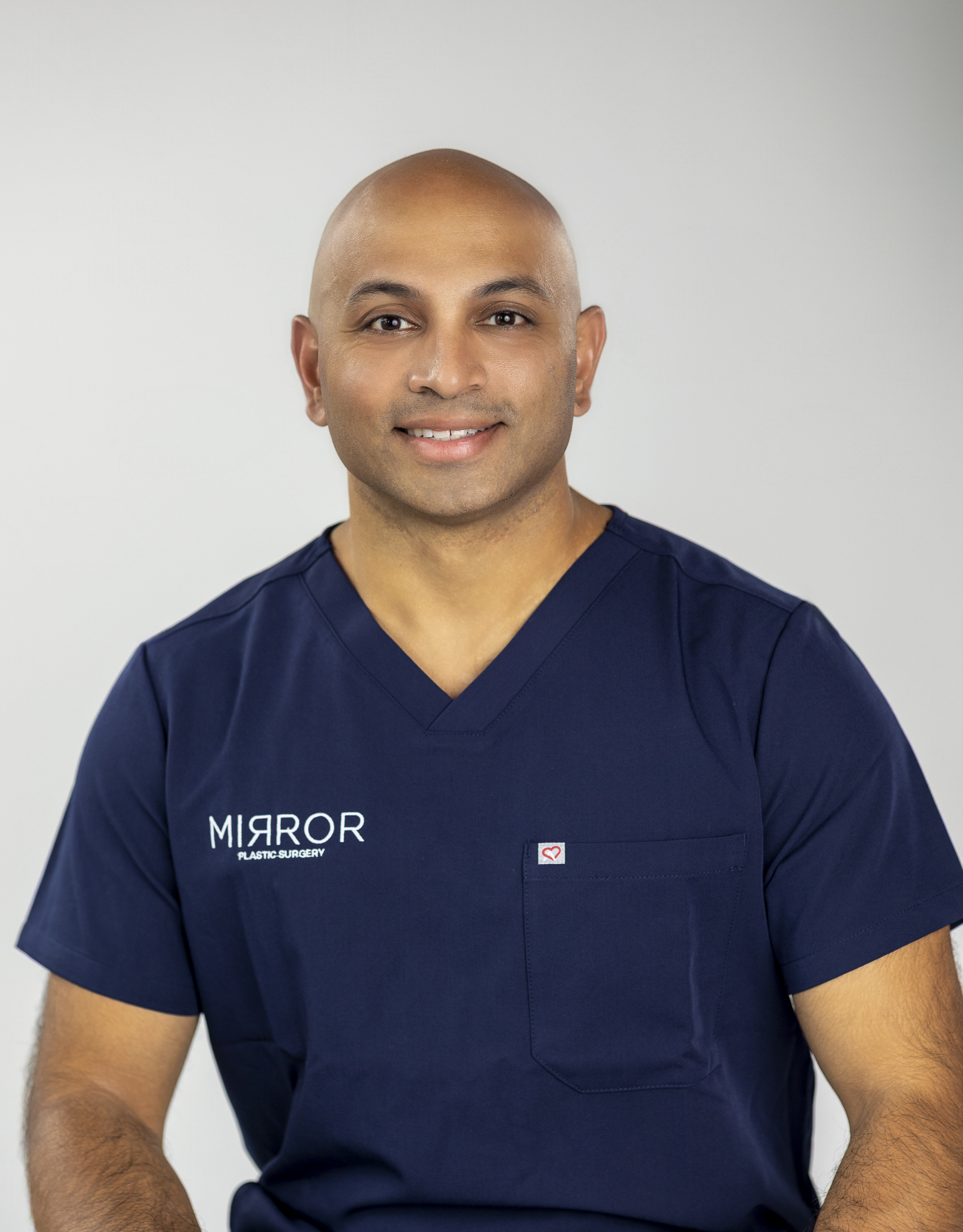
Apply these evaluation criteria directly by meeting with Dr. Akash at Mirror Plastic Surgery’s St. Petersburg location.
Frequently Asked Questions
How do I verify that a plastic surgeon is truly board certified?
Board certification by the American Board of Plastic Surgery (ABPS) is the only ABMS-recognized credential that specifically covers plastic and reconstructive surgery. It requires completion of an accredited surgical residency of at least six years, with a minimum of three years dedicated to plastic surgery, followed by rigorous written and oral examinations. Verification is available directly through the ABPS website. Titles such as “Board Certified Cosmetic Surgeon” may originate from unrecognized certifying bodies and should be independently confirmed. Hospital privileges provide a secondary verification layer, because hospitals conduct their own credentialing review before granting operating rights.
What is the difference between a fellowship-trained surgeon and one who completed only a residency?
A plastic surgery residency provides broad training across reconstructive and aesthetic procedures. A fellowship adds one to two years of intensive subspecialty focus after residency. Given the minimal cosmetic case requirements in residency described in the evaluation criteria above, a fellowship in aesthetic surgery provides concentrated, high-volume training in facial rejuvenation, breast surgery, and body contouring that residency alone does not replicate. Fellowship training is where refined technical skills and aesthetic judgment develop beyond the residency baseline.
Why does daily surgical volume matter for patient safety?
Daily surgical volume determines how much direct surgeon attention each patient receives before, during, and after a procedure. A surgeon performing one to two cases per day maintains full focus on each patient’s pre-operative planning, intraoperative execution, and post-operative follow-up. A surgeon overseeing five to ten cases per day across multiple simultaneous operating rooms divides that attention proportionally. The concierge model’s volume ceiling functions as a structural safety feature, not a marketing claim, because it directly enables the surgeon-led consultation, dedicated anesthesiologist, and structured recovery schedule that define the model.
What should I expect during a boutique concierge consultation?
A true boutique concierge consultation is surgeon-led, runs a minimum of 60 minutes, and includes an anatomy-specific assessment of the patient’s concerns and goals before any procedure recommendation. The surgeon explains the anatomical rationale for any recommended treatment, presents realistic outcomes including limitations, and provides a treatment plan tailored to the individual patient’s anatomy rather than a standard package.1 Coordinator-led intake, rushed timelines, or pressure to book immediately conflict with the boutique model. A mandatory gap of at least 24 to 48 hours between consultation and surgery supports proper evaluation and informed decision-making.
How does the concierge model support long-term outcomes compared to high-volume practices?
The concierge model supports long-term outcomes through structured surgeon-led follow-up at one week, two weeks, four weeks, eight weeks, twelve weeks, and six months after surgery.1 This schedule allows the operating surgeon to monitor healing, identify early complications, adjust post-operative care, and document final results.1 High-volume practices typically delegate post-operative follow-up to nursing staff or reduce visit frequency because of scheduling constraints. The concierge model also provides a signed operative report naming the exact surgical technique within seven days, creating a documented record that supports any future care decisions.
Conclusion: Using This Framework to Choose Your Surgeon
A true boutique concierge plastic surgery practice is defined by measurable, verifiable criteria. These include one to two daily surgical cases, surgeon-led consultations of at least 60 minutes, a dedicated board-certified physician anesthesiologist, accredited facility operations, fellowship training beyond residency, direct surgeon access, structured post-operative follow-up through six months, and transparent line-item pricing. These criteria apply equally across Beverly Hills, Manhattan, Chicago, Miami, and Tampa Bay. Regional density of concierge medicine practices varies, but the structural traits of the model remain constant.
Patients evaluating providers can apply this framework directly by verifying ABPS certification through the board’s website, confirming facility accreditation, asking specifically about fellowship training and daily case volume, and assessing whether the consultation is surgeon-led from the first contact. Red flags including coordinator-led intake, same-day scheduling, non-accredited facilities, and pressure tactics remain disqualifying regardless of geography or marketing language.
Begin your evaluation with a consultation at Mirror Plastic Surgery, Tampa Bay’s boutique concierge practice built on the safety-first, fellowship-trained, low-volume model described in this guide.
1 Results may vary from person to person. Editorial content, before and after images, and patient testimonials do not constitute a guarantee of specific results.