

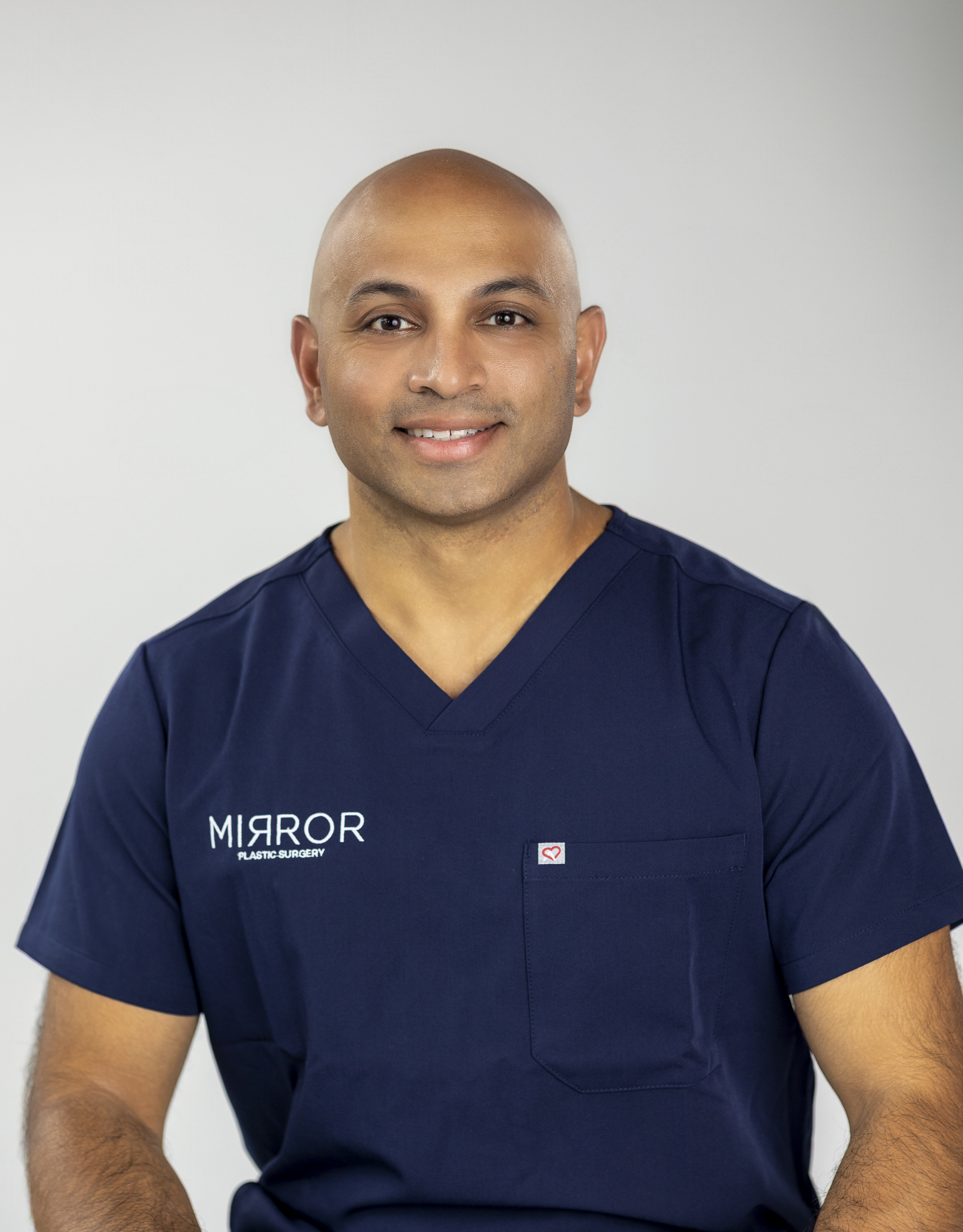
Written by: Dr. Akash Chandawarkar, Board Certified Plastic Surgeon, Mirror Plastic Surgery
Key Takeaways
- Open rhinoplasty uses a small external columella incision that gives a clear view of the nasal structures for complex cases.
- Closed rhinoplasty uses only internal incisions and works well for subtle refinements with no visible scar.
- Closed rhinoplasty usually offers faster recovery, often about 7–10 days, compared with 10–14 days after open rhinoplasty.
- Open rhinoplasty suits complex structural work, while closed rhinoplasty fits minor hump reduction or patients who want shorter downtime.
- Dr. Akash, a Harvard-trained, Newsweek-recognized plastic surgeon, bases every plan on your anatomy, safety, function, and natural aesthetics.
- Schedule a personalized rhinoplasty consult with Mirror Plastic Surgery’s Dr. Akash to choose the technique that fits your goals.
Meet Dr. Akash: Tampa’s Anatomy-Focused Rhinoplasty Specialist
Dr. Akash brings advanced training and a detail-oriented approach to rhinoplasty in Tampa Bay. He is board-certified by the American Board of Plastic Surgery and completed his medical degree at Harvard Medical School with Honors. He then finished a seven-year integrated plastic surgery residency at Johns Hopkins University.
His fellowship in aesthetic surgery at Manhattan Eye, Ear & Throat Hospital (MEETH) focused on advanced facial procedures, including complex rhinoplasty techniques. He combines this training with medical innovation experience from Stanford University and advisory roles with aesthetic companies such as Merz Aesthetics. Tampa Bay patients receive evidence-based, anatomy-driven rhinoplasty care that prioritizes safety, breathing function, and natural-looking results.
Key Differences: Open vs. Closed Rhinoplasty at a Glance
Knowing how open and closed rhinoplasty differ helps you understand which approach fits your anatomy, goals, and recovery needs. The comparison below highlights incision placement, visibility, scarring, and recovery for each technique.
|
Aspect |
Open Rhinoplasty |
Closed Rhinoplasty |
Best For |
|
Incisions |
External columella incision |
All internal incisions |
Open: Complex access needs |
|
Visibility |
Complete 360° anatomy view |
Limited visualization |
Open: Precision work |
|
Scarring |
Tiny external scar (often invisible) |
No visible scarring |
Closed: Minimal scar concerns |
|
Recovery |
10–14 days of initial swelling |
7–10 days faster recovery |
Closed: Quick return to activities |
Closed rhinoplasty often shows a lower reoperation rate, largely because surgeons use it for simpler cases. Open rhinoplasty appears to have higher revision rates because surgeons reserve it for challenging noses that need major structural changes.
Head-to-Head Analysis: Choosing the Right Rhinoplasty Approach
Open vs. Closed Rhinoplasty: Technique Strengths
Open rhinoplasty works best for complex nasal deformities that need precise structural changes. Direct visualization lets the surgeon see cartilage and bone clearly, which helps in revision rhinoplasty and cases with significant scar tissue. Tampa patients with bulbous tips, marked asymmetry, or prior surgical complications often benefit from this more comprehensive approach.
Closed rhinoplasty offers no external scar, shorter operative time, and faster early recovery. This technique suits subtle refinements such as smoothing a nasal hump or straightening a mildly curved nose. It fits patients who want modest changes and prefer less downtime.
Closed vs. Open Rhinoplasty Recovery in Tampa
Recovery speed differs between the two approaches. Closed rhinoplasty usually causes less early swelling, and many patients return to work within about 7–10 days. Open rhinoplasty often needs 10–14 days before most people feel comfortable in public.
Swelling continues to improve for many months, and full refinement of the nose can take 12–18 months for both techniques. Tampa’s humid climate may prolong swelling slightly, so Dr. Akash’s tailored post-operative protocols support smoother healing.
Swelling Differences With Closed Rhinoplasty
Closed rhinoplasty often leads to less initial swelling because it disturbs fewer tissues and avoids an external incision. The preserved blood supply and lymphatic drainage help fluid clear more quickly. Final results still depend on surgical skill, your anatomy, and how your body heals, not only on whether the approach is open or closed.
Key Drawbacks of Open Rhinoplasty
Open rhinoplasty has a few tradeoffs. Patients face a small external scar on the columella, a longer time in the operating room, and more early swelling. The columellar scar usually fades and becomes hard to see after healing, yet some patients still worry about it.
Longer operative time and wider exposure can slightly increase infection risk if sterile technique is not meticulous. Talk with Dr. Akash in a one-on-one consultation to review these risks and decide which method best supports your aesthetic and functional goals.
Best Candidates & Decision Framework: Anatomy-First Planning
Bulbous Tip: Why Open Rhinoplasty Often Wins
Open rhinoplasty usually works better for bulbous tip correction and tip asymmetry. The improved visibility and control allow precise cartilage reshaping, suturing, and graft placement. These steps often matter for refining a round or droopy tip.
With full exposure of the tip cartilages, Dr. Akash can assess their shape and strength accurately. He can then perform subtle, controlled changes that closed techniques often cannot match for complex tip work.
Ideal Candidates for Closed Rhinoplasty
Closed rhinoplasty suits patients who want modest refinements and already have good nasal support. Strong candidates often seek dorsal hump reduction, small tip adjustments, or slight nostril narrowing without major structural rebuilding. Many patients who value minimal downtime and no external scar choose this option.
Dr. Akash’s decision process weighs nasal anatomy, the scale of desired changes, healing expectations, and lifestyle. During Mirror Plastic Surgery’s comprehensive hour-long consultations, he reviews these factors and explains which approach fits your situation. This careful evaluation keeps the plan focused on your specific needs.
The practice’s concierge model limits surgeries to 1–2 cases per day. This schedule gives Dr. Akash the time and focus to apply the most appropriate technique for your anatomy and goals.
Why Tampa Patients Choose Mirror Plastic Surgery & Dr. Akash
Mirror Plastic Surgery follows a concierge medicine philosophy that contrasts with high-volume clinics across Tampa Bay. Each rhinoplasty plan reflects Dr. Akash’s Harvard-MIT medical training and Johns Hopkins surgical background. Every decision places safety first, breathing function second, and aesthetics third.
The practice uses advanced diagnostic tools such as ultrasound for detailed pre-operative assessment. These tools help match the surgical technique to your unique nasal structures. Dr. Akash’s research on artificial intelligence for rhinoplasty analysis further refines the planning and prediction of outcomes.
Tampa patients also benefit from his understanding of how Florida’s humidity affects swelling and scar maturation. His recovery protocols address local climate factors and support smoother healing. His advisory roles with leading aesthetic companies keep the practice current with new technologies and techniques that can improve results.
Experience the Mirror difference in personalized rhinoplasty care by arranging a consultation with Dr. Akash.
FAQ: Open vs. Closed Rhinoplasty in Everyday Language
Is Open or Closed Rhinoplasty Better?
No single technique works best for everyone. The right choice depends on your anatomy, the size of the changes you want, and how you prefer to recover. Open rhinoplasty gives better access for complex reshaping, while closed rhinoplasty fits simpler refinements with quicker early healing. During your consultation, Dr. Akash reviews these factors and recommends the approach that aligns with your goals.
Which Technique Has Better Long-term Results?
Both open and closed rhinoplasty can deliver excellent long-term outcomes in experienced hands. Results depend more on the surgeon’s skill, understanding of nasal anatomy, and correct technique selection than on the approach alone. Dr. Akash’s fellowship training in aesthetic surgery supports strong, stable results with either method.
How Do I Know Which Technique I Need?
Choosing a technique requires a full evaluation of your nose and your goals. Cases that involve major tip reshaping, large structural changes, or revision surgery usually benefit from an open approach. Smaller changes such as hump reduction or mild tip refinement often match well with closed rhinoplasty. Dr. Akash’s comprehensive assessment clarifies which option suits your situation.
Will I Have Visible Scarring?
Closed rhinoplasty leaves no visible external scar because all incisions stay inside the nostrils. Open rhinoplasty creates a short scar across the columella that usually fades and becomes hard to notice within 6–12 months. Careful incision placement and meticulous closure help keep this scar discreet.
Which Technique Offers Faster Recovery?
Closed rhinoplasty usually offers quicker early recovery and less swelling. Many patients return to work about 3–5 days sooner than they would after open rhinoplasty. As mentioned earlier, both techniques share a similar 12–18 month timeline for full refinement of the final result.
Ready for Your Best Rhinoplasty Results?
Your choice between open and closed rhinoplasty should reflect your anatomy and goals, not a surgeon’s habit or clinic volume. With expertise in both techniques, Dr. Akash can recommend the approach that supports natural, functional, and long-lasting results.
Schedule your personalized rhinoplasty consultation with Dr. Akash today. Arrange your rhinoplasty consultation online or contact Mirror Plastic Surgery at 727-361-6515, email hello@mirrorplasticsurgery.com, or visit 780 4th Ave S, St. Petersburg, FL 33701. Follow @mirrorplasticsurgery and @dr.akashplasticsurgery on Instagram for current insights and real patient results.
*Disclaimer: Results may vary from person to person. Editorial content, before and after images, and patient testimonials do not constitute a guarantee of specific results.*
