

Last updated: February 13, 2026
Key Takeaways
- Chin augmentation fat grafting uses your own fat for natural, semi-permanent enhancement with 50-70% survival rates, creating subtle projection and jawline definition.
- Fat grafting avoids temporary fillers and foreign implants, reducing allergy, erosion, and long-term foreign body risks.
- New 2025-2026 techniques like SVF, PRP, and ACWF increase fat retention to about 60-80%, which supports more predictable outcomes.
- Most patients return to desk work in about 1 week, with final results visible in 3-6 months and low complication rates under 5% with expert care.
- Ideal candidates want natural changes and realistic improvements. Book a consultation at Mirror Plastic Surgery with Dr. Akash for a tailored plan.
Why Chin Fat Grafting at Mirror Plastic Surgery Feels Different
Mirror Plastic Surgery follows a concierge model that focuses on time, detail, and safety. Each consultation can last up to one hour, which allows for a full anatomical evaluation and a clear, personalized treatment plan. The practice follows the philosophy of “Safety first, Function second, Aesthetics third,” so every chin fat grafting procedure starts with your health and long-term comfort in mind.
Pre-operative ultrasound helps map key structures and reduce risks such as fat embolism or asymmetry. The team limits the schedule to one or two surgeries per day. This structure keeps attention on your specific anatomy, your goals, and your recovery.
Book a consultation with Dr. Akash to experience this focused, personalized approach to chin augmentation fat grafting.
Meet Dr. Akash: Training Behind Your Chin Enhancement
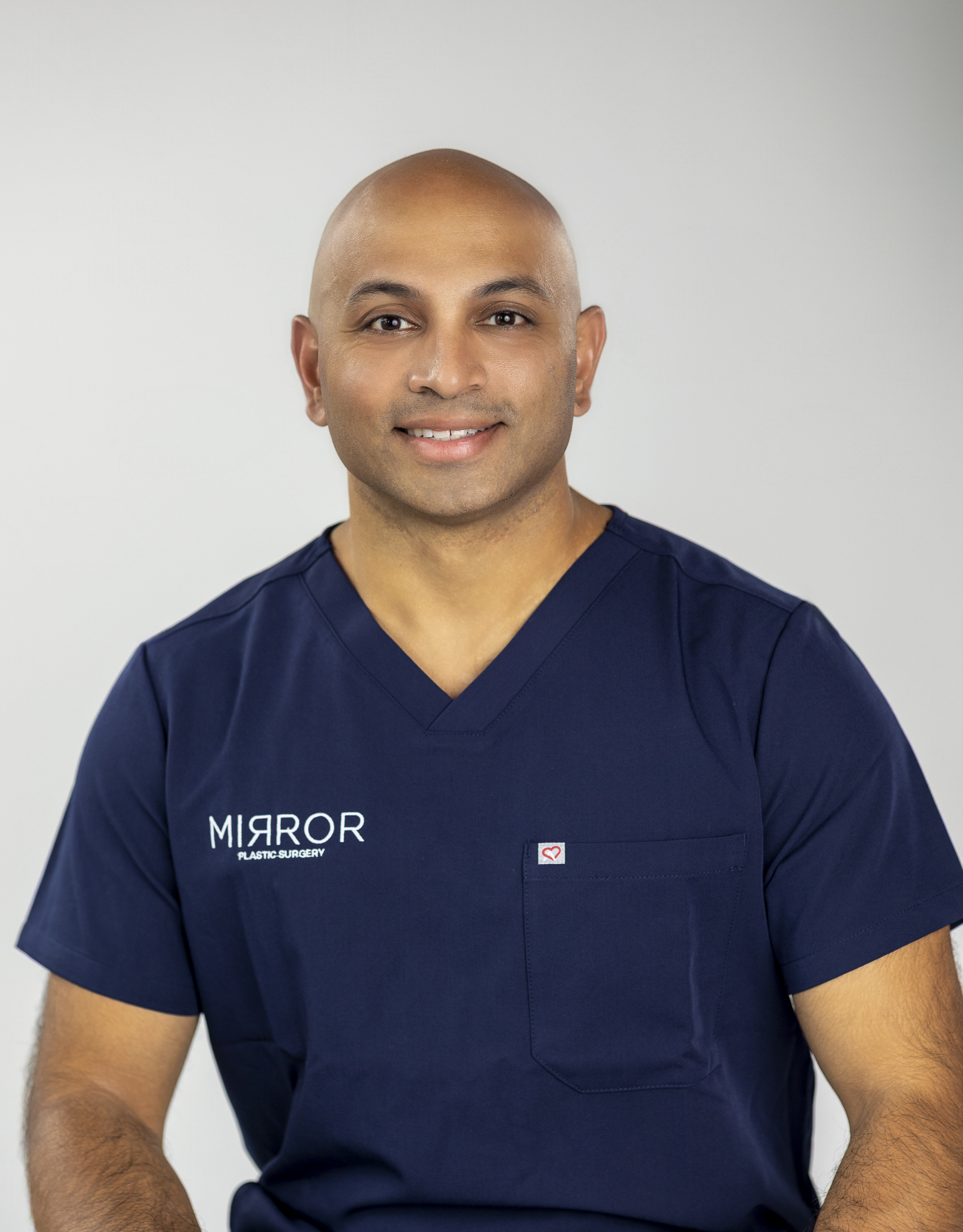
Dr. Akash Chandawarkar brings advanced training and a detail-oriented approach to chin augmentation fat grafting. He trained at the Harvard-MIT Division of Health Sciences and Technology, then completed plastic surgery residency at Johns Hopkins University. He then pursued specialized fellowship training at Manhattan Eye, Ear & Throat Hospital, where he refined advanced facial fat transfer techniques.
He is board-certified by the American Board of Plastic Surgery. His approach blends innovative methods with strict safety protocols to support higher fat survival rates and natural-looking chin contours.
How Chin Fat Grafting Works and What It Targets
Chin augmentation fat grafting follows three main steps. First, gentle liposuction harvests fat from donor areas such as the abdomen or thighs. Second, the team purifies the adipose tissue. Third, tiny amounts of fat are injected into the chin, or mental region, to increase projection and balance facial proportions.
The chin includes both bone and soft tissue. The mental region is the main focus for volume enhancement and contour. Recent studies demonstrate 50-70% survival rates when surgeons use careful technique. These numbers support chin fat grafting as a semi-permanent option for facial enhancement.
Facial fat grafting uses smaller volumes and more precise placement than structural fat grafting for areas like the breasts. Ideal candidates have enough donor fat, good overall health, and realistic expectations for subtle or moderate changes. The mental region has a strong blood supply, which supports fat integration, although some reabsorption during healing is normal.
Schedule your personalized consultation today to see whether chin fat grafting matches your anatomy and goals.
Comparing Chin Fat Grafting, Implants, and Fillers
Clear comparison between chin enhancement options helps you choose a method that fits your anatomy, lifestyle, and comfort with maintenance.
|
Method |
Longevity |
Risks |
Naturalness |
|
Fat Grafting |
5-10+ years |
Resorption (30-50%), lumps (<5%) |
High (autologous) |
|
Implants |
Permanent |
Infection, erosion, contracture |
Moderate |
|
Fillers |
6-18 months |
Vascular occlusion, nodules |
Moderate |
Fat grafting uses your own tissue, which removes allergy risk and foreign body reactions. The grafted fat blends with existing structures and tends to age in step with the rest of your face. Some fat reabsorption can occur, and a small number of patients may want a touch-up session to fine-tune volume.
Chin implants create a more dramatic and fixed change but can require future revision and carry risks such as infection or capsular contracture. Dermal fillers give immediate results with no surgery, yet they need repeat treatments and can cause vascular complications if not placed correctly.
Discover if fat grafting suits your anatomy through a detailed evaluation with Dr. Akash.
New Advances Improving Chin Fat Grafting Results
Facial fat grafting has progressed rapidly in 2025-2026. Techniques that enrich fat with stromal vascular fraction (SVF) and platelet-rich plasma (PRP) show improved survival rates of about 60-80%. Clinical data support these higher retention rates when surgeons apply these methods correctly.
Advanced Centrifugal Washing and Filtration (ACWF) has also gained attention as a more refined purification method. Recent randomized controlled trials demonstrate higher volume retention with ACWF compared with standard decantation. These developments support more consistent results and may reduce the need for repeat procedures.
What to Expect Before and After Chin Fat Grafting
Mirror Plastic Surgery follows strict safety steps for every chin fat grafting case. Pre-operative ultrasound helps map vessels and key structures. All procedures take place in accredited facilities with board-certified anesthesiologists. The surgical sequence includes a gentle liposuction harvest, careful fat purification, and layered micro-injections for even integration.
Typical recovery timeline includes:
- Days 1-3: Puffiness and mild bruising, with head elevation and cold compresses recommended.
- Week 1: Return to desk work is usually possible, often with makeup to cover residual bruising.
- Weeks 3-4: About 60-70% of swelling improves, and the early contour becomes clearer.
- 3-6 months: Final texture, contour, and graft stability appear as the fat fully settles.
Most patients experience temporary swelling and bruising that resolve over time. When surgeons use proper technique, fat necrosis occurs in fewer than 5% of cases. The goal is a more balanced jawline and improved facial proportions while preserving natural expression and movement.
Get your in-depth assessment to review your likely recovery course and personal risk profile.
Addressing Chin Fat Grafting Fears and Myths
Many patients worry that all transferred fat will disappear or that the chin will look overfilled or artificial. Modern harvesting, processing, and injection methods greatly reduce these issues. Careful patient selection and realistic planning also support stable, natural results.
Online stories often describe problems from unqualified or undertrained providers. These accounts highlight the value of choosing a fellowship-trained plastic surgeon who understands facial anatomy in depth. Successful outcomes depend on gentle harvesting, proper purification, and strategic placement by an experienced surgeon.
Frequently Asked Questions About Chin Fat Grafting
How long does fat transfer to the chin last?
Fat transfer to the chin usually lasts 5-10 years or longer. Clinical studies report survival rates of about 50-70% for the transferred fat. The fat that survives becomes living tissue in the chin and ages with the rest of your face. Some patients choose a touch-up session later to refine volume.
What are the downsides of fat grafting for chin augmentation?
Main downsides include variable reabsorption of about 30-50%, which can reduce volume over time. A small number of patients, under 5%, may notice lumps or contour irregularities that sometimes need minor correction. The procedure also requires enough donor fat and may not match the dramatic projection possible with a solid implant.
Who are ideal candidates for chin fat grafting?
Ideal candidates have adequate donor fat, stable weight, and good general health. They usually want subtle to moderate enhancement rather than a very sharp or extreme profile. Non-smokers with realistic expectations tend to do best. Patients seeking major structural change or those with limited donor fat may be better served by other options.
What is the recovery time for fat grafting to the chin?
Most patients resume light activities within a few days and return to desk work in about 1 week. Swelling improves significantly by 3-4 weeks, and social downtime often ends around that point. Final results appear between 3 and 6 months as the grafted fat stabilizes and the tissues soften.
Fat grafting vs. chin implants: Which is better?
Fat grafting gives softer, natural integration and avoids foreign material, but results are more subtle and can vary slightly. Chin implants provide a greater, more defined change with consistent shape, yet they introduce a permanent device and possible future revision. The better option depends on your anatomy, goals, and comfort with surgery and maintenance, which you can clarify during consultation.
Is Chin Fat Grafting Right for You?
Chin augmentation fat grafting offers a natural, long-lasting way to refine facial balance without implants. Success depends on precise technique, a strong understanding of facial anatomy, and clear expectations. Mirror Plastic Surgery focuses on safety, thoughtful planning, and individualized care to support reliable, natural-looking results.
Book a Consultation for Chin Fat Grafting
Patients ready to explore chin augmentation fat grafting can contact Mirror Plastic Surgery at 727-361-6515 or hello@mirrorplasticsurgery.com. Visit the practice at 780 4th Ave S, St. Petersburg, FL 33701, or follow @mirrorplasticsurgery and @dr.akashplasticsurgery on Instagram. Book a consultation with Dr. Akash today to start planning your natural chin enhancement.
Disclaimer: Results may vary from person to person. Editorial content, before and after images, and patient testimonials do not constitute a guarantee of specific results.
