
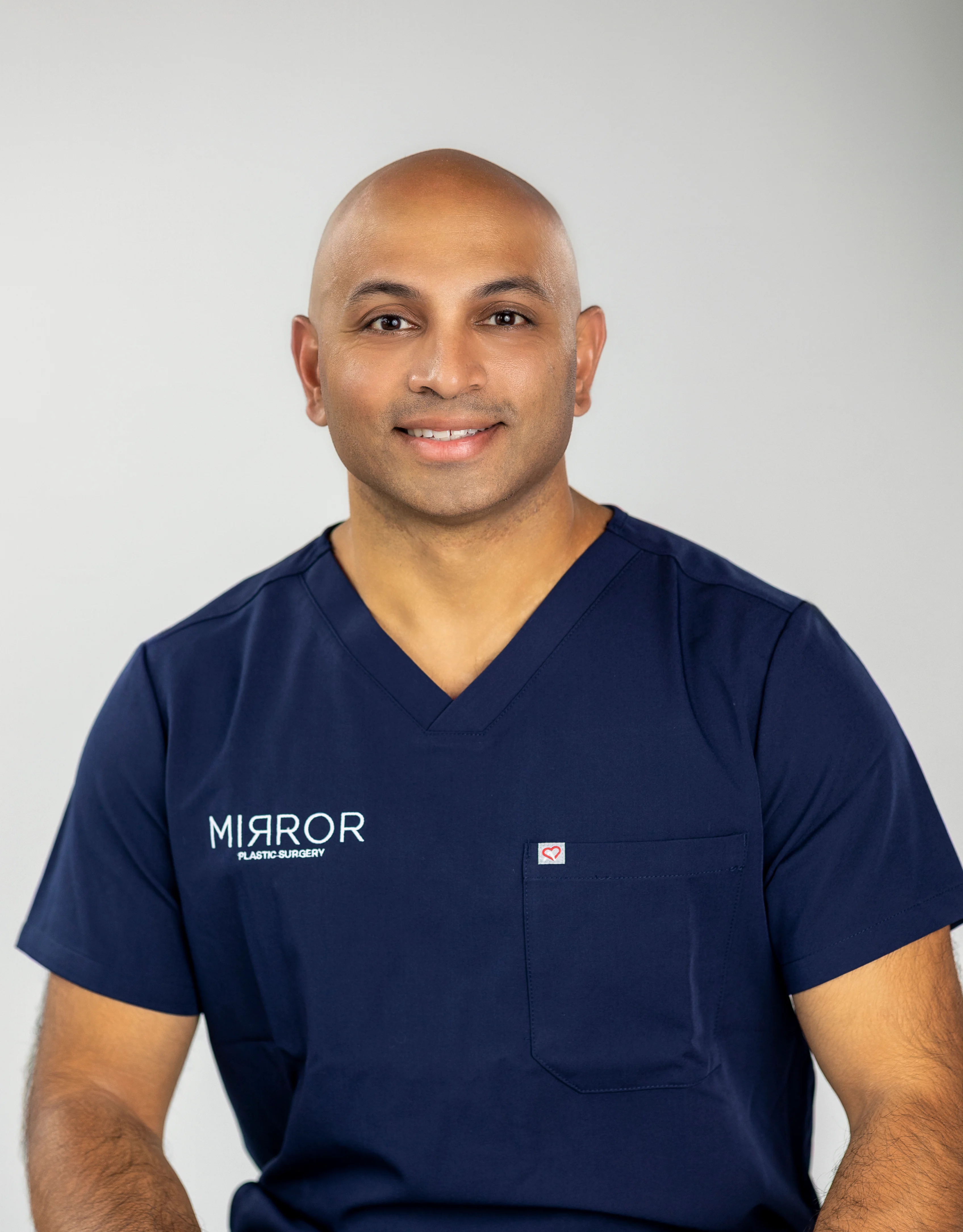
Written by: Dr. Akash Chandawarkar, Board Certified Plastic Surgeon, Mirror Plastic Surgery
Key Takeaways
- Kybella is FDA-approved only for moderate-to-severe submental fat and must stay within that defined under-chin zone.
- Key danger zones include the marginal mandibular nerve area, the platysma muscle, salivary glands, lymph nodes, vessels, and the superficial dermis, each with specific risks such as nerve injury, ulceration, or vascular damage.
- Staying 1–1.5 cm below the jawline and keeping injections in the pre-platysmal fat layer are essential to avoid complications like asymmetric smile or skin necrosis.
- Off-label use in areas such as the jowls, stomach, or other body regions is not recommended and has been linked to serious adverse events in FDA reports.
- Patients considering Kybella should meet with a board-certified plastic surgeon at Mirror Plastic Surgery for a detailed anatomical assessment before treatment.
Six Kybella No-Go Zones Under The Chin
The FDA prescribing information and the Kybella HCP Best Practice Guide outline specific no-injection zones that protect the marginal mandibular nerve, the platysma, salivary glands, lymph nodes, muscles, and arteries or veins:
- Above the inferior border of the mandible
- Within the 1–1.5 cm zone below the jawbone running from the jaw angle to the mentum
- Into or immediately adjacent to salivary glands, lymph nodes, muscles, and vessels
- Into or through the platysma muscle
- Into the superficial dermis
- Into skin that is infected or inflamed
Each zone has a clear anatomical reason behind it and a predictable consequence if violated. The sections below walk through those reasons in plain language.
Have your submental anatomy assessed by a board-certified plastic surgeon before any Kybella treatment.
The FDA-Approved Kybella Submental Treatment Area, Defined Precisely
The approved Kybella submental treatment area is bounded superiorly by the inferior border of the mandible, the jawbone itself. The FDA prescribing information states that safe and effective use outside the submental region has not been established and is not recommended. The label specifies injection points at 1 cm intervals within the marked submental fat pocket, up to 50 injections of 0.2 mL per session, for up to six sessions at least one month apart.
Everything outside this defined zone is either off-label or contraindicated. The lateral boundaries extend to the anterior borders of both sternocleidomastoid muscles to avoid lateral neck vasculature, and the inferior boundary sits above the thyroid cartilage to keep product out of the anterior neck strap muscles. Marking these boundaries with a skin pen before every session is the single most important pre-treatment discipline an injector can perform. The table below links each boundary to the structure it protects and the consequence of crossing it, so every line on the skin has a clear anatomical purpose.
| Boundary | Anatomical Structure Protected | Consequence Of Violation | FDA Label Reference |
|---|---|---|---|
| Above inferior border of mandible | Marginal mandibular nerve | Asymmetric smile, oral commissure weakness | FDA Label |
| 1–1.5 cm below jawbone | Marginal mandibular nerve | Nerve paresis | FDA Label |
| Superficial dermis | Skin cells | Ulceration, necrosis, scarring | Kybella HCP Guide |
| Platysma and deep structures | Salivary glands, lymph nodes, vessels | Tissue and vascular damage | FDA Label |
The 1–1.5 cm Safety Zone And The Kybella Marginal Mandibular Nerve
The 1–1.5 cm buffer zone below the jawbone, running from the jaw angle to the mentum, exists to protect the marginal mandibular branch of the facial nerve, the single most consequential structure at risk during Kybella treatment. The FDA label attributes marginal mandibular nerve paresis to injecting KYBELLA into or in close proximity to this branch of the facial nerve, outside the target submental fat treatment area.
The marginal mandibular branch exits the parotid gland, temporarily descends below the inferior border of the mandible near the mandibular angle, sometimes 1–2 cm below the bone, then travels forward to supply three muscles: the depressor anguli oris, the depressor labii inferioris, and the mentalis. These muscles control downward movement of the lower lip and oral commissure.
When deoxycholic acid is injected too close to the jawline and injures this nerve, the affected side of the lower lip fails to depress normally when the patient smiles or speaks. The result is an asymmetric smile and oral commissure weakness. In the Kybella pivotal trials, marginal mandibular nerve injury occurred in 4% of treated subjects and resolved spontaneously with a median recovery time of 44 days, with the longest cases taking nearly 10 months.1 The nerve injury is usually reversible but distressing, and careful respect for the safety zone makes it preventable.
Get a nerve-mapping consultation before your first treatment with a Johns Hopkins-trained plastic surgeon.
The Platysma And Pre-Platysmal Vs. Post-Platysmal Fat
Protecting the nerve is only half of the boundary challenge. The other half involves depth, because the tissue plane of the needle tip determines whether Kybella reaches fat or a more vulnerable structure. The platysma is the thin, broad muscle of the anterior neck and serves as the key depth landmark for safe Kybella injection. The approved submental treatment area targets the pre-platysmal fat compartment, the discrete subcutaneous fat layer between the skin and the platysma. Injections must remain above the platysma in the subcutaneous fat plane, because the deep platysma layer contains important structures that must not be injured, including the marginal mandibular branch, the digastric muscle, the submandibular gland, and major vessels.
Injecting beyond the pre-platysmal compartment, into or through the platysma, violates this boundary for two reasons. It places deoxycholic acid close to the post-platysmal structures listed above. It also reduces efficacy, because the target fat is pre-platysmal and product placed below the muscle does not reach the intended tissue.
Because the target is the pre-platysmal fat, the injector can confirm correct placement by feel. A correctly placed needle moves with slight resistance but remains freely mobile within fat. If it feels tethered to skin, the plane is too superficial. If it meets a firm layer, the tip has reached the platysma and must be withdrawn and re-angled.
Kybella Injection Depth And Why Superficial Injections Cause Ulceration
Kybella injection depth determines whether a patient develops skin ulceration, necrosis, or scarring. Deoxycholic acid placed in the dermis is directly cytotoxic to skin cells because it disrupts the phospholipid membranes of any cell type, not just adipocytes, so intradermal or very superficial subcutaneous placement produces a zone of skin destruction.
The clinical course of superficial injection injury follows a recognizable pattern. Patients first notice persistent or worsening redness that does not resolve on the expected timeline. This can progress to eschar formation, blistering, and ulceration. Skin necrosis and ulceration from deoxycholic acid injection are linked to overly superficial injection, excessive dose per point causing high local pressure, or accidental intravascular injection, with signs appearing within days and often progressing to crusting and ulceration at the mandibular border and submental region. Ulceration that heals without intervention still leaves scarring. This permanent outcome stems from a correctable technique error, which is why the superficial dermis appears as an explicit avoid-zone in both the FDA label and the Kybella HCP Best Practice Guide.
Structures To Stay 1–1.5 cm From: Glands, Lymph Nodes, And Vessels
The submental region contains several non-fat structures that deoxycholic acid cannot distinguish from adipocytes. The FDA label identifies salivary glands, lymph nodes, and muscles as structures requiring a 1–1.5 cm buffer, and separately advises care to avoid inadvertent injection directly into an artery or vein. The risks differ by structure:
- Submandibular salivary gland: The submandibular gland lies in the submandibular (digastric) triangle, inferior and posterior to the body of the mandible; its larger superficial part sits below the mylohyoid muscle, while its smaller deep part curves around the posterior border of the mylohyoid into the floor of the mouth. Deoxycholic acid is a cytolytic agent that, when injected into tissue, causes cell destruction and can produce injection-site nodules; when injected into glandular tissue such as salivary glands, it causes inflammatory infiltration, loss of tissue architecture, and fibrosis.
- Lymph nodes: Submental and submandibular lymph nodes lie within or adjacent to the Kybella treatment zone, and Kybella should not be injected into or within 1–1.5 cm of lymph nodes. Injection site edema or swelling and induration lasting more than 30 days occurred in 20% and 13% of subjects, respectively, which can be difficult to distinguish from a complication requiring intervention.
- Facial artery and submental artery: Vascular danger zones for cervical injection lipolysis include the facial artery and submental artery. Accidental intravascular injection can cause embolic necrosis. Aspiration before each injection and avoidance of high-pressure bolus delivery are the primary safeguards.
Active Infection And Inflammation: Absolute Contraindications
Infected or inflamed skin at the injection site is an absolute contraindication to Kybella treatment. Deoxycholic acid should not be used in patients with an infection at the injection site. Injecting into infected tissue risks spreading the infection along the needle track and into the subcutaneous plane. The inflamed environment also impairs normal healing of the cytolytic injury that Kybella intentionally produces. This avoid-zone in the FDA label is non-negotiable, regardless of patient preference or scheduling pressure.
Why Kybella Should Not Be Injected Into The Jowls
Jowl fat consists of distinct subcutaneous compartments located both above and below the mandibular border, with the inferior jowl fat pad reaching the mandibular border, so jowls are not confined to a region above the inferior border of the mandible. Treating jowls with Kybella requires working close to the jawline, the area where the marginal mandibular nerve is most vulnerable. Off-label use of deoxycholic acid in FAERS reports clusters in areas including the jawline and jowls, where the safe injection boundaries mapped for the submentum do not apply and nerve-injury risk becomes harder to control. Jowl treatment with Kybella remains off-label, carries elevated nerve-injury risk, and lacks the robust clinical evidence base that supports submental use.
Where Not To Inject Kybella In The Stomach
Kybella is FDA-approved for the submental area only. Stomach, abdominal, and other body-site use is off-label and falls completely outside the approved treatment area. The FDA identified 129 cases of adverse events when deoxycholic acid was used in areas of the body outside the approved submental region, including blurred or reduced vision with periorbital use, muscle and nerve injury, facial paresis, paresthesia, and difficulty walking. Larger body areas including the abdomen, flanks, thighs, and back are poor targets for fat-dissolving injections because the volume of medication required to produce meaningful change would be impractical and potentially unsafe. The FDA does not recommend Kybella use outside the submental region.
How Kybella Differs From Dermal Fillers
Kybella is not a dermal filler. It is deoxycholic acid, a cytolytic agent that permanently destroys fat cells by disrupting their phospholipid membranes. Dermal fillers add volume, while Kybella removes it by inducing an inflammatory response that clears lysed adipocytes over weeks and leaves fibrosis with a modest amount of new collagen.
This distinction shapes the injection boundaries. Filler placement follows vascular and tissue-plane anatomy to avoid displacement or vascular occlusion. Kybella placement follows the pre-platysmal fat compartment and the nerve-protection zones described above. The two modalities have different risk profiles, depth targets, and anatomical constraints.
How Risky Is Kybella?
Kybella’s risk profile divides into expected side effects and serious complications that arise from boundary violations. Expected effects such as swelling, bruising, numbness, and induration occur in the majority of patients and resolve within days to weeks. In the pooled Kybella trial population, the most common adverse effects were swelling (87%), bruising (72%), pain (70%), and numbness (66%).1
Serious complications such as marginal mandibular nerve paresis, skin ulceration, necrosis, and scarring depend heavily on injector anatomical knowledge and adherence to the boundaries in this article. Marginal mandibular nerve injury occurred in 4% of Kybella-treated subjects in the pivotal trials, with a median recovery time of 44 days, and every trial case resolved spontaneously.1 The risk is real but manageable. It depends on the injector marking the mandibular border, respecting the safety zone, and controlling depth within the approved treatment area.
Schedule a risk assessment with Dr. Akash before Kybella treatment at Mirror Plastic Surgery in St. Petersburg.
How To Verify Your Injector Knows These Boundaries
The anatomical knowledge required to inject Kybella safely varies widely among aesthetic providers. Before treatment, patients can ask several direct questions to gauge an injector’s command of the relevant anatomy:
- Where do you mark the inferior border of the mandible, and how do you establish the 1–1.5 cm safety zone before injecting?
- How do you confirm injection depth is pre-platysmal rather than intradermal or post-platysmal?
- What does a marginal mandibular nerve injury look like, and what is your management protocol if one occurs?
- Do you use a grid template, and how do you determine the number of injection points for my anatomy?
A qualified injector answers these questions clearly and without hesitation, because the answers are built into their pre-treatment protocol. A high-volume injector who cannot explain the anatomy behind the boundaries represents a meaningful risk factor.
At Mirror Plastic Surgery in St. Petersburg, Dr. Akash Chandawarkar personally performs every Kybella treatment. Dr. Akash is a Harvard-educated physician, Johns Hopkins-trained plastic surgeon, and American Board of Plastic Surgery board-certified surgeon, bringing a surgeon’s command of facial and subdermal anatomy to every injection. The practice’s concierge medicine approach provides each patient with a top-to-bottom assessment of up to one hour before any treatment is planned, with a safety-first, non-upselling philosophy and no supplier quotas influencing recommendations. Patients in the Tampa Bay area can call or text to secure an appointment.
Start with an anatomy-first consultation to experience surgeon-led Kybella treatment at Mirror Plastic Surgery.
Conclusion: Why The Boundaries Matter
Kybella’s injection boundaries mirror the anatomy beneath the chin. Each boundary corresponds to a structure that deoxycholic acid will injure if it reaches it: the inferior border of the mandible, the 1–1.5 cm nerve-protection zone, the pre-platysmal fat compartment, and the superficial dermis.
Knowing these boundaries, and confirming that an injector follows them, is the most practical step a patient can take before treatment. The FDA’s safety communication on Kybella labeling and the Kybella HCP Best Practice Guide provide the regulatory framework. The anatomy explains why that framework exists.
Take The Next Step
Book an appointment with Dr. Akash at Mirror Plastic Surgery in St. Petersburg for a surgeon-led, anatomy-first Kybella consultation.
Disclaimer: Results may vary from person to person. Editorial content, before and after images, and patient testimonials do not constitute a guarantee of specific results.
1 Results may vary from person to person. Editorial content, before and after images, and patient testimonials do not constitute a guarantee of specific results.