Written by: Dr. Akash Chandawarkar, Board Certified Plastic Surgeon, Mirror Plastic Surgery | Last updated: June 15, 2026
Key Takeaways
- FUE, FUT, and DHI create different scarring patterns. FUE and DHI leave small dot scars, while FUT creates a linear scar that can limit future sessions.
- All three techniques can reach graft survival rates of 90–95% with an experienced surgeon, so surgeon skill matters more than the method.1
- Recovery is typically fastest with FUE and DHI, with a 3–5 day return to light activity, while FUT usually requires 7–14 days because of the linear incision.1
- DHI works especially well for precise hairline work and unshaven procedures but becomes less practical than standard FUE for sessions above about 3,000 grafts.
- Choosing the right technique starts with an in-person evaluation. Schedule your personalized consultation at Mirror Plastic Surgery to receive expert guidance tailored to your goals.
Scarring Differences with FUE, FUT, and DHI
FUT removes a strip of donor skin typically 15–25 cm long and 1–2 cm wide, which leaves a permanent linear scar that can widen depending on genetics, skin type, and wound tension. Trichophytic closure encourages hair to grow through the incision line, reducing but not eliminating scar visibility. The FUT scar typically remains detectable at hair lengths below 1–2 cm, depending on closure technique and patient factors and can restrict the number of FUT sessions performed over a lifetime.
FUE typically uses manual punches with diameters of 0.7–1.0 mm, though sizes as small as 0.6 mm may be employed, which produces scattered dot scars. Once healed, these marks are virtually undetectable even at a grade-2 buzz cut. Punch size plays a major role, and smaller punches can create less noticeable extraction marks. The principal donor-area risk in FUE is overharvesting, and many FUE surgeons suggest that 40-50% of the donor area follicular units can be taken before there is a significant change in appearance to preserve long-term donor integrity.
DHI produces the same dot-like donor scars as standard FUE because it uses the same punch-based extraction step. Differences in donor-area appearance between DHI and FUE are negligible and depend far more on punch diameter and extraction pattern than on the implantation tool used.
Clinical Drawbacks of DHI Compared with FUE
DHI is not recognized by the International Society of Hair Restoration Surgery (ISHRS) as a distinct clinical technique separate from FUE, because it originated as a commercial brand name. The Choi implanter pen combines channel creation and graft placement in one step, which can reduce recipient-site trauma in targeted zones but also introduces specific clinical limitations.
Loading each graft individually into a pen takes time, which makes DHI less practical for large sessions requiring 3,000–5,000+ grafts. Patients with low donor density may face technical challenges with DHI and may be better served by standard FUE. A 2017 study in Hair Transplant Forum International found that Choi pens protect fragile grafts during placement but did not establish pen placement as superior to skilled manual placement. DHI offers clear benefits for hairline precision, eyebrow and beard work, and situations where the patient prefers to avoid full head shaving. Those benefits apply to specific use cases rather than representing a universal upgrade.
Graft Survival Rates: FUE vs FUT vs DHI (2025–2026 Data)
As noted earlier, all three techniques converge at 90–95% survival rates when performed by experienced teams, a finding supported by peer-reviewed data in the Journal of Cutaneous and Aesthetic Surgery and comparative FUT and FUE studies. Advanced DHI protocols can match these outcomes when highly trained surgeons perform the procedure, so training and consistency matter more than the label on the technique.
Execution influences survival far more than the chosen method. Key variables include minimizing graft out-of-body time, keeping grafts hydrated in chilled isotonic solution, gentle handling, correct punch angulation and depth, and avoiding excessive recipient-site density. FUE transection rates during extraction stay low in experienced hands and rise significantly with less skilled operators, which directly supports prioritizing surgeon credentials over technique branding.
Recovery Timeline and Downtime Comparison
The recovery advantage of FUE over FUT, outlined earlier as a 3–5 day return to light activity versus 7–14 days, stems from the absence of a linear incision. FUT patients often experience tightness, pulling sensations, and prolonged tenderness along the suture line, with possible numbness lasting weeks to months, while FUE patients usually manage mild discomfort with over-the-counter medication. FUT patients also face activity restrictions for about four weeks to protect the incision.
DHI and FUE share broadly similar recovery profiles because both avoid linear incisions. Redness and swelling peak in the first 2–3 days, crusts begin drying during days 4–7, and most crusts fall off by days 8–14. Shock loss, or shedding of 70–80% of transplanted hair shafts, occurs around weeks 3–4 while follicles remain viable beneath the skin.1 New growth usually begins at 3–4 months, with about 60% visible by 6 months and final results at 12–18 months.1
Postoperative frontal edema occurs frequently in FUE patients, while infection rates remain low when clinics follow proper sterile technique.
Matching Technique to Norwood Stage and Goals
DHI often suits patients with limited recession and very high expectations for hairline precision in the frontal and temple zones. Norwood V–VII patients typically benefit from a combination of DHI for the hairline and FUE for broader coverage. Standard FUE works well for patients who need larger graft counts and wider coverage.
FUT still fits patients who require maximum single-session graft yield and do not wear their hair short, although most ISHRS surgeons now regard FUT as a legacy technique. Norwood stage provides one input rather than the only deciding factor. Donor density, scalp laxity, hair caliber, age, hair-loss stability, and prior procedures all shape the final plan. Experienced clinics often combine FUE for efficient extraction and wider coverage with DHI pens for refined placement in the frontal hairline within the same session.
Comparison Table: Scarring, Graft Yield, Recovery, and Norwood Stage
The following table brings together the main clinical differences across FUE, FUT, and DHI so you can quickly compare scarring patterns, typical session capacity, recovery timelines, and ideal Norwood stages.
Small dot scars, virtually undetectable at short hair lengthsVaries, with care taken to avoid overharvestingReturn to light activity in 3–5 days, donor healed in 7–10 daysIII–VILinear scar that can widenSame dot scars as FUE, no linear scarSmaller sessions, less practical above 3,000 graftsBroadly similar to FUE, most crusts resolved by day 14Limited recession, combination for advanced
| Technique | Scarring | Graft Yield per Session | Recovery Timeline | Ideal Norwood Stage |
|---|---|---|---|---|
| FUE | ||||
| FUT | High graft yield per session | Typically 7–14 days for normal activity or work, exercise restricted about 4 weeks | V–VII (maximum yield needed, hair worn long) | |
| DHI |
Decision Framework: Choosing the Right Approach
Start with donor density, because this factor determines whether you qualify for surgery. A minimum of 40–60 follicular units per cm² is the clinical threshold for hair transplant candidacy. If donor density is adequate, consider session size. Patients who need more than 3,000 grafts for broad coverage usually do better with FUE or a FUE/DHI hybrid than with DHI alone.
Next, consider hairstyle preference, which directly affects which scarring pattern you can accept. Patients who wear their hair at a grade 2 or shorter can usually tolerate FUE dot scars but not a FUT linear scar, which stays visible at short lengths. Patients who consistently wear longer hair and need maximum single-session yield, typically Norwood V–VII, remain candidates for FUT despite its legacy status, because the linear scar stays hidden under length.
Finally, weigh lifestyle constraints and medical factors. In one study, 67% of surveyed medical tourists chose unshaven DHI specifically to avoid visible signs of surgery, which makes it a practical option for professionals who cannot take extended leave. Patients with active scalp disease, uncontrolled diabetes, bleeding disorders, or immunosuppressive therapy need medical clearance before any technique is selected.
No framework replaces an in-person assessment. Technique represents one variable, and the surgeon’s judgment, which integrates all variables, remains the decisive factor.
Book a consultation with Dr. Akash to receive a personalized technique recommendation based on your donor density, Norwood stage, and lifestyle goals.
Surgeon Selection Checklist
- Board certification by the American Board of Plastic Surgery (ABPS). ABPS certification requires six or more years of accredited surgical training and confers hospital privileges, which provide a critical safety net if complications require inpatient management.
- Hospital privileges. A surgeon with active hospital privileges can manage rare but serious complications that exceed an outpatient clinic’s capability.
- Fellowship training in aesthetic surgery. Fellowship-level training beyond residency signals advanced, focused expertise in the techniques relevant to hair restoration and facial anatomy.
- Documented complication-management capability. Ask specifically how the practice handles adverse events such as recipient-site necrosis, donor depletion, or infection.
- Physician-led procedure. In some clinic models, unlicensed technicians determine graft numbers, design hairlines, inject anesthesia, and plant grafts while a physician oversees multiple rooms simultaneously. Confirm that your surgeon personally performs hairline design, recipient-site creation, and graft placement.
- Volume discipline. High-volume practices that perform five to ten procedures daily cannot provide the same perioperative focus as a practice that limits itself to one or two cases per day.
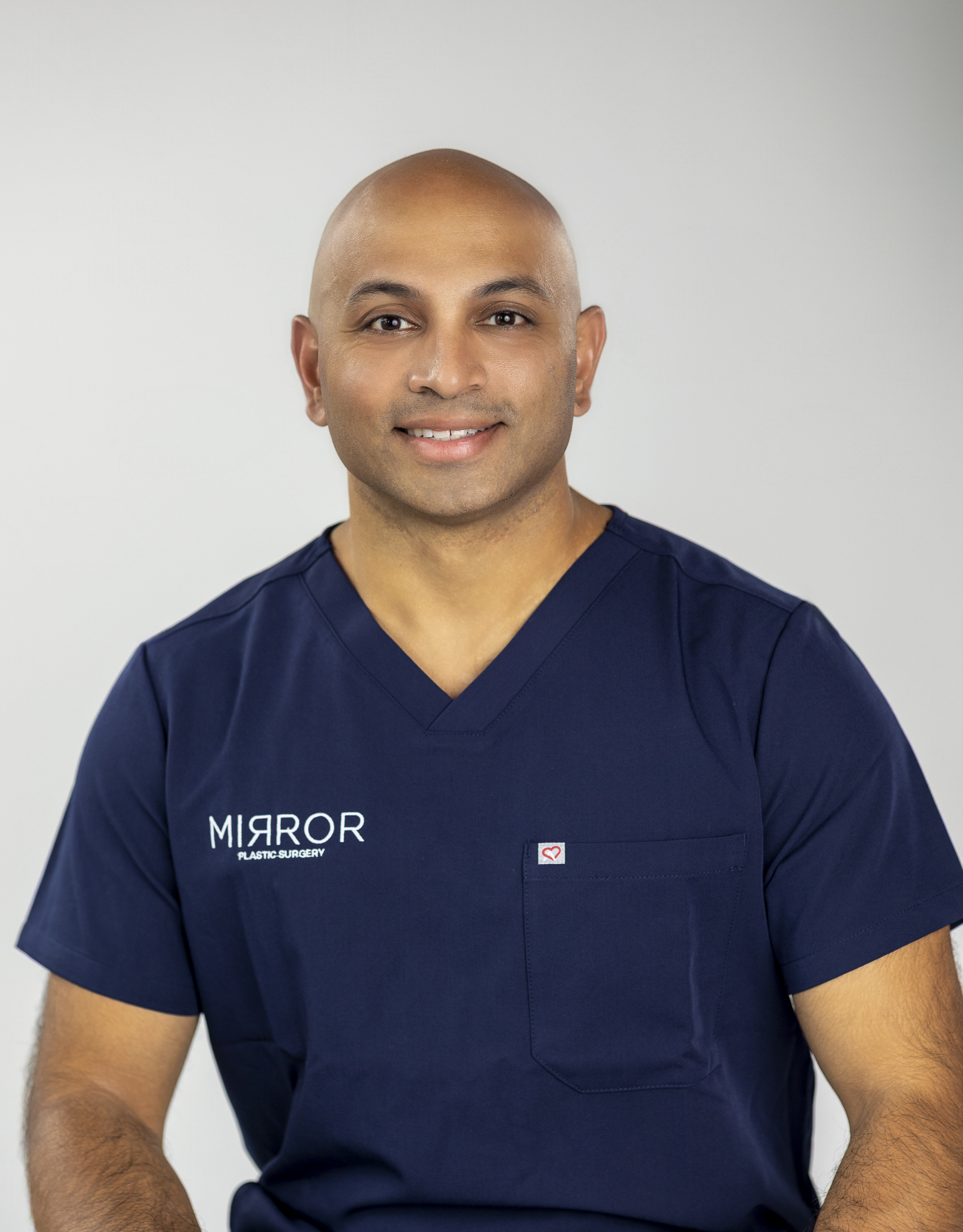
Dr. Akash, a Harvard-MIT and Johns Hopkins-trained plastic surgeon with an aesthetic surgery fellowship at the Manhattan Eye, Ear and Throat Hospital (MEETH), has been recognized as one of America’s Best Plastic Surgeons 2025 by Newsweek for two consecutive years. His ABPS board certification includes active hospital privileges, and Mirror Plastic Surgery performs only one to two procedures per day to ensure undivided perioperative attention.
Book a consultation with Dr. Akash and experience the difference that concierge-level surgical expertise provides from the first appointment onward.
U.S. Regulatory Standards and 2025–2026 Context
FUT and FUE are classified as surgical procedures requiring local anesthesia and sterile operative conditions under U.S. state medical board jurisdiction. The ISHRS publishes practice standards and outcome data that serve as the primary clinical reference for hair restoration in the United States. Robotic FUE systems such as ARTAS received FDA 510(k) clearance in 2011 for automated follicular extraction, and this clearance applies to the device itself while still requiring physician oversight.
The U.S. regulatory environment contains a meaningful gap. Any physician holding a general medical license may legally perform hair transplant procedures regardless of specialized training. This gap has consequences. The ISHRS 2025 Practice Census reports that repair procedures reached 6.9% of cases in 2024 (up from 5.4% in 2021), with 10% of those repair cases attributable to prior substandard procedures, which prompted the ISHRS to launch its “Fight the FIGHT” campaign against procedures performed by unlicensed practitioners. Patients who consider overseas options face additional risks, including language barriers affecting aftercare comprehension, varying national hygiene standards, limited post-operative follow-up, and complex legal recourse in foreign jurisdictions.
Choosing a board-certified plastic surgeon with hospital privileges and a physician-led model offers the most reliable way to align with U.S. safety standards and protect long-term outcomes.
Frequently Asked Questions
Which hair transplant method works better for most patients, FUE or FUT?
Neither technique works best for every patient. FUE usually produces less visible scarring, shorter recovery, and greater donor flexibility, which makes it the preferred choice for most people today. FUT yields the highest single-session graft count and still fits advanced Norwood V–VII patients who need maximum coverage and consistently wear their hair long enough to conceal a linear scar. The more useful question focuses on which technique suits your specific donor density, Norwood stage, hairstyle preference, and lifestyle, and that decision requires an in-person assessment by a qualified surgeon.
What are the disadvantages of DHI compared with standard FUE?
DHI’s main limitations involve session size and cost. Loading each graft individually into a Choi implanter pen takes time, which makes DHI impractical for sessions that require more than about 3,000 grafts. Patients with low donor density may not qualify as good candidates for DHI. DHI is not recognized by the ISHRS as a distinct technique from FUE, because it functions as a specialized implantation method built on the same extraction foundation. Its advantages remain real but narrow, including precise angle control for hairline and eyebrow work and the option to avoid full head shaving. For broad coverage needs, standard FUE or a FUE/DHI hybrid usually works better.
Does FUE scarring become visible if I shave my head?
FUE creates small dot scars that, when an experienced surgeon uses small punches, can remain nearly invisible even at short hair lengths. The main risk involves overharvesting, which means extracting too high a percentage of donor follicles in a single session and leaving the donor area visibly thin regardless of punch size. As discussed earlier, the 40–50% extraction threshold helps preserve donor integrity and keeps scars undetectable at short hairstyles.
How long does it take to see final results after a hair transplant?
Shock loss, or shedding of 70–80% of transplanted hair shafts, occurs around weeks 3–4 while follicles remain viable beneath the skin. New growth typically begins at 3–4 months, with about 60% of new hair visible by 6 months. Full results usually appear at 12–18 months, although crown areas can take up to 18–20 months to reach final density.1 This timeline applies broadly to FUE, FUT, and DHI because it reflects follicular biology rather than differences in technique.
How do I verify that a hair transplant surgeon meets U.S. safety standards?
Confirm board certification by the American Board of Plastic Surgery, the American Board of Dermatology, or the American Board of Facial Plastic and Reconstructive Surgery, because each requires six or more years of accredited training. Ask whether the surgeon holds active hospital privileges, which enables management of rare but serious complications. Verify that the surgeon personally performs hairline design, recipient-site creation, and graft placement instead of delegating these steps to unlicensed technicians. Ask how many procedures the practice performs per day, because a low-volume, physician-led model signals the individualized attention that complex hair restoration requires.
Next Steps
Technique selection, whether FUE, FUT, or DHI, represents a meaningful clinical decision, yet it remains secondary to the surgeon’s training, board certification, hospital privileges, and ability to manage complications. Graft survival rates converge at 90–95% across all three techniques when a highly trained physician performs the procedure, and they diverge sharply when inadequately credentialed operators perform it. The safest, most natural, and most sustainable outcomes come from selecting an elite, credentialed surgeon first and then allowing that surgeon to recommend the technique that best matches your anatomy and goals.
Mirror Plastic Surgery’s concierge model, which includes one to two procedures per day, up to an hour of consultation time, and a safety-first philosophy, suits Tampa-area professionals who research thoroughly and refuse to compromise on credentials or personalized care.
Book a consultation with Dr. Akash at Mirror Plastic Surgery in St. Petersburg, FL, and receive an evidence-based, anatomy-specific hair restoration plan from a Harvard-MIT and Johns Hopkins-trained plastic surgeon recognized among America’s Best Plastic Surgeons 2025 by Newsweek for two consecutive years.
1 Results may vary from person to person. Editorial content, before and after images, and patient testimonials do not constitute a guarantee of specific results.