Written by: Dr. Akash Chandawarkar, Board Certified Plastic Surgeon, Mirror Plastic Surgery
Key Takeaways
- Standardized lighting, angle, expression, timing, and product disclosure make any Juvéderm before and after photo pair more trustworthy.
- Each Juvéderm formulation is FDA-approved for specific facial zones, so matching product to depth and area supports natural-looking results.
- Swelling peaks in the first 1–3 days and final results appear at 2–4 weeks, so very early photos can mislead patients about outcomes.1
- Natural results show balanced proportions and preserved movement, while overfilled results appear heavy, puffy, or disproportionate.1
- Mirror Plastic Surgery in St. Petersburg provides physician-performed, anatomy-first Juvéderm treatments with standardized photography and conservative dosing.
See Standardized Before and After Photos
What To Look For In Juvéderm Before And After Photos
Tampa patients browsing dermal filler before and after photos want to know whether a result will look natural on their own face. Many local galleries show images with no lighting disclosure, no angle information, no note of how many days after treatment the photo was taken, and no explanation of which Juvéderm product was used where. Even photographs of the same person can make a difference look larger or smaller than it really is if lighting, head angle, camera distance, facial expression, neck position, or retouching change between shots.
Juvéderm is a family of dermal fillers, and each formulation is designed for specific facial areas and tissue depths. This article focuses on evaluating photos and recognizing natural results rather than serving as a full Juvéderm overview or injector-selection guide. Mastering the five core variables turns a guessing game into an informed review of any gallery.
The Five Variables That Make a Juvéderm Before and After Photo Honest
Before trusting any Juvéderm before and after Tampa gallery, verify these five variables in every photo pair:
- Lighting. A before image shot in natural morning light compared against an after image shot under a ring light in the evening is not a valid clinical comparison, because apparent improvement may be entirely attributable to the different lighting conditions. Consistent, diffused illumination is the standard.
- Angle. A slight change in camera height or head tilt can make cheeks or lips look fuller without any product difference. Same angle, same distance, and a neutral head position create a valid comparison.
- Expression. Mismatched animation states are the single biggest gap in aesthetic photography: a lip filler patient photographed smiling at baseline and at rest at follow-up will look like the filler dissolved, even when the treatment was textbook. Both images should show the same relaxed, neutral expression.
- Time Since Injection. Day-one swelling flatters lips and can unfairly disappoint for cheeks due to redness and local swelling. Ask whether the “after” was taken at three days or two weeks, because that timing changes how you interpret the result.
- Product and Volume Used. Know which Juvéderm product was used, how much, and where it was placed. The most informative dermal filler galleries disclose the exact treatment map, the total volume of product used, and whether the patient still looks natural when smiling. Galleries rarely share this level of detail, even though it matters most.
Review Your Photos With a Physician Injector
How To Decode Which Juvéderm Product Goes Where
Juvéderm Voluma before and after cheeks Tampa searches are common, yet Voluma is only one product in a six-member family. The Juvéderm Collection comprises six specifically designed injectable formulations that are FDA-approved for 10 indications, allowing treatment to be precisely tailored to each patient’s unique anatomy and aesthetic goals. The table below shows why product choice is not interchangeable: each formulation is engineered for a specific tissue depth, so the same face may call for different products in different zones.
| Juvéderm Product | FDA-Labeled Treatment Area | Why It Is Matched to That Area |
|---|---|---|
| Voluma XC | Cheeks, chin, temples | Deep injection restores structural support and lifts the mid-face. |
| Vollure XC | Nasolabial folds | Softer, more flexible correction of moderate folds. |
| Volbella XC | Lips, perioral lines, undereye hollows | Subtle lip volume and under-eye hollowing correction in thin tissue. |
| Ultra XC and Ultra Plus XC | Ultra XC: moderate to severe facial wrinkles and folds (for example, nasolabial folds) and lip augmentation. Ultra Plus XC: moderate to severe facial wrinkles and folds (for example, nasolabial folds). | Classic lip enhancement and fold correction. |
The right product depends on the area, tissue thickness, and the patient’s anatomy. A familiar off-label use does not expand a product’s approved indication, so FDA labeling still ties each product to specific anatomies. A physician with deep facial anatomy training can match product to area more precisely than a provider working from a limited portfolio.
How Long Until Juvéderm Results Are Visible? A Healing Timeline
The healing timeline often creates confusion when patients compare Juvéderm before and after photos in Tampa galleries. This sequence shows what typically happens after injection:
- Days 1–3: Lip filler swelling peaks in the first 24 to 48 hours, during which lips can appear 20 to 30 percent larger than the final settled result.1 Cheeks and chin usually peak within the same window.
- Days 4–7: Swelling resolves and the result may appear subtler than intended as the acute edema fades. Bruising also tends to resolve during this period.
- Weeks 1–2: Filler is hygroscopic, so it attracts and binds water from surrounding tissue over 2–4 weeks, expanding slightly to a fully hydrated state and softening. A lip or cheek that looks stiff or irregular at one week often looks precisely right at three weeks.
- Weeks 2–4: Final results appear between 2–4 weeks once swelling resolves, which makes that window the appropriate time for assessment and touch-up treatment.1
Early Juvéderm before and after photos can look overfilled because residual swelling, rather than the true result, is still visible. Booking a touch-up at 1–2 weeks risks over-filling, because at 4 weeks both the original and touch-up have fully integrated and the total volume exceeds what was wanted. Always ask a provider when the “after” photo was taken.
How To Tell a Natural Juvéderm Result From an Overfilled One
A natural result shows balanced facial proportions, smooth transitions between the upper, middle, and lower face, no isolated puffiness, and movement that still looks like the patient. Loss of the “ogee curve” — the gentle S-shaped contour running from the cheekbone to the mid-face — is one of the most reliable early indicators of filler overcorrection.
An overfilled result shows disproportionate cheeks or lips, heaviness in the mid-face, and a “done” appearance. Central or medial filling applied repeatedly to tissues that have already descended may produce a face that appears “fuller but not younger, wider but not better supported, and smoother but less natural.”
“Overfilling is not an accident, it accumulates, and it is very largely preventable by the person holding the syringe.” Mirror Plastic Surgery’s approach prioritizes conservative, full-face dosing over isolated area treatment, which helps prevent the gradual drift toward an overdone appearance across sessions.
Honest Answers To Common Tampa Juvéderm Questions
What Are the Downsides of Juvéderm?
The most commonly reported side effects of Juvéderm injectable gels are redness, swelling, pain, tenderness, firmness, lumps/bumps, bruising, discoloration, and itching; most resolve within 30 days.1 Rare but serious risks include unintentional injection into a blood vessel. Complications can be serious and permanent, including vision abnormalities, blindness, stroke, temporary scabs, or permanent scarring of the skin.1 The qualifications and anatomical knowledge of the injector are the single largest modifiable factor in complication risk.
Does Cheek Filler Make You Look Older or Younger?
Placement and volume determine whether cheek filler refreshes or weighs down the face. Better cheek filler restores structure, improves light reflection, and keeps movement natural. Overfilling the mid-face adds weight, widens the face, and can produce a fuller appearance that does not read as younger. Technique and restraint matter more than the specific product.
Why Are People Moving Away From Fillers?
Industry data shows a shift in how filler is used rather than a collapse in demand: dermal fillers grew just 1% in 2024 while neuromodulators grew 4%, and the American Society of Plastic Surgeons characterized injectables that year as favored for their personalization and subtle results. “The future of filler treatment is better-directed filler.” The shift reflects a move toward natural dosing and better-directed treatment within the filler category.
Will My Skin Sag If I Stop Fillers?
Dissolving filler does not age the face; it returns the face to its baseline. When filler is fully metabolized after stopping treatment, the area returns to its pre-treatment state with no rebound effect. The perception of looking worse usually comes from comparing the current face to an earlier point in life, when skin, fat compartments, bone structure, and sun exposure were different, rather than from a harmful effect of filler.
Why Physician-Performed Juvéderm in Tampa Produces More Consistent Photo Results
Juvéderm before and after photos are only as reliable as the injector’s technique and anatomical knowledge. At Mirror Plastic Surgery in St. Petersburg, injectables are performed by Dr. Akash Chandawarkar, MD. He is board-certified by the American Board of Plastic Surgery and trained at Harvard and Johns Hopkins. His fellowship in aesthetic surgery at Manhattan Eye, Ear & Throat Hospital (MEETH)/Lenox Hill Hospital gave him a surgeon’s command of facial and subdermal anatomy, which informs every injection decision.
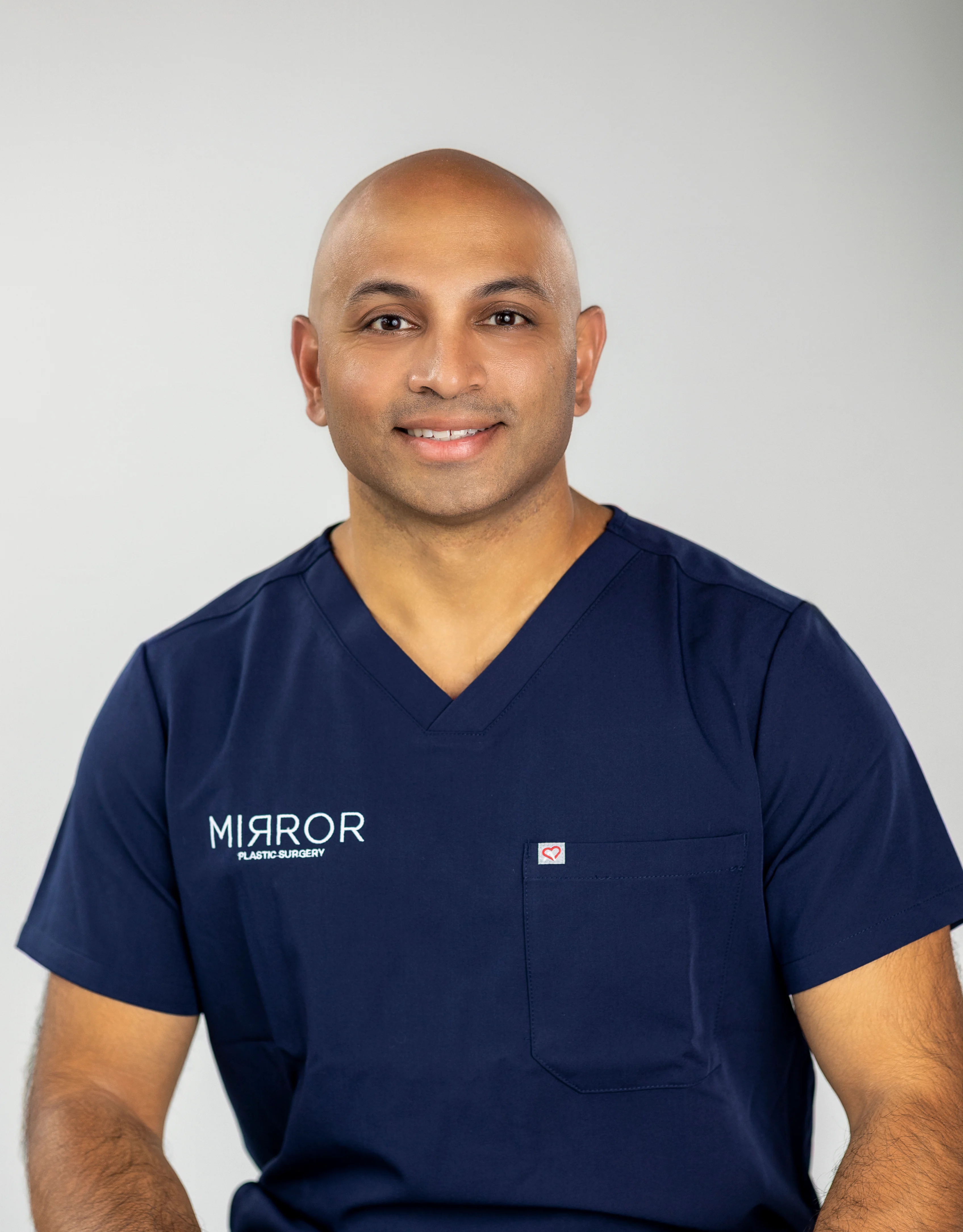
Anatomical knowledge, personalized evaluation, and skilled injection technique are equally vital clinically — proper material selection alone cannot guarantee ideal results. Because Mirror Plastic Surgery is a supplier-neutral practice, product selection is based on the patient’s anatomy and goals rather than a limited portfolio or commercial arrangement.
Patients who want to see this approach in person can visit the practice at 780 4th Ave S, St. Petersburg, FL 33701, or call or text 727-361-6515 to reach the team directly.
Your Tampa Consultation Checklist: Questions That Protect Your Results
Bring these questions to any Tampa Juvéderm consultation to understand both the plan and the person holding the syringe:
- Ask to see Juvéderm before and after photos of patients with similar anatomy and goals, because dissimilar faces tell you little about your own outcome.
- Ask when the “after” photos were taken, with two weeks as a minimum and four weeks preferred, so you see settled rather than swollen results.
- Ask which Juvéderm product is recommended for each area and why, and confirm that the plan aligns with FDA-labeled zones.
- Ask how much volume is planned and whether a conservative first session is possible, especially if this is your first filler treatment.
- Ask about the injector’s credentials, training, and who manages complications, so you know who will care for you if something unexpected occurs.
Mirror Plastic Surgery consultations can last up to an hour and include a top-to-bottom assessment, which gives ample time to work through every question on this list and understand the anatomical rationale behind every recommendation.
Ask These Questions at Your Consultation
Frequently Asked Questions
How Long Until Juvéderm Results Are Visible?
The healing timeline above explains that swelling peaks in the first few days and the settled result appears between two and four weeks. Assessment photos and touch-up decisions are most reliable around the four-week mark.
What Are the Downsides of Juvéderm?
The side effects and risks outlined earlier in this article apply here as well, including common temporary reactions and rare vascular complications. Focus on injector training, anatomy expertise, and emergency preparedness to reduce these risks.
Does Cheek Filler Make You Look Older or Younger?
Cheek filler can refresh or weigh down the face depending on placement and volume. The cheek-filler section above explains how structural support, light reflection, and restraint create a younger-looking result.
Why Are People Moving Away From Fillers?
Patients are gravitating toward natural dosing and better-directed treatment rather than abandoning fillers. The earlier section on shifting trends covers the data and explains how this change supports more subtle results.
Will My Skin Sag If I Stop Fillers?
Skin does not sag because filler stops. The section on stopping or dissolving filler explains how the face returns to baseline while natural aging continues.
How Do I Choose a Juvéderm Provider in Tampa?
Look for a provider who shows standardized before and after photos with disclosed timing and product information, holds verifiable board certification and documented anatomical training, offers a conservative first session, and clearly explains the rationale behind every product and placement decision. A physician injector with surgical training in facial anatomy provides a high level of precision and complication management.
Conclusion: Read the Photos, Then Choose the Injector
Juvéderm before and after photos in Tampa become useful once you understand the five variables of lighting, angle, expression, time since injection, and product used. Combine that framework with the product-to-area table and the two-to-four-week healing timeline, and you can evaluate any gallery with the same critical eye a plastic surgeon brings to a clinical record.
Natural results come from conservative, anatomy-first treatment performed by a qualified physician who understands what lies beneath the skin. That is the standard Mirror Plastic Surgery follows, and it is the standard you can apply when choosing any provider whose photos you are considering.
Book a Physician-Led Juvéderm Consultation
Disclaimer: Results may vary from person to person. Editorial content, before and after images, and patient testimonials do not constitute a guarantee of specific results.
1 Results may vary from person to person. Editorial content, before and after images, and patient testimonials do not constitute a guarantee of specific results.