
Written by: Dr. Akash Chandawarkar, Board Certified Plastic Surgeon, Mirror Plastic Surgery
What Is Juvéderm Under Eye Treatment?
Juvéderm under eye treatment uses filler to restore volume in the tear trough and infraorbital hollow. The product most commonly used for this indication is Juvéderm Volbella XC, which carries FDA approval specifically for improvement of undereye hollows in adults over 21 and typically lasts around one year.1 Because that approval is narrow, the right treatment option depends entirely on why the under-eyes look tired, and for a meaningful subset of patients, Juvéderm is not the correct answer at all.
Key Takeaways
- Only one Juvéderm product is approved for the tear trough area, and it is formulated specifically for infraorbital hollows.
- Under-eye concerns stem from four distinct causes: true volume loss, pigmentary dark circles, fat-pad pseudoherniation, and skin laxity. Filler is appropriate only for true volume loss.
- Patients with pigment-dominant dark circles, prominent under-eye bags, significant skin laxity, or very thin eyelid skin are generally poor candidates for under-eye filler.
- Results are not permanent.1 See the longevity section below for the typical maintenance interval and what affects how long results last.
- Mirror Plastic Surgery provides a surgeon-led, diagnosis-first consultation that prioritizes safety and anatomy before any product is chosen.
Book A Consultation At Mirror Plastic Surgery
The Four Causes Of Under-Eye Aging And Where Juvéderm Fits In
Under-eye concerns do not come from a single cause. They fall into four anatomically distinct categories, and each requires a different treatment approach.
- True Volume Loss And Hollowing Of The Tear Trough. The tear trough is the groove formed where the orbicularis retaining ligament tethers skin and muscle to the inferior orbital rim. As the surrounding malar fat pad descends with age, a relative depression forms, and the resulting shadow comes from that hollow. Filler placed deep to the orbicularis oculi in the preseptal or supraperiosteal plane addresses this structural hollowing directly. This is the one cause Juvéderm under eye filler is designed to treat.
- Pigmentary Dark Circles. Melanin-driven pigmentation in the lower eyelid skin produces darkness that is unrelated to volume. Filler does not address melanin-based pigmentation. It may indirectly soften the appearance of darkness when a hollow is also present, because filling the hollow reduces the shadow. Filler placed over a pigment-dominant dark circle produces volume where volume is not the problem.
- Fat-Pad Pseudoherniation (Under-Eye Bags). Orbital fat herniates forward through a weakened orbital septum and creates a visible bulge. The shadow here is cast by a protrusion rather than a depression. Adding filler beneath a herniated fat pad increases volume in an area where volume is already the problem and typically makes the appearance worse. Filler is the wrong tool for this cause.
- Skin Laxity And Crepey Texture. Dermal thinning, loss of elasticity, and fine surface texture changes are intrinsic skin-quality concerns. Fillers have limited impact on skin quality parameters such as elasticity, hydration balance, and fine textural irregularities. In patients whose primary concern is crepiness or dermal thinning, volumization alone may fail or even accentuate irregularities through overfilling or fluid retention.
Identifying which of these four causes, or which combination, is driving the under-eye concern is the only responsible starting point for any treatment recommendation. An injector who skips this step is guessing.
Find Out Which Cause Is Driving Your Under-Eye Concern
What Type Of Juvéderm Works Best Under The Eyes?
Juvéderm Volbella XC is the only product in the Juvéderm family with FDA approval for improvement of undereye hollows. It is a soft, low-viscosity filler with a concentration of 15 mg/mL and 0.3% lidocaine, designed for subcutaneous and/or supraperiosteal placement at the orbital rim. Results in the tear trough last up to approximately 12 months.1 No other Juvéderm product carries this specific indication.
The table below shows why product choice is not interchangeable. Only one Juvéderm product carries an under-eye indication, and the rest are labeled for entirely different areas of the face.
| Product | Concentration | FDA-Approved Under-Eye Indication | Typical Use | Typical Longevity |
|---|---|---|---|---|
| Juvéderm Volbella XC | 15 mg/mL | Yes, infraorbital hollows, adults 21+ | Tear trough, lips, perioral lines | Up to ~12 months (under-eye) |
| Juvéderm Voluma XC | 20 mg/mL | No, cheek, chin, temple only | Midface volume, chin projection, temple hollowing | Up to ~24 months (cheeks) |
| Juvéderm Vollure XC | 17.5 mg/mL | No, nasolabial folds only | Moderate-to-severe facial wrinkles and folds | Up to ~18 months (nasolabial folds) |
| Juvéderm Volux XC | 25 mg/mL | No, jawline only | Moderate-to-severe loss of jawline definition | Up to ~12 months (jawline) |
| Juvéderm Ultra XC / Ultra Plus XC | 24 mg/mL | No, nasolabial folds; Ultra XC also lips | Facial wrinkles, folds, lip augmentation | Up to ~12 months |
Key points for product selection in the under-eye area:
- Juvéderm Volbella XC is the primary tear-trough product. It is soft, low-hydrophilic, and FDA-labeled for this specific anatomy.
- Juvéderm Voluma XC is a cheek and midface product. Supporting the cheek can indirectly improve the under-eye by reducing the hollow, but Voluma is not placed in the tear trough itself because its higher G-prime and greater viscosity make it inappropriate for this thin-skinned area.
- Juvéderm Vollure XC is formulated for mid-to-deep dermis placement in nasolabial folds. It is not labeled for infraorbital hollowing and its rheological properties are not suited to the tear trough.
- Juvéderm Volux XC is a high-concentration jawline product. It has no role in the periorbital area.
- Juvéderm Ultra and Ultra Plus XC are higher-viscosity products designed for facial wrinkles and folds. Structural products at high G-prime are contraindicated in the tear trough and will produce palpable ridging, visible product, and Tyndall effect regardless of practitioner experience.
Restylane is another filler option sometimes used in the tear trough, and Restylane Eyelight carries its own FDA approval for this area. Product selection should follow diagnosis and anatomy, and brand preference comes later.
Discuss Which Filler, If Any, Fits Your Under-Eye Area
Who Is Not A Good Candidate For Under-Eye Filler?
A responsible injector will decline some patients. Being told no is a sign of a good provider and a safety-first approach. The following groups are poor candidates for under-eye filler, for anatomical or medical reasons:
- Pigment-Dominant Dark Circles. When darkness originates from melanin in the skin rather than from a structural shadow, filler adds volume where volume is not the problem. The darkness does not improve, and the area may look puffier.
- Prominent Fat-Pad Pseudoherniation. Filler placed over a herniated fat pad adds volume to an already puffy zone and worsens the appearance. These patients are surgical candidates rather than filler candidates.
- Significant Skin Laxity Or Crepey Texture. Patients with significant eyelid skin excess are poor candidates for tear-trough filler. Filler does not tighten skin and may make looseness more apparent.
- Very Thin Skin With Visible Vasculature. Thin, crêpey eyelid skin does not hide filler well and increases Tyndall risk. In some patients, even correctly placed filler at the right depth will produce bluish discoloration because the skin is too thin to conceal it.
- Active Infection Or Skin Inflammation In The Treatment Area. Juvéderm labeling advises postponing treatment where skin sores, pimples, rashes, hives, cysts, or infections are present, as this may delay healing or worsen skin problems.
- Pregnancy And Breastfeeding. The safety of Juvéderm products for use during pregnancy or while breastfeeding has not been studied.
- History Of Severe Allergies Or Anaphylaxis. Patients with a history of multiple severe allergies or severe allergic reactions, allergy to lidocaine, or allergy to Gram-positive bacterial proteins used in these products should not receive Juvéderm.
- Autoimmune Conditions Or Medications That Suppress Immune Response. Medications that reduce the body’s natural defense system may increase infection risk.
- Bleeding Disorders Or Anticoagulant Therapy. Medications that can prolong bleeding, such as aspirin, ibuprofen, or other blood thinners, may result in increased bruising or bleeding at the injection site.
- Unrealistic Expectations. Patients who expect filler to eliminate dark circles caused by pigmentation, correct fat-pad herniation, or produce results lasting three or more years without maintenance need education and expectation alignment before treatment.
Find Out If You Are A Candidate For Under-Eye Filler
Does Under-Eye Filler Migrate? Risks And What “Gone Wrong” Looks Like
The tear trough is one of the most technically demanding areas of the face for filler placement. The infraorbital skin is exceptionally thin at approximately 0.5 mm and is underpinned by a highly vascularized, dynamic musculoskeletal framework, which narrows the therapeutic window for safe intervention. The following complications are documented in the peer-reviewed literature:
- Migration And Contour Irregularities. The risk of filler migration is linked to inadequate anatomical knowledge, suboptimal injection technique, or inappropriate patient selection. The filler itself is not the cause. A long-term follow-up of 147 periorbital filler patients found contour irregularities in 30.5% of cases, though 90% of these were mild and often required no intervention.
- The Tyndall Effect. The Tyndall effect is a bluish discoloration caused by light scattering through translucent gel placed too superficially under thin eyelid skin. It does not resolve on its own and does not fade like a bruise. Management is enzymatic degradation with hyaluronidase, typically using 30–75 units injected directly into the affected area, with visible improvement within 24–72 hours. The same long-term follow-up cited above found blue-grey dyschromia in 31.3% of periorbital filler patients.
- Persistent Malar Edema. Persistent malar or periorbital edema results from impaired lymphatic drainage combined with the hydrophilic nature of filler, and when persistent or cosmetically significant the most effective causal treatment is removal of the filler using hyaluronidase. The same follow-up found malar edema in 11% of periorbital filler patients.
- Lumps And Nodules. Lumps can result from overcorrection, product placed in the wrong plane, or delayed inflammatory reactions. Hyaluronidase is first-line management. Persistent or refractory nodules may require intralesional corticosteroids or additional sessions.
- Vascular Occlusion. The angular artery, the terminal branch of the facial artery, runs in the medial periorbital region, typically 6–8 mm medial to the medial canthus. Intravascular injection there carries a risk of retrograde embolism into the ophthalmic circulation, which can cause partial or complete visual loss. Vascular occlusion is rare, with reported incidences below 0.1%, but the consequences can include skin necrosis and, in severe cases, permanent vision loss. Emergency access to hyaluronidase is critical for suspected vascular compromise in the periorbital region.
Hyaluronidase is an enzyme that degrades filler and is the primary reversal agent for Juvéderm and other fillers. Reversibility is a reactive measure that treats a complication after it happens, not a way to remove risk upfront. The better strategy is to prevent the complication in the first place, which is why a surgeon-level command of facial and subdermal anatomy, including where the angular artery runs, which plane to inject, and how much volume is appropriate, matters before the needle ever touches the skin.
Talk Through Under-Eye Filler Risks With A Surgeon
How Long Does Under-Eye Filler Last?
Juvéderm Volbella XC results in the tear trough last up to approximately 12 months.1 The “3 years” figure that circulates online is not typical for tear-trough filler. While a 2026 MRI study found detectable filler in tissue up to 15 years after injection, detectable product on imaging is not the same as a maintained cosmetic result. Objective filler presence on imaging and patient-perceived benefit do not always end at the same time.
A surgeon-level understanding of anatomy and technique also influences how long results look good. Placement depth and volume affect how the filler integrates and how the under-eye area ages around it.
Variables that drive longevity variation include:
- Product Choice. Volbella XC’s lower concentration and Vycross technology are tailored for the periorbital area and trade some duration for a smoother, more natural feel in thin skin.
- Volume Placed. Smaller injected volumes may produce more predictable outcomes in the tear trough, and a conservative approach to injection volumes is recommended to avoid overcorrection.
- Injection Depth And Technique. Injector technique, particularly how deep the filler is placed, matters as much as which product is chosen.
- Individual Metabolism. Individual metabolism is one of the variables that most significantly influences under-eye filler longevity.
- Lifestyle Factors. UV exposure, weight changes, and smoking all influence how the surrounding face ages and how filler integrates over time.
- Underlying Cause Of The Hollow. A patient with progressive midface descent will continue to age around the filler, which affects how long the result looks natural.
Most patients settle into an annual maintenance schedule. The final result should be assessed at two weeks once swelling has resolved, with a formal review at four to six weeks. Maintenance decisions should be based on clinical assessment of what is present, not a fixed calendar interval.
Plan A Personalized Under-Eye Maintenance Schedule
What Can I Do Instead Of Under-Eye Fillers?
For many patients, non-filler options are the correct first-line treatment. The choice depends on which of the four causes is driving the under-eye concern.
- Lower Blepharoplasty. This is the definitive surgical treatment for fat-pad pseudoherniation. Modern lower blepharoplasty often favors fat repositioning over aggressive fat removal, preserving volume by relocating herniated fat into the tear trough below, to avoid the hollow, skeletal appearance that historical fat-removal techniques sometimes produced. Results are long-lasting. Fat removal or repositioning is essentially permanent, and most patients enjoy their results for 10 years or more.1 Filler cannot replicate this outcome in a patient with true fat herniation.
- Fat Repositioning. This is a component of lower blepharoplasty in which herniated orbital fat is transposed into the tear trough rather than excised. It addresses both the bulge and the hollow simultaneously, using the patient’s own tissue.
- Fat Grafting. Autologous fat transferred from elsewhere in the body can restore volume in the tear trough with potentially longer-lasting results than filler. It is a surgical procedure and carries its own considerations around resorption and technique.
- Midface Volumization. Many apparent tear trough concerns are primarily driven by midface descent, so the cheek should be treated first and tear trough appearance reviewed before adding periorbital product. Voluma XC placed in the cheek can indirectly improve the under-eye by lifting the malar fat pad and reducing the hollow, without any product placed in the tear trough itself.
- Energy-Based Skin Tightening. Radiofrequency and ultrasound devices address skin laxity and crepey texture, the fourth cause of under-eye aging that filler cannot treat. They work by stimulating collagen remodeling in the dermis, which gradually thickens and tightens the skin over several sessions.
- Lasers And Resurfacing. Laser treatments address both pigment and skin texture. For pigmentation-driven dark circles, patients should be referred for topical treatment or laser/IPL assessment rather than filler. Resurfacing also improves crepey texture that volumization cannot correct.
- Microneedling. Microneedling stimulates dermal collagen and can improve skin quality in the periorbital area. It addresses texture and early laxity rather than volume.
- Pigment-Directed Topical Skincare. For melanin-driven dark circles, topical agents including vitamin C, retinoids, and kojic acid address the underlying pigmentation. These are appropriate as standalone treatments or in combination with procedural options.
As noted above, Restylane Eyelight is the other approved tear-trough filler option. The key decision is whether filler is appropriate at all, and only then which brand to use.
Explore Non-Filler Options For Your Under-Eye Area
How A Surgeon-Led Consultation Changes The Decision
A surgeon-led evaluation of the under-eye area follows a different structure than a high-volume injectable appointment. At Mirror Plastic Surgery, the initial consultation runs up to an hour and follows a top-to-bottom assessment framework that identifies the cause before the product. The sequence is safety first, function second, aesthetics third, and that principle guides every injectable and surgical recommendation.
Dr. Akash Chandawarkar is the founder of Mirror Plastic Surgery and personally performs every injectable treatment at the practice. He is a Harvard-educated physician and Johns Hopkins-trained plastic surgeon, board certified by the American Board of Plastic Surgery, with aesthetic surgery fellowship training at Manhattan Eye Ear & Throat Hospital (MEETH)/Lenox Hill Hospital and medical innovation training at Stanford University. Because every neuromodulator and dermal filler is placed by a physician with a surgeon’s command of facial and subdermal anatomy, injectable treatment at Mirror is both safer and more precise than what is available at many high-volume injection-only settings.
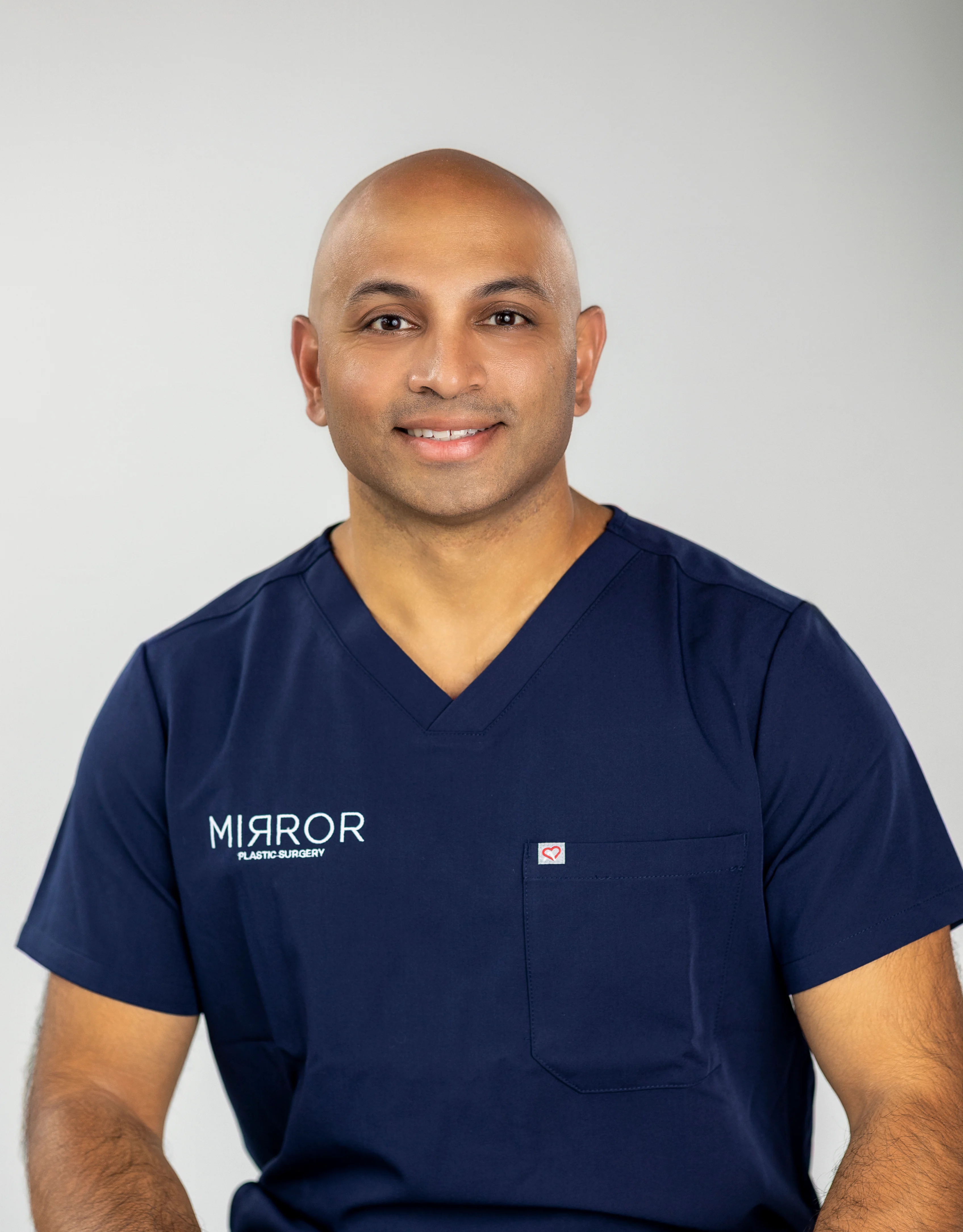
Dr. Akash serves on advisory boards for several companies developing injectable products, including Merz Aesthetics and Tiger Aesthetics. Mirror Plastic Surgery is a supplier-neutral practice, so product recommendations are driven by anatomy and evidence rather than brand relationships or quotas. The practice works with the full range of available fillers, including Juvéderm, Restylane, RHA, Versa, and others, and selects the product that fits the patient’s specific anatomy and concern.
The full-face philosophy at Mirror means the under-eye is never evaluated in isolation. The relationship between the tear trough, the midface, the orbital rim, and the surrounding skin is assessed as a system. Sometimes that assessment concludes that filler is the right answer. Sometimes it concludes that midface support is the better starting point. Sometimes it concludes that surgery is the only option that will address the cause. A surgeon-led consultation is how that determination gets made before any product is chosen.
*Disclaimer: Results may vary from person to person. Editorial content, before and after images, and patient testimonials do not constitute a guarantee of specific results.
1 Results may vary from person to person. Editorial content, before and after images, and patient testimonials do not constitute a guarantee of specific results.