
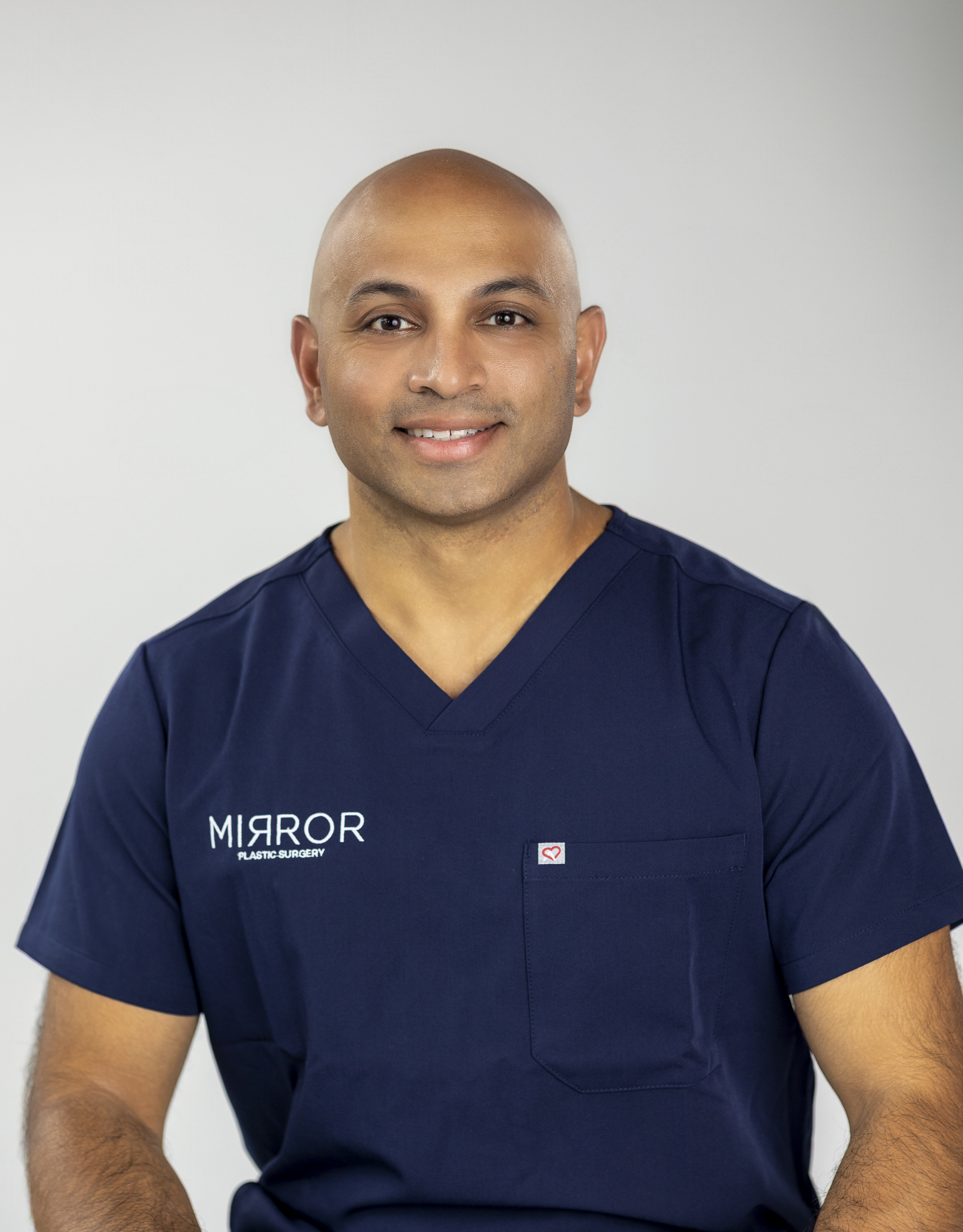
Written by: Dr. Akash Chandawarkar, Board Certified Plastic Surgeon, Mirror Plastic Surgery
Key Takeaways For Safe, Natural Lip Augmentation
- Safe lip augmentation relies on FDA-approved hyaluronic acid fillers, a board-certified plastic surgeon, a sterile setting, and on-site hyaluronidase.
- Provider credentials, including ABPS board certification, hospital privileges, and facial anatomy training, drive complication rates more than any specific technique.
- Patients should confirm FDA-approved HA products, a clear vascular occlusion protocol, and a thorough anatomical assessment before treatment.
- Technique patterns such as the Russian lip method carry similar risks to classic filler when an experienced injector selects the right patients and volumes.
For personalized, anatomy-based lip augmentation performed under strict safety standards, schedule a consultation at Mirror Plastic Surgery.
The Safety-First Care Model For Lip Augmentation
A safety-first care model starts well before any syringe is opened. It encompasses three elements: a personalized evaluation of anatomy, medical history, and aesthetic goals; evidence-based product selection; and a treatment hierarchy that places safety first, function second, and aesthetics third. This sequence reflects the clinical reality that a beautiful result that harms tissue health is not a good result.
Concierge-level practices differ from high-volume clinics by the depth of attention given to each patient. Where a high-volume practice may perform five to ten procedures daily, a concierge model limits daily volume to preserve undivided focus before, during, and after each treatment. Initial consultations often last up to an hour, which allows time for detailed anatomical assessment, honest discussion of risks and realistic outcomes, and trust-building that guides every later decision.
Mirror Plastic Surgery follows this philosophy in the Tampa Bay area, limiting surgical volume and dedicating extended consultation time so every lip augmentation plan reflects the patient’s unique anatomy rather than a template. See how a safety-first evaluation applies to your lips and facial structure.
Why Provider Credentials Are The Foundation Of Safe Lip Augmentation
There is no single federally mandated injector certification in the United States. The FDA approves filler products and regulates manufacturers, but it does not certify individual injectors. Legal authority to inject comes from state licensure, scope-of-practice law, and documented training. This structure places the responsibility for credential verification on the patient, and the stakes remain high.
The foundational credential to seek is board certification by the American Board of Plastic Surgery (ABPS). Board-certified practitioners maintain proper licensing, carry appropriate malpractice coverage, and follow facility standards that non-credentialed injectors may bypass. Board certification in plastic surgery also supports hospital privileges, which means that in the rare event of a serious complication, the surgeon can manage it in a hospital setting instead of sending the patient to an unfamiliar emergency team.
Dr. Akash is board certified by the American Board of Plastic Surgery and holds hospital privileges for this reason. His training includes undergraduate studies in neuroscience and nuclear engineering at MIT; a medical degree from Harvard Medical School, completed with Honors through the Harvard-MIT Division of Health Sciences and Technology; a seven-year integrated plastic and reconstructive surgery residency at Johns Hopkins University; and a fellowship in aesthetic surgery at the Manhattan Eye, Ear and Throat Hospital (MEETH)/Lenox Hill Hospital. He also completed the Stanford University Biodesign Innovation Fellowship, training in medical device development with engineers and clinicians.
Dr. Akash serves on the advisory board of Merz Aesthetics for biostimulatory fillers such as Radiesse, has testified before the U.S. Food and Drug Administration on breast implant safety, and has been recognized in America’s Best Plastic Surgeons 2025 by Newsweek for two consecutive years. These roles keep him in direct dialogue with the regulatory and scientific bodies that shape injectable safety standards. Verify Dr. Akash’s credentials and training firsthand at your consultation.
Key Concepts And Terminology Every Patient Should Know
Credentials tell you who is qualified to inject; terminology tells you what to ask once you are in the room. Understanding the language of lip augmentation enables patients to evaluate providers and ask the right questions. The following terms support an informed safety discussion.
Hyaluronic acid (HA) fillers are the most widely used lip augmentation products. The FDA classifies dermal fillers as medical devices and has approved specific HA formulations, including products in the Juvéderm and Restylane families, for lip augmentation in adults. FDA approval is product-specific and indication-specific, so approval for one formulation does not extend to other products in the same brand family.
Vascular occlusion is the most serious complication of lip filler injection. It occurs when filler enters or compresses a blood vessel and blocks blood flow to downstream tissue. Vascular occlusion occurs in roughly 1 in every 6,000 filler syringes, with some estimates ranging between 1 in 2,000 and 1 in 10,000 injections. It represents a time-critical emergency.
Hyaluronidase is the enzyme that dissolves HA filler. HA fillers are reversible because hyaluronidase breaks them down within minutes to hours, which is the primary reason HA remains the standard for lip augmentation. Permanent and semi-permanent fillers do not dissolve and carry a very different risk profile.
Cannula vs. needle refers to the instrument used to deliver filler. A blunt-tipped cannula displaces rather than pierces tissue, which lowers the risk of intravascular injection in certain planes. That benefit depends entirely on technique and plane selection, and arterial wall penetration and ischemic events remain possible with improper use. Needle technique remains standard for precise vermillion border work.
The Russian lip technique places a series of small filler deposits vertically from the inner lip toward the vermillion border. This pattern lifts the lip upward for height and a defined cupid’s bow instead of building outward for projection. It describes an injection pattern, while the filler product remains a separate decision, because FDA clearance covers the material and its indication rather than the injection pattern.
Lip anatomy and danger zones are critical knowledge for any injector. The superior and inferior labial arteries, which branch from the facial artery, supply the lips. Perioral venous mapping studies show that labial venous tributaries are consistently present but anatomically variable, with zones of venous accumulation overlapping common lip injection sites. This pattern makes the lips a true danger zone for intravascular filler placement. Anatomical knowledge of these structures forms the foundation of safe technique. Ask at your consultation how this anatomical mapping shapes your treatment plan.
How Safe Lip Augmentation Fits The 2026 Aesthetic Landscape
The terminology above sets the stage for understanding today’s regulatory and clinical environment. The landscape around lip augmentation has grown more complex. The FDA has issued warnings about unapproved versions of Juvederm, including Ultra 2, Ultra 3, and Ultra 4, being sold by online retailers, and has released a separate safety communication about serious adverse events with needle-free filler pens. Filler is a prescription device that licensed providers must purchase and administer.
The rise in filler procedures has driven a 1,700% increase in serious filler-related injuries between 2005 and 2020, a 30-fold jump in ischemic skin injuries, and a 300% increase in stroke reports. These figures reflect expanded access without matching growth in provider training standards.
Authoritative sources, including the FDA, the American Society of Plastic Surgeons, and The Aesthetic Society, consistently highlight provider credentials, FDA-approved HA fillers, sterile clinical settings, and complication management as the pillars of safe practice. Patients in 2026 increasingly prioritize natural-looking results and long-term lip health over short-lived trends. The Russian lip trend has raised legitimate questions about technique-specific safety that deserve clear, evidence-based answers.
The Lip Augmentation Safety Checklist: What To Evaluate Before You Commit
Patients can reduce risk by evaluating specific factors before choosing a provider or procedure:
- Provider credentials: Board certification by the American Board of Plastic Surgery or equivalent; documented facial anatomy training; hospital privileges; and verifiable membership in professional societies such as The Aesthetic Society, whose Active Membership is limited to board-certified plastic surgeons who devote a significant part of their practice to aesthetic surgery.
- Product selection: FDA-approved HA fillers only. Confirm the specific product and formulation. Avoid permanent fillers such as silicone and PMMA in the lips, as permanent fillers have a much narrower FDA approval, limited to nasolabial folds and cheek acne scars only.
- Clinical setting: Accredited facility, sterile environment, hyaluronidase on site, and a defined vascular occlusion protocol.
- Candidacy assessment: Full medical history review, including medications, allergies, history of cold sores, autoimmune conditions, and prior filler treatments.
- Technique discussion: Needle vs. cannula, injection planes, volume per session, and whether the proposed technique suits your specific anatomy.
- Expected outcomes: Realistic discussion of longevity, maintenance intervals, and what natural results look like on your anatomy instead of on a social media filter.
- Aftercare requirements: Written instructions, after-hours contact information, and clear guidance on warning signs that require immediate attention.
Of all the checklist items, two deserve direct questions during your visit: whether hyaluronidase is on site and what the provider’s vascular occlusion protocol includes. These questions reveal how prepared a practice is for an emergency, and a qualified provider answers both without hesitation.
Comparing Lip Augmentation Approaches: Options, Longevity, And Reversibility
The four main approaches to lip augmentation differ most clearly in FDA status, reversibility, and how long results last. The table below compares these methods so you can see how HA fillers stand out for reversibility and regulatory support.
| Approach | FDA Approval Status | Reversibility | Typical Longevity |
|---|---|---|---|
| FDA-Approved HA Fillers (e.g., Juvéderm, Restylane) | FDA-approved as medical devices for lip augmentation in adults | Fully reversible with hyaluronidase | Approximately 6–18 months depending on product and metabolism1 |
| Permanent Fillers (e.g., silicone, PMMA) | FDA approval limited to nasolabial folds and cheek acne scars only; not approved for lips | Not dissolvable or reversible | Permanent by design |
| Fat Transfer (Fat Grafting) | Surgical procedure using the patient’s own tissue; FDA filler warnings do not apply | No enzyme-based reversal method; considered non-reversible | Variable; studies report graft retention rates from 30% to 70%, with volume stabilizing after initial loss1 |
| Lip Lift Surgery | Surgical procedure outside the FDA dermal filler device pathway | Permanent tissue removal; revision may refine but not restore original anatomy | Long-lasting structural change with permanent repositioning; aging may still cause later drooping, and some patients seek touch-up after five or more years1 |
Within the HA filler category, technique variations include traditional lip filler, which builds volume and projection along the lip body, and the Russian lip technique, which uses vertical microdroplet placement to lift the cupid’s bow and create a heart-shaped silhouette. The Russian technique uses the same class of HA fillers as classic lip augmentation, and its risk profile reflects the injector’s anatomy training. More injection points create more entry sites, which increases the chance of bruising, while the injector’s skill remains the key safety variable.
HA fillers generally offer the safest starting point for lip augmentation because they are reversible with hyaluronidase and carry FDA approval for this use. Mirror Plastic Surgery offers HA fillers and lip lift surgery, and Dr. Akash matches each approach to the patient’s anatomy and goals.
Risks, Limitations, And Common Misconceptions
Several persistent misconceptions about lip filler safety deserve clear explanation.
Misconception: Lip fillers are risk-free. Normal side effects include swelling that peaks at 24–72 hours, bruising, redness, tenderness, and transient asymmetry1. True complications are uncommon, occurring in fewer than 1 in 100 cases1, but they require prompt medical attention when they appear.
Misconception: Any provider can safely inject lips. The single most important factor in preventing dermal filler complications is provider experience and anatomical knowledge, especially knowledge of facial vascular anatomy and appropriate injection technique.
Misconception: The Russian lip technique is inherently unsafe. Serious complications remain rare, and overfilling and migration represent preventable technique-related problems that depend on volume, placement, and injector skill.
Misconception: Fillers always cause sagging. The “duck lips” or “sausage lips” silhouette usually stems from over-volumization across multiple sessions without dissolving old product, injection that crosses the vermillion border into the white roll, or product migration from too much filler placed too superficially. Conservative, anatomy-based injection supports natural-looking results.
The warning signs of a vascular complication require immediate action. Classic evolving signs of vascular occlusion include immediate blanching (white discoloration), followed by reticulate bluish-purple discoloration called livedo reticularis, pain, and in severe cases skin darkening that signals impending necrosis. Any vision change after filler injection requires immediate emergency evaluation.
A critical clinical nuance involves venous events. A 2026 case report published in Cureus by Olivares et al. describes venous outflow obstruction of the lips presenting with rapid edema, violaceous or bluish congestion, preserved capillary refill, and mild-to-moderate pressure-like pain, a pattern that may be mistaken for post-procedural edema or hematoma. Both patients received 1,500 IU of hyaluronidase with complete resolution and no tissue loss. A separate 2026 Cureus case report by Rasheed et al. showed that ultrasound-guided hyaluronidase administration, after confirming occlusion of the left angular and superior labial arteries, produced immediate restoration of vascular flow and full healing at one-month follow-up.
Mirror Plastic Surgery’s safety-first philosophy and Dr. Akash’s anatomical training aim to minimize these risks through careful patient selection, conservative volume, and a defined emergency protocol. Ask about hyaluronidase availability and emergency protocols during your visit.
Frequently Asked Questions
What Is The Safest Type Of Lip Filler?
FDA-approved hyaluronic acid (HA) fillers are the standard of care for lip augmentation and are widely considered the safest option for this indication. Their main safety advantage is reversibility, because hyaluronidase can dissolve HA filler within minutes to hours and allows rapid management of vascular complications or unwanted results. Juvéderm Volbella and Restylane Kysse are HA dermal fillers commonly used for lips, with Volbella a soft, low-G-prime gel and Kysse a flexible gel formulated to retain shape in motion, which matters in tissue that moves constantly during speaking and eating. Permanent fillers, including silicone and PMMA, are not FDA-approved for lip use and are not reversible, which makes them a higher-risk choice in this area. The safest filler remains an FDA-approved HA product administered by a board-certified physician with documented lip-specific training and hyaluronidase on site.
Is The Russian Lip Technique Safe?
The Russian lip technique is a vertical microdroplet injection pattern that lifts the cupid’s bow and creates a heart-shaped silhouette. It uses the same class of FDA-approved HA fillers as traditional lip augmentation and carries a similar baseline risk when performed correctly. The technique involves more injection points and works closer to the vermillion border, a more superficial and more vascular area, which typically produces greater swelling and a slightly higher likelihood of bruising. Safety depends on the injector’s anatomical expertise. In suitable anatomy and in the hands of a provider with deep knowledge of labial artery and venous anatomy, the Russian technique can produce natural, lifted results. It suits patients seeking more vertical height rather than those whose main concern is projection, and it is less appropriate for very thin lip tissue where superficial product becomes more visible.
How Do I Verify A Lip Filler Provider’s Credentials?
Credential verification requires active research beyond a provider’s self-reported biography. Use the following checklist:
- Confirm board certification through the American Board of Plastic Surgery’s public verification tool or an equivalent recognized board such as dermatology or facial plastic surgery.
- Verify facial anatomy training, including residency program, fellowship training, and any documented aesthetic surgery specialization beyond standard residency.
- Ask clearly about emergency protocols: whether hyaluronidase is on site at every appointment, what the vascular occlusion protocol includes, and how the provider can be reached after hours.
- Confirm hospital privileges at an accredited facility, which indicates that the provider’s credentials have passed independent institutional review.
- Review before-and-after galleries for cases similar to your own and look for consistent, natural-looking results across many patients.
- Research the provider through your state medical board’s public database to confirm licensure and check for disciplinary history.
- Verify membership in professional societies such as The Aesthetic Society, whose Active Membership is limited to board-certified plastic surgeons with a demonstrated commitment to aesthetic surgery.
Red flags include pricing far below local norms, skipping a thorough consultation, dismissing questions about credentials, and pressuring immediate treatment without proper assessment.
What Are The Warning Signs Of A Lip Filler Complication?
Warning signs that require immediate contact with the treating provider, or emergency care if the provider is unreachable, include:
- Severe pain disproportionate to the procedure, or pain that worsens after 48 hours
- White blanching or pale patches on the skin, which often signal arterial occlusion
- Dusky, mottled, or bluish-purple skin discoloration in a livedo reticularis pattern
- Cold skin on or around the lips
- Any change in vision, including blurring, double vision, or loss of vision, which requires immediate emergency department evaluation
- Fever, spreading warmth, pus, or swollen lymph nodes, which suggest infection
- A hard lump not improving after 7–10 days, or new nodules appearing 2–4 weeks after injection
- Filler migration visibly beyond the lip border
Normal post-procedure swelling peaks at 24–72 hours and begins to subside by day four. Any presentation that worsens after day three warrants clinical evaluation. Vascular occlusion is time-critical, and outcomes depend on how quickly treatment begins.
How Should I Care For My Lips After Filler To Support Safe Healing?
Standard aftercare for lip filler includes these steps:
- Apply a wrapped cold compress in 10-minute intervals during the first 24–48 hours to reduce swelling.
- Sleep with the head elevated on two pillows for the first few nights.
- Avoid strenuous exercise, saunas, and hot showers for 48–72 hours, because heat increases swelling and bruising.
- Avoid straws or vigorous mouth movement for 24–48 hours.
- Avoid blood-thinning medications, alcohol, and excess caffeine in the days following treatment, unless a prescribing physician advises otherwise.
- Stay well hydrated, aiming for roughly 64 ounces of water daily.
- Do not massage or apply heat to the treated area without provider guidance.
- Contact the provider immediately if severe pain, color changes, cold skin, or any vision changes occur.
Can Lip Fillers Cause Sagging?
Sagging or an unnatural appearance after lip filler almost always reflects technique and planning rather than the filler material itself. As noted earlier, sagging tends to arise from over-volumization across multiple sessions without dissolving old product, border-crossing injection, and superficial placement that encourages migration. Conservative volume, correct anatomical placement, and an injector who tracks cumulative filler load across sessions provide the main safeguards. Patients who space maintenance treatments and work with a provider who monitors long-term tissue response have a much lower chance of migration or an unnatural look.
What Should I Ask During A Lip Augmentation Consultation To Ensure Safety?
A safety-focused consultation should include direct questions on these topics:
- Which specific FDA-approved product will be used, and what volume is planned?
- What is your board certification, and how can I verify it independently?
- Do you have hyaluronidase on site, and what is your vascular occlusion protocol?
- How many lip augmentation procedures have you performed, and can I see before-and-after examples for cases similar to mine?
- Do you have hospital privileges in the event of a rare serious complication?
- How can I reach you after hours if I have concerns?
- Based on my anatomy, which technique and volume do you recommend, and why?
A qualified provider welcomes these questions and answers them clearly.
Conclusion: Making A Safe, Informed Decision About Lip Augmentation
Safe lip augmentation depends on the provider’s anatomical expertise, the regulatory status of the materials, the clinical environment, and a clear emergency protocol. Patients who understand these variables can evaluate any provider with confidence and recognize when a practice does not meet the standard.
The decision to pursue lip augmentation deserves the same rigor as any medical procedure, including thorough research, realistic expectations, and a provider whose credentials can be independently verified. In the Tampa Bay area, Mirror Plastic Surgery and Dr. Akash offer a safety-first standard built on elite academic training, board certification, hospital privileges, and a concierge philosophy that prioritizes each patient’s anatomy and long-term well-being.
Get a personalized, anatomy-based lip augmentation plan at Mirror Plastic Surgery.
Take The Next Step With Mirror Plastic Surgery
Mirror Plastic Surgery is located at 780 4th Ave S, St. Petersburg, FL 33701. Patients in the Tampa Bay area can call or text 727-361-6515 or email hello@mirrorplasticsurgery.com to schedule. Schedule your lip augmentation consultation with Dr. Akash.
1 Results may vary from person to person. Editorial content, before and after images, and patient testimonials do not constitute a guarantee of specific results.