
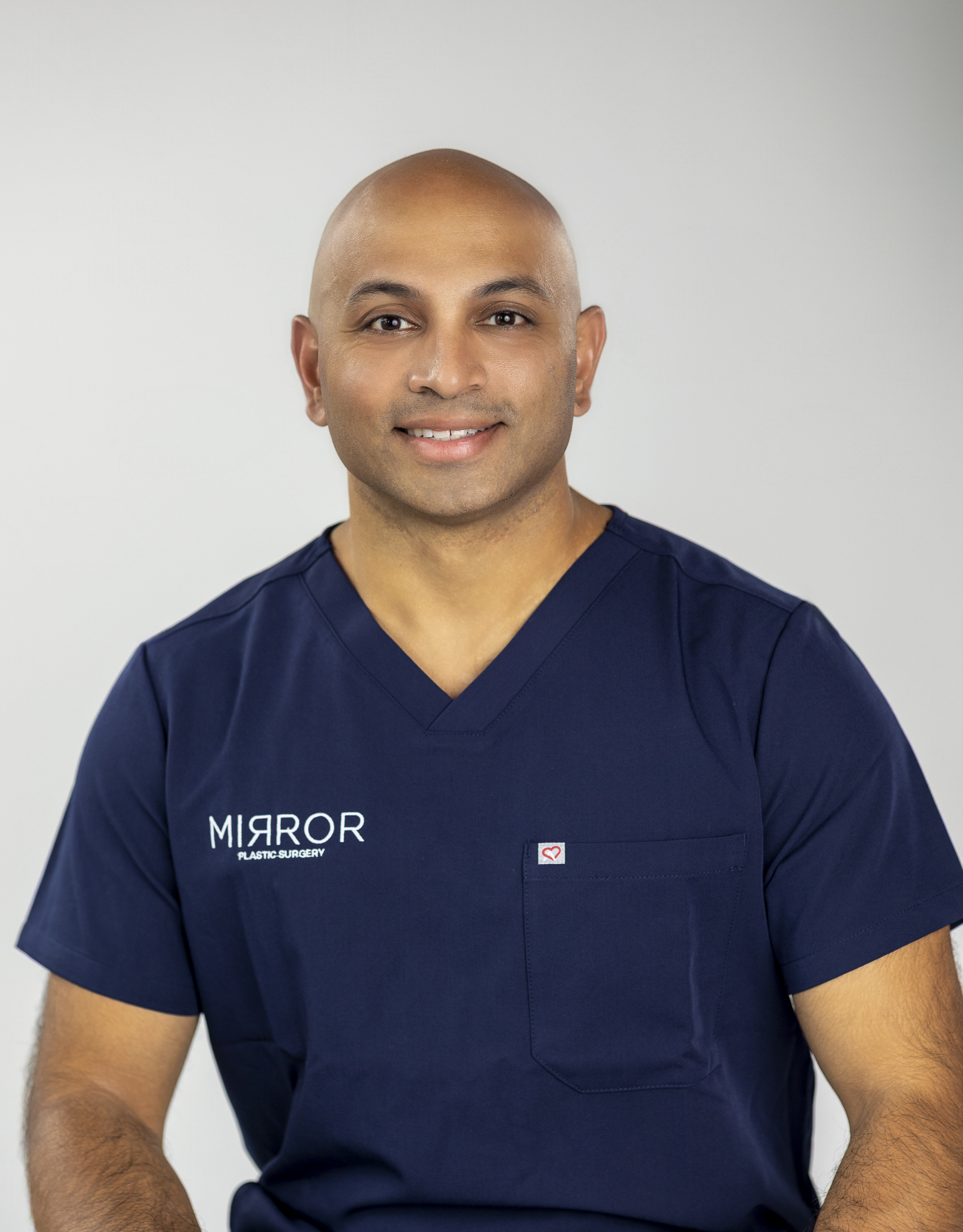
Written by: Dr. Akash Chandawarkar, Board Certified Plastic Surgeon, Mirror Plastic Surgery
Key Takeaways
- Brachioplasty incision placement is the key pre-operative decision because it drives scar visibility in daily life.
- Surgeons look at skin laxity, tissue volume, arm shape, clothing habits, and nerve anatomy together before choosing a placement.
- Five primary incision types exist: medial, posterior, posteromedial, short-scar axillary, and extended, each with specific visibility trade-offs.
- Recent comparative data suggests posteromedial placement often has the most favorable overall visibility profile, while medial placement hides well from the front and side with arms down.1
- Patients considering brachioplasty can schedule a personalized consultation at Mirror Plastic Surgery to match incision options to their anatomy and lifestyle.
How Thoughtful Surgeons Approach Brachioplasty Planning
A high-quality brachioplasty consultation starts with an in-depth assessment of skin laxity pattern, tissue volume, arm shape, and the patient’s clothing and lifestyle priorities before any incision is marked. Pre-operative markings occur with the patient standing upright so gravity’s effect on tissue is fully visible. This approach reflects the true distribution of excess skin instead of the flattened appearance seen when lying down.
Mirror Plastic Surgery operates on a concierge medicine model, limiting surgical volume to one to two procedures per day. That limit exists so the surgical team can give each patient full attention before, during, and after the procedure, which contrasts with high-volume settings where five to ten surgeries may be performed daily. The same priority order governs every stage of planning and execution: safety first, function second, aesthetics third.
Incision placement is determined by the intersection of anatomical findings and patient priorities, not chosen from a fixed menu. The consultation maps the arm as a three-dimensional structure and aligns scar location with how the patient lives, dresses, and moves.
That anatomy-first, patient-centered planning style reflects the training and research background of the surgeon who leads the practice.
Clinical Perspective: How Dr. Akash’s Background Shapes Planning
Mirror Plastic Surgery is led by Dr. Akash, a Harvard-educated physician and Johns Hopkins-trained plastic surgeon who completed an aesthetic surgery fellowship at the Manhattan Eye, Ear and Throat Hospital (MEETH) and a Biodesign Innovation Fellowship at Stanford University. He is board certified by the American Board of Plastic Surgery and has been named in America’s Best Plastic Surgeons 2025 by Newsweek for two consecutive years.
Dr. Akash serves as Next Generation Editor at the Aesthetic Surgery Journal and leads research on objective aesthetic analysis using artificial intelligence. That work informs his approach to anatomical decision-making in body contouring and scar planning. His practice is located in St. Petersburg, Florida, serving the Tampa Bay area and patients traveling nationally.
Key Concepts and Terminology for Brachioplasty Incision Placement
Clear definitions help patients follow their surgeon’s recommendations and sort through information they encounter during research.
- Brachioplasty: Arm lift surgery that removes excess skin and tissue from the upper arm.
- Incision placement: The specific anatomical location where the surgeon creates the surgical cut.
- Medial bicipital groove: The natural depression on the inner arm between the biceps and triceps muscles, and the most common landmark for standard brachioplasty incision placement.
- Posterior brachial sulcus: The groove along the back of the upper arm, used in posterior incision placement.
- Posteromedial incision: A placement between the inner and back surfaces of the arm that blends medial and posterior positions.
- Short-scar (axillary) brachioplasty: A mini arm lift with the incision confined to the armpit crease, appropriate only for mild laxity near the axilla.
- Extended brachioplasty: An incision that continues from the arm onto the lateral chest wall, used when laxity extends beyond the arm after significant weight loss.
- Sinusoidal (wavy) closure: A closure technique using a wavy rather than straight line to distribute tension across a broader surface, which may reduce scar contracture and widening.
Scar location and scar appearance describe different things. Location refers to where on the arm the incision sits. Appearance refers to how the scar looks as it matures, which depends on closure technique and healing biology. A mini brachioplasty scar is shorter and confined to the axilla, while a full brachioplasty scar extends along the arm, and each fits a different laxity pattern.
With those terms defined, it helps to see how surgeons and patients have evaluated these placements in practice.
How Brachioplasty Incision Placement Fits the Current Evidence
Patient-preference research has examined whether patients favor medial or posterior scar placement. A PubMed-indexed survey evaluation of optimal brachioplasty scar placement found that patients generally favored a straight medial scar over a straight posterior scar.
More recently, findings presented at the 13th National Congress of the Italian Association of Plastic Aesthetic Surgery (AICPE) in Rome and published in Surgical Techniques Development, 2026 compared three placement strategies: posterior, medial bicipital groove, and posteromedial transitional. Posteromedial transitional placement showed the most favorable visibility outcomes, and posterior scars were rated more often as highly visible at six months than either medial or posteromedial placements.1
Modern approaches emphasize individualized marking based on anatomical landmarks, nerve protection, and the patient’s specific laxity pattern. The field now favors anatomy-grounded design decisions made collaboratively during consultation.
Discuss which incision placement fits your anatomy during a dedicated consultation.
Main Decision Factors: What Determines Your Incision Placement
Several patient-specific variables together determine which incision placement makes sense. The surgeon weighs each factor during the pre-operative assessment.
- Skin laxity pattern: Where excess skin concentrates, such as near the axilla, along the full arm, or extending to the chest wall, guides which technique can achieve adequate correction.
- Tissue volume: Whether the main issue is skin excess, fat excess, or both influences whether liposuction occurs first and how much skin must be removed.
- Arm shape: The natural contour and how tissue shifts with arms raised versus lowered affect where tension will concentrate along the closure.
- Visibility trade-offs: Hiding the scar with arms down and minimizing visibility from behind often compete, so the plan reflects which view matters more to the patient.
- Clothing habits: Patients who frequently wear sleeveless clothing or raise their arms overhead in professional, athletic, or social settings have different visibility priorities than those who rarely do.
- Nerve safety: Protection of the medial brachial and antebrachial cutaneous nerves, which supply sensation to the inner arm and forearm, sets limits on dissection depth and incision placement.
- Scar maturation expectations: Aljerian et al., Plastic and Reconstructive Surgery, 2022 found pathological scarring in 9.9% of brachioplasty patients, the most common complication, which highlights how placement, closure technique, and healing biology shape scar quality over a 12–18 month maturation period.1
The Five Brachioplasty Incision Types: A Structured Overview
The five incision types differ most in one practical way: how visible the scar is when your arms are down versus raised. The table below compares each option on that dimension so you can see which placements trade front-view concealment for rear-view concealment.
A scenario-based framework helps map laxity pattern to technique:
- Mild axillary laxity: Short-scar axillary brachioplasty with an incision confined to the armpit crease, which offers limited correction when laxity does not extend down the arm.
- Moderate to significant laxity along the arm: Medial or posteromedial brachioplasty with an incision that runs from the axilla toward the elbow along the inner or transitional surface.
- Massive weight loss with chest wall involvement: Extended brachioplasty with an incision that continues onto the lateral chest wall to address the axillary roll as one continuous contour unit.
Closure technique also affects final scar quality. A sinusoidal (wavy) closure distributes tension across a wavy line rather than concentrating it along a straight line, which may reduce the risk of scar widening and contracture. This approach is particularly relevant along the inner arm, where mechanical tension activates pro-fibrotic pathways and suppresses myofibroblast apoptosis, making scars more prone to thickening near mobile joints.
Schedule a scar-planning consultation to determine which incision type and closure approach align with your anatomy, laxity pattern, and daily life.
Risks, Limitations, and Misconceptions About Brachioplasty Scars
Several misconceptions circulate among patients researching brachioplasty incision placement. Many people expect the scar to be completely hidden, yet a virtually invisible scar should not be promised in brachioplasty. More skin removal requires a longer scar, and arm scars remain permanent to some degree even after fading and softening.
Another misconception is that all surgeons place the incision the same way. In reality, placement varies by technique, laxity pattern, and surgeon judgment. Some patients also assume a wavy scar is always worse than a straight one, when sinusoidal closure is a deliberate technique choice with a documented rationale for tension distribution.
Nerve safety deserves specific attention. The medial brachial cutaneous nerve supplies sensation to the inner upper arm. The medial antebrachial cutaneous nerve supplies sensation to the inner forearm, and its course runs alongside the basilic vein through the brachioplasty field. High-resolution ultrasound anatomy confirms the medial antebrachial cutaneous nerve courses within the brachial fascia alongside the basilic vein, which makes the basilic vein a reliable landmark for anatomy-aware dissection.
Temporary numbness or tingling along the inner arm and forearm is common after brachioplasty and typically resolves over months.1 The same Aljerian et al. study cited earlier also found nerve-related events in approximately 2.47% of brachioplasty patients, which occurs less often than scarring or wound-healing issues but still matters for counseling.1
Additional honest trade-offs include:
- Visibility from behind often persists to some degree regardless of incision placement.
- Scars often look worse at 3–6 months before improving, as redness and firmness peak during the proliferative phase before the remodeling phase begins.1
- Full scar maturation takes 12–18 months; a one-year scar is typically flat, pale pink to silver, and 2–4 mm in width when healing has proceeded without complications.1
- More skin removal generally requires a longer scar, so correction and scar length are directly linked.
For more detail on what to expect after surgery, see Natural Brachioplasty Results: Timeline & What to Expect and Brachioplasty Risks: What You Need to Know.
Frequently Asked Questions About Brachioplasty Incision Placement
These are the questions patients most often raise when they weigh different incision options and visibility trade-offs.
Where Is the Brachioplasty Scar Typically Placed?
The most common placement runs along the inner arm in the medial bicipital groove, the natural depression between the biceps and triceps muscles, extending from the armpit toward the elbow. This location keeps the scar out of view from the front and side when arms rest at the sides of the body. The exact length depends on how much skin must be removed to achieve adequate correction.
How Visible Is a Brachioplasty Scar With Arms Down Versus Raised?
With arms down, a medial incision is typically hidden from front and side views, and the scar becomes visible when arms are raised overhead. Posterior placements offer different trade-offs and are often less visible from the front but visible from behind even with arms at rest. Posteromedial placement represents a middle ground that, as noted above, showed the most favorable visibility outcomes across arm positions in recent comparative data.
What Is a Mini Brachioplasty or Short-Scar Arm Lift?
A mini brachioplasty confines the incision to the armpit crease and fits mild skin laxity concentrated near the axilla in the upper third of the arm. It offers limited correction and does not suit significant skin excess extending down the arm. Choosing a shorter incision when laxity is more extensive produces an incomplete result because the lower arm remains unchanged while the upper arm is tightened, which creates an abrupt transition.
How Long Does a Brachioplasty Scar Take to Heal?
Initial wound closure after brachioplasty typically occurs over 2–4 weeks, though in post-bariatric patients who do not require surgical intervention the average time to wound closure or epithelialization can be longer, at 34 ± 21.28 days. The scar then matures through a proliferative phase (months 1–3, during which it is typically at its most raised and red) and a remodeling phase (months 3–18, during which collagen reorganizes and the scar softens, flattens, and fades). As noted earlier, final maturation occurs at 12–18 months.
Can the Scar Be Placed So It Is Hidden From Behind?
A purely medial incision along the bicipital groove is generally not visible from behind when arms are at rest. A posterior or posteromedial placement may be visible from behind depending on arm position and clothing. The trade-off between front-view and rear-view concealment is a key discussion point during consultation, and the right balance depends on how the patient uses their arms in daily life.
Conclusion: Making an Informed Decision About Your Brachioplasty Incision
Brachioplasty incision placement is a deliberate design decision that shapes the final result. Where the scar goes is determined by skin laxity pattern, tissue volume, arm shape, visibility priorities, nerve anatomy, and closure technique, all weighed together during a thorough pre-operative assessment. Understanding these variables before surgery supports realistic expectations and better-aligned outcomes.
The right placement is the one that fits a specific patient’s body and life, which is why surgeons evaluate each case individually. For a detailed look at how results evolve over time, see Brachioplasty Before and After: Results & Scars.
Reserve a consultation to review your options and have your arm anatomy evaluated in detail.
Next Step: Schedule Your Brachioplasty Consultation
Mirror Plastic Surgery is located at 780 4th Ave S, St. Petersburg, FL 33701, serving the Tampa Bay area and patients traveling from across the country. Call or text 727-361-6515 to secure an appointment. Map your incision options during a consultation and bring your questions about incision placement, scar visibility, and the planning process for your specific anatomy.
1 Results may vary from person to person. Editorial content, before and after images, and patient testimonials do not constitute a guarantee of specific results.