
Written by: Ellie Pranckevicius, FNP-BC, Aesthetic Nurse Practitioner & Aesthetic Injector | Facial Restoration & Regenerative Injectable Specialist, Mirror Plastic Surgery
Key Takeaways from Mirror’s Concierge Approach
- Concierge medical spa services at Mirror replace high-volume clinic models with extended, physician-overseen appointments that prioritize safety and individualized treatment planning over speed.
- Mirror Plastic Surgery limits daily procedures to one or two so the clinical team can stay focused on each patient before, during, and after treatment.
- Injectable services are led by Ellie Pranckevicius, FNP-BC, whose dual background as a licensed esthetician and board-certified family nurse practitioner brings layered anatomical insight to every injection.
- Every new patient begins with a comprehensive top-to-bottom assessment, allowing time for detailed medical history review, physical examination, and psychological screening before any treatment is scheduled.
- Patients in the St. Petersburg and Tampa area seeking personalized, safety-first aesthetic care can schedule a consultation at Mirror Plastic Surgery to start a relationship-based treatment journey.
How Concierge Aesthetic Care Works in Practice
Concierge medicine in aesthetics shifts the clinical incentive away from units of product per hour and toward an ongoing patient relationship. In this model, treatment plans grow from a full medical assessment of health history, medications, anatomy, and goals rather than a quick selection from a preset service menu. This structure allows the provider to recommend waiting, doing less, or addressing a different concern when that choice better serves the patient.
Mirror Plastic Surgery follows a safety-function-aesthetics hierarchy. Patient well-being comes first, functional considerations come second, and cosmetic outcomes come third. This sequence is supported by a low-volume schedule that keeps the team focused on each individual patient throughout the entire treatment process.
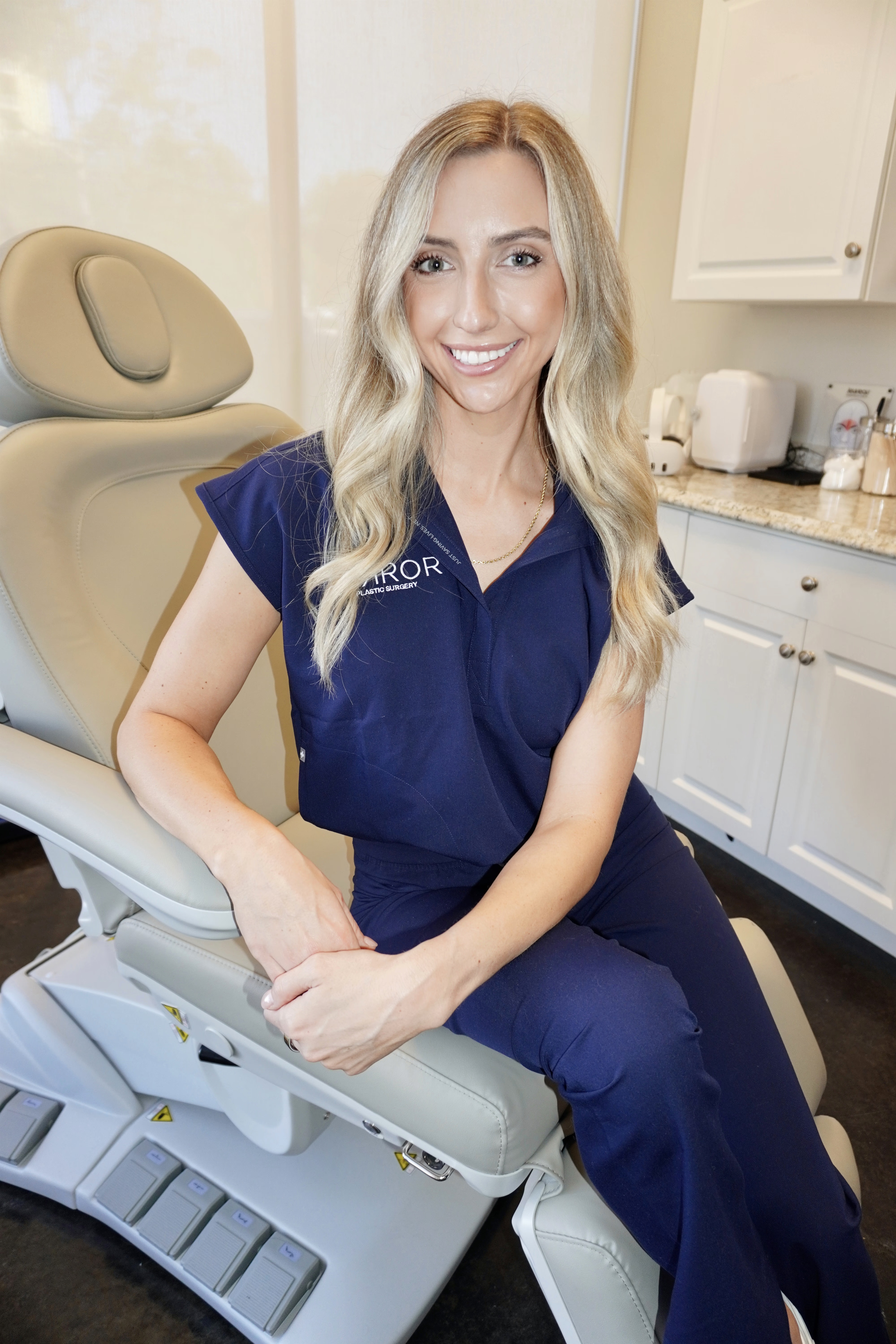
Non-surgical injectable services at Mirror are led by Ellie Pranckevicius, FNP-BC, whose career path is uncommon in the field. Ellie holds a Bachelor’s in Health Science from Boston University, completed a 600-hour aesthetics licensure program, and earned both her Bachelor’s and Master’s in Nursing from the University of South Florida. Four years in the Neuroscience ICU at Tampa General Hospital sharpened her clinical judgment and physiological understanding before she transitioned fully into aesthetic medicine. That dual background as a licensed esthetician and board-certified family nurse practitioner gives her a layered understanding of skin physiology and subdermal anatomy that guides every injection decision.
Surgical oversight comes from Dr. Akash Chandawarkar, MD, a Harvard-educated physician, Johns Hopkins-trained plastic surgeon, MEETH/Lenox Hill Hospital fellowship-trained aesthetic surgeon, and medical innovation trainee at Stanford University. Physicians with genuine aesthetics experience and active oversight responsibilities represent the preferred standard for compliant physician-led practices in 2026. Dr. Akash’s credentials and hands-on involvement set the standard of care across every service Mirror offers.
Step-by-Step Treatment Planning at Mirror Plastic Surgery
Every new patient relationship at Mirror starts with a comprehensive top-to-bottom assessment rather than a quick treatment visit. A professional aesthetic consultation of this length allows time for thorough medical history review, physical tissue examination, and psychological screening, which short appointments cannot support.
During the assessment, Ellie explores the emotional drivers behind a patient’s interest in treatment, not only the visible concern. Practitioners ask patients “why now?” to reveal true motivations and avoid treating temporary emotional states with long-term physical changes. That conversation shapes the treatment plan that follows.
Ellie’s facial approach is holistic and sequential. She focuses first on restoring inherent facial characteristics by addressing volume loss, structural asymmetry, and skin quality. Only after those foundations are addressed does she consider augmentation. This order reduces the risk of a disjointed or overdone appearance that can result from isolated single-area injections.
Neuromodulators and dermal fillers come from a supplier-neutral portfolio that includes Botox, Dysport, Xeomin, Daxxify, Juvederm, RHA, Versa, Restylane, Radiesse, and Evolysse, among others. Product choice is driven by individual anatomy and treatment goals rather than brand agreements or quotas.
For patients interested in body contouring, Ellie offers a non-surgical Brazilian Butt Lift using biostimulatory fillers, specifically Radiesse and AlloClae. This approach refines shape, reduces the appearance of cellulite and stretch marks, and addresses concerns such as hip dips.1 Each plan reflects whether the patient wants significant volume, subtle enhancement, or structural correction.
Book a consultation with Ellie to begin a top-to-bottom assessment and receive a personalized, evidence-based treatment plan.
Regulatory Standards and Patient Expectations in 2026
A robust medical spa compliance system in 2026 includes signed clinical protocols, standing orders, delegation matrices, good-faith exam records, chart-review logs, training and credentialing records, and adverse-event logs to demonstrate genuine physician oversight rather than nominal supervision. Florida med spa services fall under the Florida Board of Medicine through Florida Statute Chapter 458.
In most states, patients must complete an initial good-faith exam, in person or via live video, with a physician, nurse practitioner, or physician assistant before most regulated medical aesthetic treatments. This exam screens the patient, establishes the clinical indication, and authorizes the specific treatment, which converts delegated procedures from unlicensed practice into lawful care.
Alongside regulatory tightening, patient preferences now favor personalization. A McKinsey & Company report found that 71% of consumers expect personalized interactions and 76% become frustrated when they do not receive them, with that frustration in aesthetics often pushing patients to switch providers. Providers also report higher client satisfaction with combination treatment programs, and many patients feel the results justify the greater investment.
How to Evaluate a Concierge Aesthetic Provider
Patients evaluating concierge med-spa services can use a simple sequence of checks to understand how a practice truly operates. Start with consultation length, then look at daily volume, product selection, long-term planning, and provider continuity.
Consultation length sets the foundation. Five minutes rarely allows a new patient enough time to cover suitability, health history, timing, expectations, risks, consent, aftercare, and accountability with the practitioner. Longer visits create space for that level of review.
That extended time only becomes meaningful when daily procedure volume stays low. Practices that perform five to ten procedures per day spread clinical attention across many patients at once, while a one-to-two-procedure-per-day model concentrates focus on the individual.
Once you confirm the provider has time to focus, examine their product selection criteria. Supplier-neutral practices choose products based on patient anatomy and evidence. Practices tied to a narrow brand portfolio may recommend what is available rather than what best fits the patient.
Next, consider long-term planning. Concierge aesthetic consultations often run 45 to 90 minutes, with the first appointment focused on assessment only and no treatment performed, which reflects a more conservative philosophy than high-volume models. This structure supports staged plans instead of one-off transactions.
Finally, look at provider continuity. Concierge care keeps patients with the same provider rather than rotating injectors, which supports consistent interpretation of history and anatomy over time. That continuity strengthens both safety and aesthetic consistency.
Risks, Psychological Screening, and Tradeoffs
A 2024 meta-analysis of 65 studies reports an 18.6% prevalence of body dysmorphic disorder among patients in aesthetic and reconstructive plastic surgery settings. These findings support routine BDD screening with validated tools such as the BDDQ or COPS during consultations. Mirror’s extended assessment format creates the time needed to identify psychological contraindications that shorter appointments often miss.
Aesthetic treatment should proceed only after a written plan is provided and the patient is confirmed to be fully informed, physically and psychologically suitable, optimized, and able to access postoperative surveillance. Ellie’s approach includes advising patients when a requested procedure is not yet necessary, which builds long-term trust but conflicts with volume-driven revenue models.
The primary tradeoff in concierge care involves availability. Limiting daily volume naturally reduces the number of appointment slots. For patients who have experienced rushed consultations and upselling pressure, that constraint feels like a benefit rather than a drawback.
Common Misconceptions About Concierge Med-Spas
Many people assume concierge med-spa care simply costs more than standard treatment without offering structural differences. In reality, the distinction lies in how the practice is built. Standard med-spa appointments focus on throughput, with short consultations, frequent room turnover, and financial models that depend on units of product injected per hour, which creates pressure for each visit to convert to treatment. Concierge structures reduce that pressure by compensating the provider for the relationship instead of the volume of product.
A second misconception suggests that rotating injectors deliver equivalent outcomes as long as each holds a valid license. High provider turnover often leads to inconsistent interpretation of patient history and disjointed treatment plans, while concierge practices maintain detailed records of product type, batch number, placement location, and patient responses to support continuity. Anatomical knowledge accumulated across multiple visits with the same provider rarely transfers fully through chart notes alone.
Book a consultation with Ellie to experience how a single, consistent, anatomically informed provider can guide your treatment journey.
Concierge vs High-Volume: How Structure Shapes Your Experience
The table below illustrates how Mirror’s structural commitments, including limited daily volume, extended consultation time, and supplier-neutral product selection, create measurably different patient experiences across four core dimensions of care quality.
| Factor | High-Volume Med Spa | Mirror Plastic Surgery (Concierge) |
|---|---|---|
| Consultation Length | Short consultation times per appointment slot | Up to 60 minutes, with a top-to-bottom assessment covering anatomy, health history, and emotional drivers |
| Daily Procedure Volume | 5–10 or more procedures per day across rotating providers | 1–2 procedures per day, with full team focus on each patient before, during, and after treatment |
| Product Selection Criteria | Standardized protocols and preset menus, with standard unit placement regardless of individual anatomy | Supplier-neutral, with product chosen by anatomy, skin quality, and evidence, not brand agreements or quotas |
| Long-Term Planning | Isolated transactions, with revenue tied to appointment volume and product units per visit | Relationship-based care, where the provider may recommend waiting, doing less, or a different approach when that better serves long-term goals |
FAQ
Is concierge med-spa care worth the cost?
For patients who have experienced rushed appointments, upselling pressure, or results that required correction, concierge care often changes the value equation. Longer assessments reduce the likelihood of needing corrective treatment by identifying contraindications, screening for psychological suitability, and matching products to the individual’s anatomy before any procedure begins.1 Patients who return to the same provider over multiple visits also build a cumulative anatomical record that improves the precision of each subsequent treatment.1 In many cases, the cost of a single corrective procedure exceeds the premium associated with a more thorough initial consultation.
What is the difference between a med spa and concierge medicine?
A traditional med spa is organized around a defined service menu delivered in a retail-style setting, with appointments structured for throughput and revenue tied to product volume. Concierge medicine in aesthetics replaces that model with a provider-guided relationship in which the same qualified clinician conducts the assessment, develops the plan, performs the procedure, and follows up over time. Treatment decisions come from a full medical assessment rather than a quick menu selection, and the provider retains the clinical authority to recommend no treatment when that outcome best serves the patient. Mirror Plastic Surgery applies this model to both surgical and non-surgical services, with Ellie Pranckevicius leading injectable care and Dr. Akash Chandawarkar providing surgical and oversight expertise.
How does Ellie’s background as both an esthetician and a nurse practitioner affect treatment outcomes?
Most injectors enter aesthetic medicine from either a clinical nursing background or an esthetics background, but rarely both. Ellie’s 600-hour esthetics licensure program gave her a detailed understanding of skin physiology, texture, and surface anatomy before she pursued her nursing degrees and four years in a Neuroscience ICU. That combination means she evaluates a patient’s skin the way an esthetician would, assessing barrier function, texture, and surface quality, while also applying the clinical judgment of a board-certified family nurse practitioner who has managed critically ill patients. The result is a more complete picture of what a patient’s skin needs and why, which informs both product selection and injection technique.
What should I expect during my first appointment at Mirror Plastic Surgery?
The first appointment functions as a comprehensive assessment rather than a treatment session. Ellie reviews your health history, current medications, prior procedures, and skincare regimen, then conducts a physical examination of your facial anatomy at rest and in motion. She asks about your goals and the emotional reasons behind your interest in treatment and explains her clinical observations in plain language. If a treatment plan makes sense, she outlines the rationale for each recommended product or procedure, including realistic timelines and maintenance expectations. If a requested procedure is not yet indicated, she says so directly. No treatment is performed under pressure, and patients are encouraged to ask questions at every stage.
Conclusion: A Different Structure for Safer, More Personal Care
The defining characteristics of luxury concierge medical spa services, including extended assessments, low daily procedure volume, supplier-neutral product selection, and relationship-based long-term planning, function as structural features rather than marketing language. They exist because safety-first clinical care requires time and focus that high-volume models rarely allocate. Mirror Plastic Surgery’s low-volume policy, Ellie’s dual esthetician and FNP-BC credentials, and Dr. Akash’s MEETH fellowship and Stanford training together create a practice environment where personalized, complication-aware, anatomically grounded care operates as the standard.
Patients in the St. Petersburg and Tampa area who have experienced rushed consultations, rotating injectors, or upselling pressure now have a structurally different option.
Book a consultation with Ellie at Mirror Plastic Surgery and begin with a top-to-bottom assessment designed around your anatomy, your goals, and your long-term well-being.
Disclaimer: Results may vary from person to person. Editorial content, before and after images, and patient testimonials do not constitute a guarantee of specific results.
1 Results may vary from person to person. Editorial content, before and after images, and patient testimonials do not constitute a guarantee of specific results.