
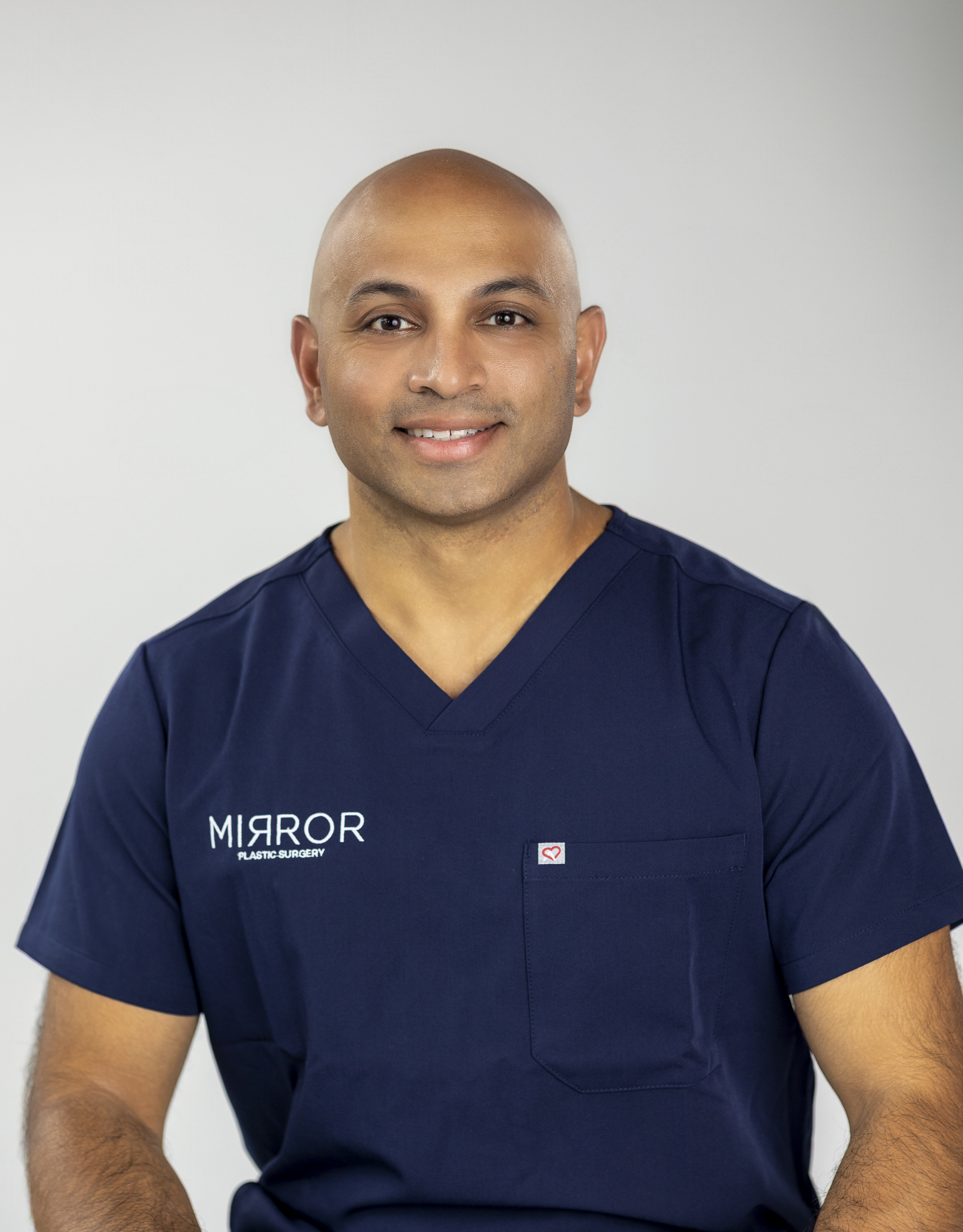
Written by: Dr. Akash Chandawarkar, Board Certified Plastic Surgeon, Mirror Plastic Surgery
Key Takeaways
- Facial aging involves descent of ligaments, SMAS, and fat compartments that only surgical repositioning can correct.
- The dual-plane facelift technique at Mirror Plastic Surgery combines SMAS and deep-plane elements for natural, long-lasting results tailored to each patient.
- Board-certified surgeons with fellowship training, low surgical volume, and accredited facilities deliver safer outcomes and higher patient satisfaction.
- Composite-layer facelifts outperform skin-only procedures in longevity, with studies showing durable results over a decade after surgery.1
- Schedule your personalized consultation with Dr. Akash at Mirror Plastic Surgery to receive an anatomical assessment and technique recommendation.
How the Dual-Plane Facelift Works
A dual-plane facelift operates at two tissue depths. The skin is elevated in one plane, while the SMAS and deeper retaining ligaments are released and repositioned in a second, sub-SMAS plane. This approach moves skin, fat, and support structures together as a unit, which creates more natural and longer-lasting rejuvenation than skin-only tightening.1
At Mirror Plastic Surgery, Dr. Akash uses a dual-plane approach that blends SMAS and deep-plane techniques, tailored to each person’s anatomy. He calibrates dissection depth, ligament release, and tissue repositioning to what your face actually needs, rather than following a one-size-fits-all protocol.
Why Surgeon Training Matters for Facelift Results
Board certification is the foundational credential to verify before selecting any facelift surgeon. The American Board of Plastic Surgery (ABPS) is the only American Board of Medical Specialties–recognized board certifying physicians in plastic surgery, requiring completion of an accredited residency and comprehensive certification examinations. Certification can be verified at certificationmatters.org.
| Credential or Training Category | Dr. Akash at Mirror Plastic Surgery | General ABPS Standard |
|---|---|---|
| Medical Degree | M.D. with Honors, Harvard Medical School via Harvard-MIT HST program | M.D. from accredited medical school |
| Surgical Residency | 7-year integrated plastic and reconstructive surgery residency, Johns Hopkins University | Accredited plastic surgery residency |
| Aesthetic Fellowship | Aesthetic Surgery Fellowship, Manhattan Eye, Ear and Throat Hospital (MEETH), focused on advanced facial surgery | Fellowship not required for ABPS certification |
| Innovation Training | Stanford University Biodesign Innovation Fellowship | Not a standard requirement |
| Board Certification | American Board of Plastic Surgery (ABPS) | ABPS or ABFPRS for facial procedures |
| National Recognition | Named to Newsweek’s America’s Best Plastic Surgeons list two years in a row | Not a standard benchmark |
| Procedural Volume | 1–2 surgeries per day maximum | No regulated daily limit, some practices perform 5–10 per day |
This level of training and controlled volume shapes how a surgeon approaches technique choice and execution in the operating room.
Comparing Facelift Techniques: Dual-Plane, Traditional SMAS, and Skin-Only
A SMAS-based facelift works at or above the superficial musculoaponeurotic system by folding, tightening, or trimming the SMAS while the skin is lifted separately, while a deep plane approach works below the SMAS and releases retaining ligaments so the skin, fat, and SMAS move together as a composite unit. The dual-plane technique at Mirror Plastic Surgery combines elements of both and is calibrated to the patient’s degree of descent.
| Metric | Dual-Plane (Mirror Approach) | Traditional SMAS | Skin-Only |
|---|---|---|---|
| Tissue Layers Addressed | Skin, SMAS, and retaining ligaments as a composite layer | Skin and SMAS separately, ligaments not fully released | Skin only |
| Typical Result Longevity | 10–15 years, with patient satisfaction documented at a mean 12.6 years in composite-layer studies1 | 5–10 years based on technique literature | Shorter duration, addresses less laxity |
| Patient Satisfaction (meta-analysis) | 94.4% (deep plane cohort, 2,896 patients)1 | 87.8% (SMAS cohort, same review) | Not directly comparable, discussed in prose below |
| Skin Necrosis Risk | Lower, composite flap retains its own blood supply | Moderate, skin and SMAS elevated separately | Higher, skin flap depends entirely on surface perfusion |
| Best Candidate Profile | Midface descent, deepened nasolabial folds, jowling, neck laxity | Early descent mostly along jawline, midface still holds position | Minimal laxity, younger patients with early changes only |
Skin-only satisfaction data is not pooled in the same meta-analyses as SMAS and deep-plane cohorts, so a direct percentage comparison would be misleading. Evidence consistently shows that SMAS facelifts last longer than skin-only techniques, while deep-plane and composite approaches offer the most natural and durable outcomes at higher technical demand.
Safety-First Checklist for Facelift Patients
Safe facelift surgery rests on surgeon training, facility standards, anesthesia oversight, and careful medical screening working together.
- ABPS Board Certification: Confirm certification at certificationmatters.org or abplasticsurgery.org, which list the only ABMS-recognized board for plastic surgery. Board certification verifies that your surgeon has completed required training and passed rigorous exams.
- Accredited Surgical Facility: That training must be paired with a safe environment. Surgery should be performed in a licensed hospital or AAAASF-accredited ambulatory surgical center, not an unaccredited office suite. Facility accreditation confirms proper equipment, staffing, and emergency protocols.
- Board-Certified Physician Anesthesiologist: An accredited facility supports safe anesthesia. Local anesthesia with sedation is associated with lower hematoma risk than general anesthesia. Regardless of the method, a board-certified anesthesiologist should be present for the entire case to monitor your vital signs and respond quickly to any issues.
- Low Procedural Volume: Mirror Plastic Surgery limits surgeries to one to two per day, which keeps the entire clinical team focused on each patient before, during, and after the procedure. This model contrasts with practices performing five to ten surgeries daily.
- Pre-Operative Medical Clearance: Mayo Clinic recommends a full medical history review, medication check, and facial examination including bone structure and skin quality assessment before any facelift. This screening helps tailor the plan and reduce risk.
- Smoking Cessation: Smoking must stop at least six weeks before surgery and remain stopped through recovery because nicotine constricts the small blood vessels that skin flaps rely on for healing.
- Written Revision Policy: Experienced surgeons provide a written revision policy before surgery that specifies conditions, timeframe, and cost terms. This clarity sets expectations on both sides.
Book a consultation with Dr. Akash to experience Mirror’s safety-first evaluation process in person.
What Results Look Like at Different Ages
Most facelift patients are in their mid-40s through their 70s, and age matters less than the pattern of facial aging. Defined jowls, neck laxity, midface descent, and loss of jawline definition guide candidacy more than the number of birthdays.
- Early 40s: Structural descent is usually early and localized. A dual-plane approach addresses emerging jowling and nasolabial deepening while preserving natural volume. Younger patients generally experience faster recovery and less edema, and results in this age group often align with the 12.6-year satisfaction benchmark seen in dual-plane outcome studies.1
- 50s: This is the most common decade for facelift surgery. Midface descent, jowling, and neck laxity are typically all present, which makes composite-layer repositioning an anatomically sound choice. A well-performed facelift typically lasts 7 to 15 years, with longevity influenced by genetics, sun exposure, and weight stability.1
- 60s and beyond: Age itself is not a major risk factor for facelift complications, while general health and patient selection matter far more than chronological age. Well-screened patients in their seventies can undergo facelift surgery safely, though skin elasticity and healing capacity influence technique selection and recovery planning.
What to Avoid When Choosing a Facelift Surgeon
Certain practice patterns repeatedly correlate with weaker outcomes, regardless of the advertised technique.
- Rushed consultations: A brief visit that skips detailed anatomical assessment, technique rationale, and honest risk discussion cannot produce a personalized surgical plan. Mirror Plastic Surgery dedicates up to an hour per consultation for this reason, and that time investment becomes difficult when a practice prioritizes volume over depth.
- High daily surgical volume: Outcomes correlate with volume and the technique’s documented 2–3 year learning curve. A surgeon performing five to ten procedures daily cannot provide the same perioperative focus that a low-volume model allows. The consultation time crunch is often the first sign of a volume-driven approach that affects every stage of care.
- Unverified credentials: Some practitioners use board names that are not recognized by the American Board of Medical Specialties. Always verify ABPS certification independently before proceeding.
- Overdone aesthetic goals: Tension-based skin pulling creates the “operated” look that many patients want to avoid. Structural repositioning of deeper layers, not surface tension, produces natural results.
- Ignoring prior non-surgical history: Prior dermal fillers and energy-based device treatments can create anatomical, vascular, and technical challenges for facelift surgery. These factors require more strategic operative planning.
Recovery Timeline: Dual-Plane vs. Mini-Lift
| Recovery Milestone | Dual-Plane Facelift | Mini Facelift |
|---|---|---|
| Swelling Peak | 48–72 hours post-surgery | 48–72 hours post-surgery |
| Return to Desk Work | 11–15 days | 1–2 weeks |
| Socially Presentable | 2–3 weeks after major bruising and swelling subside | 1–2 weeks |
| Exercise Clearance | Weeks 7–9 | Around 4 weeks |
| Majority of Swelling Resolved | About 80% by 3 weeks | About 80% by 3 weeks |
| Final Result Visible | 4–7 months, with some refinement beyond 6 months | 3–6 months |
| Typical Result Longevity | 10–15 years, with satisfaction maintained at a 12.6-year mean in published cohorts1 | 8–10 years |
Frequently Asked Questions
Who is the best facelift surgeon in St. Petersburg, Florida?
The most reliable way to evaluate any facelift surgeon is through verifiable credentials, not marketing language. Look for ABPS board certification, fellowship training at a recognized aesthetic surgery program, a low daily surgical volume that allows genuine personalized attention, and a philosophy that places safety and function before aesthetics. Dr. Akash’s training pathway, detailed in the credentials comparison above, reflects the highest tier of surgical education, including a Harvard medical degree, Johns Hopkins residency, and MEETH aesthetic fellowship. His Newsweek recognition and strict volume limits translate that background into a practice model built for individualized care rather than throughput.
What are the downsides of a deep plane or dual-plane facelift?
The main trade-offs include longer operative time, a more technically demanding dissection near facial nerve branches, and a recovery period that lasts slightly longer than a mini facelift. The dual-plane approach requires a surgeon with deep anatomical expertise and experience with sub-SMAS dissection. At Mirror Plastic Surgery, this need is addressed through Dr. Akash’s specialized fellowship training, rigorous pre-operative evaluation, surgery performed only in accredited facilities with a board-certified anesthesiologist, and a strict limit of one to two cases per day. The higher upfront investment in recovery time is offset by long-term satisfaction documented in dual-plane outcome studies, which shows a clear longevity advantage over surface-level alternatives.
How much does a facelift cost in St. Petersburg, Florida?
Facelift pricing is personalized because each patient’s anatomy, degree of descent, and surgical plan differ. Mirror Plastic Surgery provides individualized quotes during the consultation after a thorough anatomical assessment. Any all-in quote should include board-certified surgeon fees, an accredited surgical facility, a board-certified anesthesiologist, and comprehensive pre- and post-operative care, rather than a stripped-down price that omits safety-critical components. A consultation with Dr. Akash is the appropriate starting point for understanding what your specific plan would involve.
At what age should I consider a facelift?
There is no fixed chronological age for facelift candidacy. Clinical indicators such as defined jowls, midface descent, neck laxity, deepened nasolabial folds, and loss of jawline definition matter more than your birth year. Many patients start considering surgery in their early 40s when structural descent first appears, while others in their 70s remain excellent candidates when their overall health is well managed. Dr. Akash’s hour-long consultation evaluates each patient’s anatomy, health history, and goals to determine whether surgery is appropriate, which technique fits best, and what realistic outcomes look like for that person.
Is a facelift safe, and what complications should I know about?
Facelift surgery performed by a board-certified surgeon in an accredited facility carries a low risk of serious complications. Hematoma is the most common complication, usually forming within the first 24 hours and requiring prompt treatment. Permanent facial nerve injury is rare, and most postoperative nerve weakness resolves over time. Smoking significantly increases the risk of poor wound healing and skin necrosis, which is why Mirror Plastic Surgery requires strict smoking cessation well before surgery. Pre-operative medical clearance, blood pressure control, and careful patient selection are key tools for minimizing risk, and these steps form the core of Mirror’s safety-first protocol.
Conclusion: Choosing a Facelift Surgeon with Confidence
Choosing a facelift surgeon in St. Petersburg or the Tampa Bay area deserves the same rigor you would apply to any major medical decision. Technique matters, because composite-layer repositioning consistently outperforms skin-only approaches in longevity and natural appearance. Credentials matter, because ABPS board certification, fellowship training, and a verifiable case history form a non-negotiable baseline. Process also matters, because a surgeon who limits daily volume, spends real time in consultation, and operates within a safety-first framework is structurally positioned to deliver better outcomes than one focused on volume.
Mirror Plastic Surgery follows this model with concierge-level attention, clear anatomical education at every step, and a hierarchy of safety, function, and aesthetics that keeps patient well-being at the center of every decision.
Book a consultation with Dr. Akash at Mirror Plastic Surgery in St. Petersburg and take the first step toward a natural, long-lasting result grounded in evidence, anatomy, and truly personalized care.
1 Results may vary from person to person. Editorial content, before and after images, and patient testimonials do not constitute a guarantee of specific results.