
Written by: Dr. Akash Chandawarkar, Board Certified Plastic Surgeon, Mirror Plastic Surgery
Key Takeaways for Tampa Bay Patients
- Natural-looking, long-term hair restoration depends on surgeon involvement, careful donor management, and age-appropriate hairline design, not advertised graft counts or technology labels.
- Elite credentials, such as an integrated plastic surgery residency and ISHRS-accredited fellowship, support the anatomical precision and aesthetic judgment needed for subtle, lasting results.
- Red flags like non-physician consultations, missing donor-area assessments, or rushed hairline design suggest a clinic falls below ISHRS standards of care.
- Five core questions about surgeon involvement, lifetime graft budgeting, age-appropriate planning, comparable results, and native-hair management help patients compare clinics confidently.
- Whether you pursue surgical FUE or non-surgical Secretome, strong outcomes start with a physician-led consultation that produces a personalized plan for natural, enduring results.1
Key Decision Factors for Evaluating Hair Restoration Clinics
Four practical factors help you separate clinics that deliver natural, lasting results from those that focus on volume and marketing.
Surgeon involvement versus technician-led extraction. In many high-volume clinics, technicians perform extraction and implantation while the surgeon’s role stays mostly on paper. This delegation creates quality-control gaps that ISHRS guidelines address by requiring the operating surgeon to stay directly involved in donor harvesting, recipient site creation, and oversight of graft placement. Because clinics may not volunteer this information, patients need a clear answer on who performs each step.
Donor management for 10-year outcomes. The donor area is a finite, non-renewable resource that must last your lifetime. A clinic that quotes graft counts without a documented donor-area assessment is not practicing responsible medicine and risks overharvesting, visible thinning, and limited options for future procedures.
Hairline artistry and age-appropriate design. ISHRS guidelines highlight five core components of natural hairline design: feathered anterior edges, age-appropriate positioning, natural frontotemporal angles, deliberate irregularity, and proper graft selection. A well-planned hairline respects these principles so it still looks appropriate decades later as your face and hair continue to age.
Non-surgical alternatives and combined approaches. A combined approach using medication, PRP, and FUE transplant often produces the strongest long-term results for patients with stable but advanced hair loss, because non-surgical treatments can preserve native hair while transplanted follicles restore density.1 When clinics present surgery as the only option and skip these complementary pathways, they leave out treatments that could significantly improve your long-term outcome.
Surgeon Credentials That Support Natural Results
The American Hair Loss Association describes hair transplant surgery as a highly specialized procedure and stresses the need to select a proficient surgeon. Any licensed physician may legally perform hair transplants, yet only a subset receive formal, in-depth training. That gap makes credential verification essential. The table below shows how elite-tier training in plastic surgery and aesthetic fellowships provides skills that go beyond minimum licensing requirements and directly support natural hairlines and long-term planning.
| Credential Category | Minimum Standard | Elite Standard | Relevance to Natural Results |
|---|---|---|---|
| Medical Degree | MD or DO from accredited program | Research-integrated MD program (e.g., Harvard-MIT HST) | Foundational anatomical and biological knowledge |
| Surgical Residency | Dermatology (4 yr) or Plastic Surgery (6+ yr) | Integrated plastic and reconstructive surgery at a top-ranked institution | Plastic surgery residency emphasizes tissue handling, incision planning, scar management, and aesthetic proportion |
| Aesthetic Fellowship | ISHRS-accredited hair restoration fellowship (9–12 months, 70+ supervised cases) | Aesthetic surgery fellowship at a nationally recognized institution (e.g., MEETH/Lenox Hill) | Advanced training in facial rejuvenation, hairline design, and technique refinement |
| Board Certification | ABHRS Diplomate or ABPS/ABD certification | ABPS board certification plus specialty society leadership | ABHRS Diplomate status requires an active medical license, documented training, written and oral examinations, and ongoing continuing education |
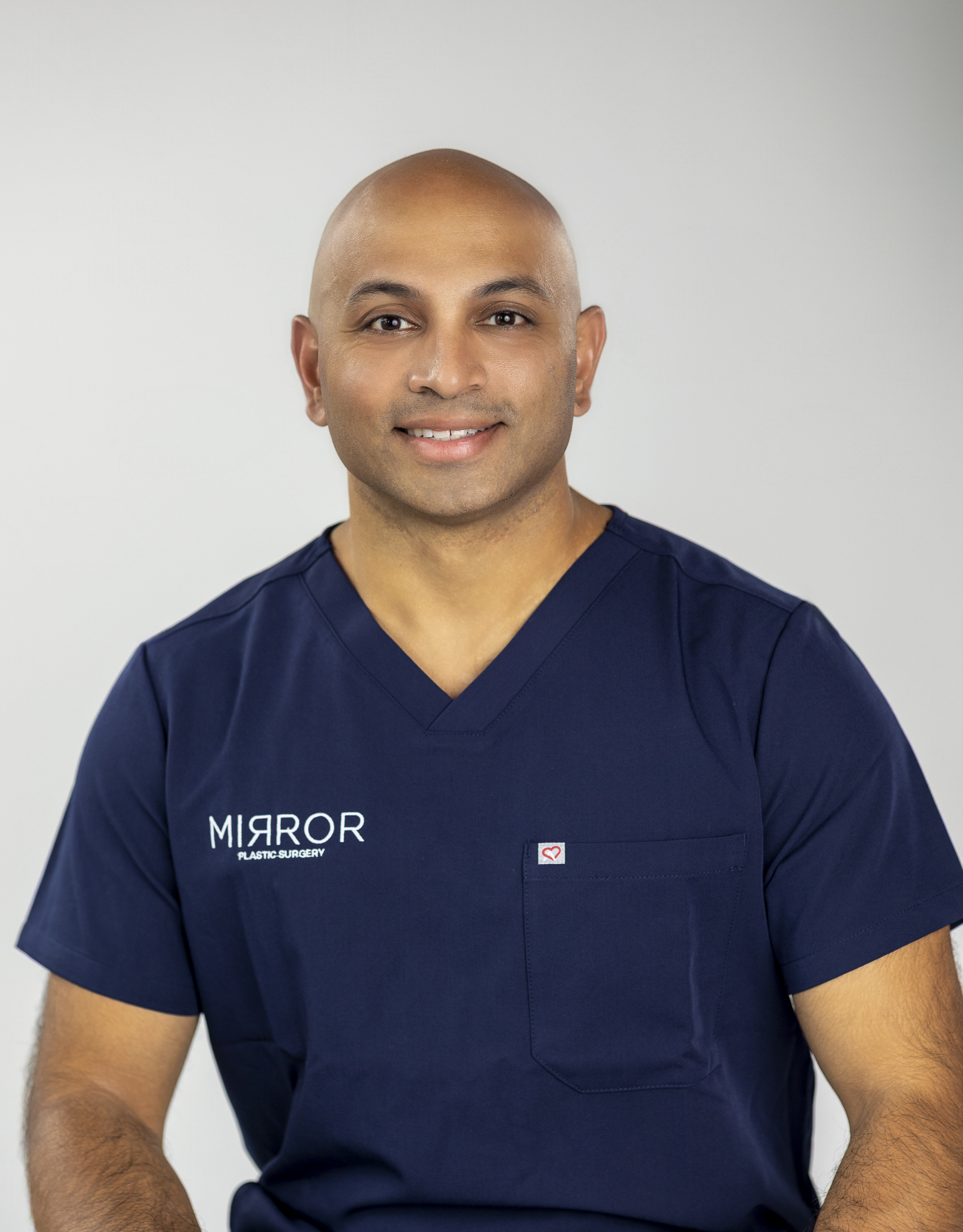
Dr. Akash at Mirror Plastic Surgery illustrates what elite-tier credentials look like in practice. He completed his medical degree through the Harvard-MIT Division of Health Sciences and Technology, followed by a seven-year integrated plastic and reconstructive surgery residency at Johns Hopkins University and an aesthetic surgery fellowship at the Manhattan Eye, Ear and Throat Hospital (MEETH). He also completed the Stanford University Biodesign Innovation Fellowship and has been named to Newsweek’s America’s Best Plastic Surgeons list two years in a row. This depth of training supports the anatomical precision and long-term planning that natural hair restoration requires.
Red-Flag Checklist for Hair Restoration Consultations
Specific patterns, drawn from patient forums and ISHRS reporting, suggest a clinic may not meet the standard of care needed for natural, lasting results.
- Non-physician consultation. Physician-led consultations allow accurate assessment of donor density, identification of contraindications, and evidence-based candidacy decisions. A sales coordinator conducting the evaluation is a disqualifying red flag.
- No donor-area assessment before quoting grafts. Clinics that quote grafts and cost without a pre-operative donor assessment are not practicing responsible medicine.
- Rushed or template-based hairline design. Hairline design must be individualized to age, facial features, existing hair, likely future loss, donor supply, and personal goals.
- No discussion of future hair loss. Long-term planning requires designing the hairline for your projected appearance in twenty years to avoid an isolated “island” of transplanted hair.
- High daily surgical volume. Surgeons scheduling more than two comprehensive FUE procedures per day risk splitting attention and compromising outcomes.
- No published outcome data. Clinics that follow ISHRS standards publish outcome data with sample sizes and clear measurement methods.
- Rising repair case rates in the region. Fifty-nine percent of ISHRS members reported black-market hair transplant clinics operating in their cities, which correlates with higher repair volumes.
Recognizing these red flags is the first step. The next step involves asking targeted questions during your consultation so you can confirm that a clinic truly follows ISHRS standards and protects your long-term donor supply.
Five Essential Questions to Ask at Your Consultation
- Who performs each step of the procedure? Ask who designs the hairline, who creates the recipient sites, who extracts the grafts, and who makes the candidacy decision. Verify surgeon involvement at every critical stage.
- What is my lifetime graft budget, and how does today’s plan preserve future options? Your first consultation should establish a Lifetime Graft Budget based on your individual donor supply and projected future needs.
- How is the hairline designed for my age and projected hair loss? Request an explanation of graft type selection, exit angles, and how the design accounts for Norwood progression over the next 20 years.
- Can I see 9–12 month results from patients with comparable hair characteristics and loss patterns? Results from patients with similar hair type and loss pattern confirm consistent, natural hairline design.
- What is the plan for managing native hair loss after the procedure? Patients using finasteride achieve 94% visible improvement versus 67% without it.1 A complete plan addresses both transplanted and native hair.
Essential Hair Restoration Terms Explained
FUE (Follicular Unit Extraction). FUE removes individual hair follicles from the donor area without a strip of scalp, usually leaving small dot-like marks that fade over time.
FUT (Follicular Unit Transplantation). FUT removes a strip of scalp from the donor area, then dissects follicular units for implantation. It allows larger graft sessions but leaves a linear scar and involves a longer initial recovery than FUE.
Donor area. This zone at the back and sides of the scalp contains DHT-resistant follicles. Overharvesting creates patchy appearance, transection damage, and permanent depletion of reserves, which limits future options.
Hairline design. This process determines hairline position, shape, graft type, exit angle, and density gradient. A natural hairline forms a three-dimensional transition zone that starts with fine vellus hairs, then scattered single terminal hairs, and only later uses multi-hair follicular units.
Secretome. This non-surgical regenerative treatment uses cell-secreted signaling molecules, including growth factors and exosomes, to stimulate existing follicles. Mirror Plastic Surgery offers hair restoration with Acorn Biolabs Secretome as an injectable or topical option for patients who are not surgical candidates or who prefer a non-invasive approach.
Surgical FUE and Non-Surgical Secretome Pathways
FUE and non-surgical regenerative treatments address different stages and patterns of hair loss, so the right choice depends on your specific situation and goals.
FUE suits patients with established moderate-to-advanced hair loss (Norwood 3–6) who have sufficient donor hair at the back and sides of the scalp. Recovery usually takes 7–14 days for scalp healing and scab resolution. Most patients return to desk work within 3–5 days. New growth often begins around 3–4 months and reaches mature density between 12–18 months.
Non-surgical options, including Secretome-based treatments and PRP, work better for early-stage thinning, prevention, and post-transplant maintenance. PRP tends to help patients with early androgenetic alopecia (Norwood stages I–III) or those maintaining results from a prior hair transplant, but rarely improves areas that have been completely bald for years.
Many patients assume that robotic technology or a high graft count guarantees natural results. FUE, DHI, and Sapphire FUE techniques can all produce excellent outcomes. The operator’s skill and planning determine whether the result looks natural, not the marketing label on the device.
Mirror Plastic Surgery’s Concierge Model in Practice
Mirror Plastic Surgery follows a concierge model that prioritizes focused attention, consistent teams, and long-term planning over daily volume. The practice limits procedures to one to two surgeries per day so the entire clinical team can focus on a single patient before, during, and after the procedure. This focused approach allows the same team to maintain synchronized workflows throughout each case, which protects graft viability by minimizing the time follicles spend outside the body.
High-volume practices that perform five to ten surgeries daily often split teams across multiple operating rooms or rush individual cases. Both patterns make it harder to maintain the workflow synchronization that reduces follicle damage and supports consistent outcomes.
Initial consultations at Mirror Plastic Surgery can run up to one hour. This time supports thorough trichoscopic examination, donor-area mapping, hairline design discussion, and long-term planning that ISHRS guidelines describe as the foundation of responsible hair restoration care. The practice’s guiding philosophy, stated as safety first, function second, aesthetics third, applies directly to hair restoration, where donor preservation and scalp health come before density or design.
Dr. Akash’s training in plastic surgery, facial aesthetics, and medical innovation, detailed in the credentials section above, positions him to evaluate hair restoration within the full context of facial anatomy, aging, and long-term aesthetics. This broader perspective often differs from that of purely hair-focused clinics.
Frequently Asked Questions
Am I a candidate for a hair transplant?
Candidacy depends on five core factors: adequate donor density above threshold, acceptable scalp laxity, a stable or predictable hair loss pattern for at least 6–12 months, realistic expectations, and good overall health without active contraindications. Conditions such as alopecia areata, active scalp infections, or uncontrolled systemic diseases that impair healing may disqualify a patient from surgery. Only 2 to 5% of women with hair loss are true surgical candidates, because the evaluation must distinguish between diffuse patterned alopecia and diffuse unpatterned alopecia. A physician-led consultation remains the only reliable way to determine candidacy.
How long do hair transplant results last?
Transplanted follicles from the safe donor zone are genetically resistant to DHT and can remain stable for decades when harvested and implanted correctly.1 Long-term studies show high survival rates under optimal conditions.1 A transplant does not stop ongoing native hair loss, so surrounding non-transplanted hair may continue to thin and change the apparent density of results over time. Patients who continue hair-loss medications after the procedure consistently report higher long-term satisfaction.1 Some patients choose additional procedures years later because of progressive native hair loss rather than failure of the original grafts.
What makes a hairline look natural versus artificial?
A natural hairline forms a three-dimensional transition zone, not a sharp line. It begins with fine single-hair grafts at the leading edge placed at exit angles of about 15–20 degrees, incorporates deliberate micro- and macro-irregularity, and uses multi-hair grafts only further back to build density. Position usually follows the facial rule of thirds and must stay age-appropriate, often 7–8 cm above the glabella in adult men. Common errors that create artificial results include placing multi-hair grafts at the front edge, setting the hairline too low for the patient’s age, ignoring future hair loss, and implanting grafts at near-vertical angles.
What is the Secretome treatment, and who is it for?
Secretome refers to a collection of bioactive molecules, including growth factors and exosomes, secreted by cells that influence follicle activity and tissue repair. Mirror Plastic Surgery offers Acorn Biolabs Secretome as an injectable or topical non-surgical option. It suits patients with early-stage thinning who are not yet surgical candidates, those who prefer to avoid surgery, or patients maintaining results after a prior transplant. Unlike FUE, it does not relocate follicles or deplete the donor area. It involves no surgical downtime and can pair with other non-surgical protocols.
How do I compare clinics when every clinic claims natural results?
Start by requesting written documentation of the surgeon’s credentials, board certifications, and procedure volume. Ask to see before-and-after results from patients with comparable hair characteristics and loss patterns at 9–12 months post-procedure. Confirm that the operating surgeon, not a coordinator or technician, will personally design the hairline, create recipient sites, and oversee extraction. Verify that a donor-area assessment occurs before any graft count is quoted. Check independent third-party reviews across at least 20 verified patients. Clinics that cannot provide these elements operate below ISHRS standards regardless of their marketing claims.
Summary: Choosing a Tampa Bay Hair Restoration Partner
Natural-looking hair restoration in Tampa Bay depends on choosing a clinic based on surgeon credentials, hands-on involvement, donor management philosophy, and hairline artistry rather than technology labels or advertised graft counts. The evaluation criteria, red-flag checklist, and consultation questions in this guide give you a clear framework for that decision. Patients who research and verify clinic credentials tend to experience lower revision rates than those who book based on advertising alone.
Strong long-term outcomes also rely on planning that considers decades of potential hair loss progression, not just the first year after surgery. Whether your best path is surgical FUE, non-surgical Secretome, or a combined approach, the decision should follow a thorough physician-led consultation grounded in anatomy, evidence, and individualized planning.
1 Results may vary from person to person. Editorial content, before and after images, and patient testimonials do not constitute a guarantee of specific results.