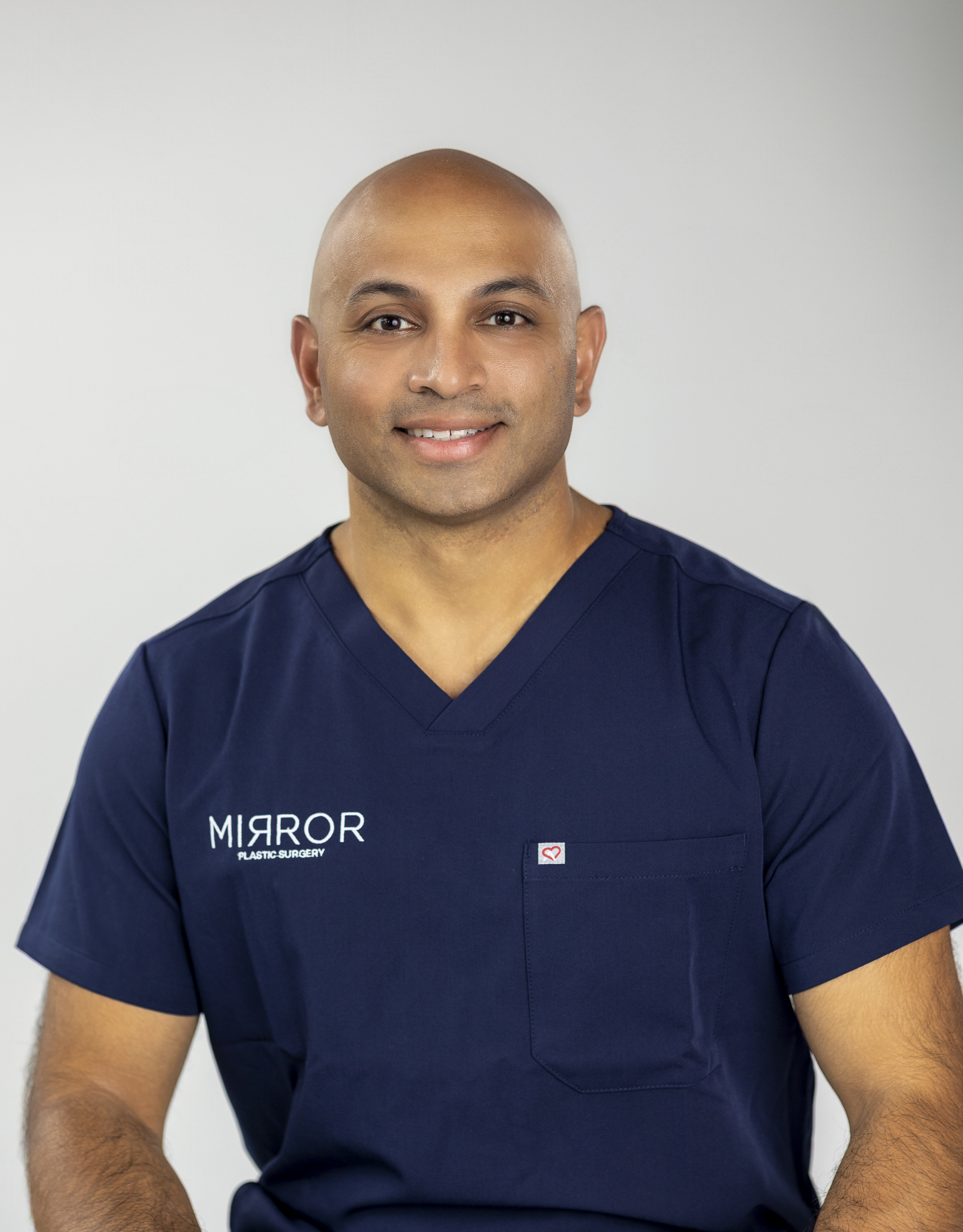
Written by: Dr. Akash Chandawarkar, Board Certified Plastic Surgeon, Mirror Plastic Surgery
Key Takeaways
- Concierge hair restoration limits daily surgical volume to one or two cases, which allows up to an hour per consultation and full surgeon attention throughout every procedure.
- Board-certified plastic surgeons with elite training such as Dr. Akash provide the highest safety benchmark, supported by integrated residencies and aesthetic fellowships that most hair-restoration providers do not have.
- Lower daily volume directly improves graft survival and reduces transection rates by removing the rushed conditions common in high-volume clinics.1
- Patients who understand key terms like FUE, FUT, safe donor zone, and graft survival can better evaluate providers and protect their long-term donor supply.
- Patients ready for a physician-led, personalized hair restoration plan can schedule a consultation at Mirror Plastic Surgery to discuss candidacy and long-term outcomes with Dr. Akash.
Why Board-Certified Plastic Surgeons with Elite Training Are the Benchmark
Hair restoration surgery has no ABMS-recognized specialty board, no accredited residency, and no fellowship dedicated specifically to the procedure. Any licensed physician can legally perform hair transplants regardless of surgical background. Only approximately 270 surgeons worldwide hold ABHRS Diplomate certification, and just 83 of those are based in the United States.
Against that backdrop, the foundational training of the operating surgeon becomes the primary safety variable. Plastic surgery training requires either 6 years in an integrated residency or 3 years in an independent program after completing a prerequisite residency such as 5 years of general surgery, compared with a three-year dermatology residency focused on skin, hair, and nail disorders. This training gap becomes especially relevant when evaluating providers in the Tampa Bay market, where patients often see aggressive marketing from clinics with very different levels of surgical expertise.
Dr. Akash at Mirror Plastic Surgery holds board certification from the American Board of Plastic Surgery, completed a seven-year integrated plastic and reconstructive surgery residency at Johns Hopkins University, earned his medical degree from Harvard Medical School with Honors through the Harvard-MIT Health Sciences and Technology program, and completed an aesthetic surgery fellowship at the Manhattan Eye, Ear and Throat Hospital (MEETH). He has been named to Newsweek’s America’s Best Plastic Surgeons list for two consecutive years, including 2025. This combination of ABPS certification, elite residency training, and subspecialty fellowship represents a credential tier that most hair restoration clinics in St. Petersburg and the broader Tampa Bay region do not offer.
How Daily Surgical Volume Directly Affects Planning, Execution, and Outcomes
Boutique practices that limit daily volume can achieve lower transection rates and higher graft survival rates compared with higher transection rates and lower graft survival in high-volume or technician-led settings. Transection, the accidental severing of a follicle during extraction, permanently destroys grafts from a patient’s finite lifetime supply.
The stakes of this difference become clear when you consider the math. High transection rates on a typical graft procedure can destroy a substantial portion of grafts from a patient’s limited lifetime supply of harvestable grafts. That loss is irreversible. Excessively prolonged procedures increase physiologic stress on the patient, surgeon, and harvested grafts, which causes technical precision to decline as operative duration extends. Over time, this combination leaves fewer options for future procedures as native hair continues to thin.
Key Terminology for Comparing Hair Restoration Providers
Before comparing providers or evaluating their claims about graft counts and survival rates, patients need to understand several core technical terms that appear in almost every consultation. These definitions help you ask focused questions and recognize when a provider is overpromising or cutting corners on donor preservation.
- FUE (Follicular Unit Excision): Individual follicular units are extracted one by one from the donor zone using a small punch instrument. This technique has become the most popular method in the hair transplant market because it avoids a linear scar and allows patients to wear shorter hairstyles.
- FUT (Follicular Unit Transplantation / Strip): A strip of donor scalp is excised, dissected into individual grafts, and implanted. Comparative studies have examined differences in graft survival between FUT and FUE, and FUT can suit patients who need larger graft numbers in a single session.
- Safe Donor Zone: The safe donor area has a baseline follicular unit density that supports good coverage. Follicles harvested from this zone are genetically resistant to DHT and therefore more likely to grow for the long term after transplantation.
- Graft Survival: Modern hair transplants achieve graft survival rates of 90–98% in ideal conditions, with elite surgeons reaching 95–98%.1 These rates depend on careful harvesting, handling, and implantation.
- Overharvesting: Extraction that exceeds safe limits can cause permanent donor depletion, visible thinning, and a moth-eaten appearance in the back and sides of the scalp.
- Donor Dominance: Transplanted follicles retain the genetic characteristics of their origin site and continue growing in the recipient area for life when harvested correctly.
How Mirror Plastic Surgery Prioritizes Safety, Function, and Aesthetics
Mirror Plastic Surgery applies its core operating principle of safety first, function second, and aesthetics third directly to hair restoration planning. Safety includes rigorous pre-operative donor density assessment, anesthesia administered by a board-certified physician anesthesiologist, and strict per-session extraction limits grounded in peer-reviewed thresholds. Maintaining adequate residual donor density preserves cosmetic coverage in the donor region after FUE.
Function addresses long-term donor preservation and native hair management. This matters because a transplant that depletes the donor zone prematurely eliminates future surgical options and leaves the patient with fewer choices as native hair thins over the following decades. Only after safety and function are secured does the practice turn to aesthetics, including hairline design, angulation, and density distribution, which are treated as the final layer rather than standalone targets.
Addressing Common Misconceptions About Providers and Technology
Several misconceptions circulate among patients researching hair restoration in St. Petersburg and the greater Tampa Bay market. Clarifying these points helps patients separate marketing language from actual clinical standards.
Misconception: Robotic or automated FUE eliminates the need for surgeon skill. Robotic systems assist with extraction geometry but do not perform donor zone planning, recipient site creation, or graft placement. The American Board of Hair Restoration Surgery classifies creation of extraction incisions and recipient site incisions as non-delegable acts that must be performed personally by the licensed physician of record. Technology can support a skilled surgeon but cannot replace one.
Misconception: Any board-certified physician is equally qualified. Any licensed physician in the United States can legally perform hair transplant surgery with zero specialized training in hair restoration. Board certification in dermatology or plastic surgery verifies foundational specialty training but does not verify hair-specific surgical volume or competency. Patients still need to ask about case numbers, complication management, and who performs each step of the procedure.
Misconception: High graft counts per session indicate superior capability. In appropriately selected patients, the number of grafts that can safely be transplanted in a single FUE procedure depends on individual donor characteristics. Advertising megasessions as a selling point often signals donor zone risk rather than surgical excellence, especially when clinics do not discuss long-term donor preservation.
If you have encountered these misconceptions during your research and want to separate marketing claims from clinical reality, schedule a consultation with Dr. Akash to get an evidence-based evaluation of your candidacy, donor density, and long-term hair restoration plan.
Long-Term Outcomes: What Happens 5–10 Years After Hair Transplantation
Properly harvested and implanted grafts can maintain strong survival rates over time, and the 95–98% survival rates mentioned earlier hold true over decades when technique is meticulous.1 The primary long-term issue is progressive thinning of surrounding native hair rather than loss of transplanted follicles. However, outcomes diverge significantly based on provider quality and post-operative management.
Post-transplant use of medications like finasteride can improve visible outcomes for many patients.1 In the years following a procedure, some patients may require minor touch-up procedures because native hair around transplanted areas continues to thin.
Physician-led concierge practices address this trajectory through structured follow-up, proactive medical management, and staged planning that preserves donor supply for future sessions. The ISHRS 2025 Practice Census reports that 6.9% of all hair transplants performed in 2024 were repair procedures, up from 5.4% in 2021, a rise directly attributable to botched procedures from unqualified or high-volume providers. Patients in St. Petersburg benefit from choosing a practice that plans for this long horizon from the start.
Decision Factors for Choosing a Hair Restoration Practice
The concierge care model described throughout this article translates into four concrete evaluation criteria that distinguish physician-led practices from high-volume clinics. When comparing providers, use these factors as a checklist to verify whether a practice truly prioritizes safety, function, and long-term outcomes over transactional volume.
- Candidacy assessment: Donor density measurement, degree and pattern of existing loss, age, and projected future loss trajectory must be evaluated before any graft count is proposed. Hair transplants are generally discouraged at a very young age because the donor hair follicles can still be affected by DHT and continue to fall after the transplant.
- Anesthesia oversight: Mirror Plastic Surgery employs board-certified physician anesthesiologists, a standard not universally applied in medspa or high-volume clinic settings.
- Recovery planning: Megasessions and dense frontal packing can increase the risk of postoperative edema in some FUE patients. Controlled tumescence and perioperative protocols reduce this risk and support a smoother recovery.
- Physician-led follow-up: Long-term outcomes depend on monitoring native hair progression and adjusting medical therapy. A concierge model provides continuity of care rather than a transactional single encounter.
Treatment Options: FUE, FUT, Tools, and Adjunctive Therapy
The choice between FUE and FUT depends on donor characteristics, scalp laxity, lifestyle factors, and long-term graft budget planning rather than patient preference alone. The number of grafts that can safely be transplanted in a single procedure varies by technique, patient selection, and other individual factors, which your surgeon should explain clearly during consultation.
Adjunctive therapies can extend surgical results. Combining PRP with FUE can improve graft survival in some cases.1 Mirror Plastic Surgery also offers hair restoration with Acorn Biolabs Secretome as a non-surgical adjunctive option for appropriate candidates, integrated within the same physician-led, long-term care framework.
Frequently Asked Questions
What makes a board-certified plastic surgeon different from a dermatologist for hair restoration?
A board-certified plastic surgeon completes either a 6-year integrated residency or a 3-year independent program after completing a prerequisite residency such as 5 years of general surgery covering reconstructive procedures, microsurgery, and soft tissue surgery across the entire body, followed in some cases by an additional aesthetic surgery fellowship. A dermatologist completes a three-year residency focused on skin, hair, and nail disorders with an emphasis on medical and in-office procedures. Neither specialty has a dedicated hair restoration residency or ABMS-recognized board certification in the field. The plastic surgeon’s broader surgical training, particularly in scalp anatomy, wound closure, and tissue handling, provides a functional advantage for complex hair restoration cases, donor zone management, and complication response.
How many grafts can safely be transplanted in a single session?
Safe graft counts depend on individual donor density, scalp laxity, age, degree of existing and projected hair loss, and the technique used. For most patients with untreated scalps, the number of grafts that can safely be transplanted in a single FUE session depends on the patient’s specific characteristics, while FUT may allow for higher graft numbers in selected candidates. Exceeding safe thresholds risks permanent donor depletion, visible thinning, and compromised options for future procedures. Every patient at Mirror Plastic Surgery receives an individualized donor density assessment before any graft count is proposed.
Will a hair transplant last permanently?
Transplanted follicles harvested from the DHT-resistant safe donor zone are genetically programmed to continue growing for life under the principle of donor dominance. Retrospective studies show that transplanted graft survival rates can be high when follicles are harvested and implanted correctly, consistent with the 95–98% survival range discussed earlier.1 The primary long-term variable is progressive thinning of surrounding native hair, not loss of transplanted follicles. Patients who combine their procedure with ongoing finasteride and minoxidil therapy, periodic physician follow-up, and staged planning for potential future sessions achieve the most durable cosmetic results over a 10–20-year horizon.
What questions should I ask when evaluating a hair restoration provider?
The following questions help distinguish physician-led concierge care from high-volume or technician-driven alternatives:
- Is the operating surgeon board-certified by an ABMS member board such as the American Board of Plastic Surgery?
- Who personally performs the extraction incisions and recipient site creation during the procedure?
- How many procedures does the surgeon perform per day, and will the surgeon be present throughout my case?
- What is the practice’s measured transection rate and graft survival rate?
- How does the practice plan for long-term donor preservation and native hair management?
- What follow-up protocol is included after the procedure?
Does Mirror Plastic Surgery offer non-surgical hair restoration options?
Yes. For patients who are not yet surgical candidates or who want to complement a transplant with ongoing maintenance, Mirror Plastic Surgery offers hair restoration with Acorn Biolabs Secretome, available as an injected or topical treatment. Non-surgical options are evaluated within the same concierge framework, where candidacy is assessed individually, treatment is physician-directed, and long-term outcomes are monitored rather than treated as a one-off procedure.
Next Steps for Personalized Evaluation in St. Petersburg
Patients in St. Petersburg and the broader Tampa Bay area who have already explored medspa or dermatology hair-loss options and now want a board-certified plastic surgeon with elite training, strict daily volume limits, and a documented commitment to long-term outcomes have a clear local benchmark in Dr. Akash at Mirror Plastic Surgery. Named to Newsweek’s America’s Best Plastic Surgeons list for two consecutive years including 2025, Dr. Akash brings Harvard-MIT, Johns Hopkins, and MEETH training to every consultation and spends up to an hour with each patient to assess donor anatomy, project future hair loss, and build a staged plan that preserves the lifetime graft budget.
Schedule your personalized evaluation at Mirror Plastic Surgery, located at 780 4th Ave S, St. Petersburg, FL 33701. Call or text 727-361-6515, or email hello@mirrorplasticsurgery.com.
1 Results may vary from person to person. Editorial content, before and after images, and patient testimonials do not constitute a guarantee of specific results.