
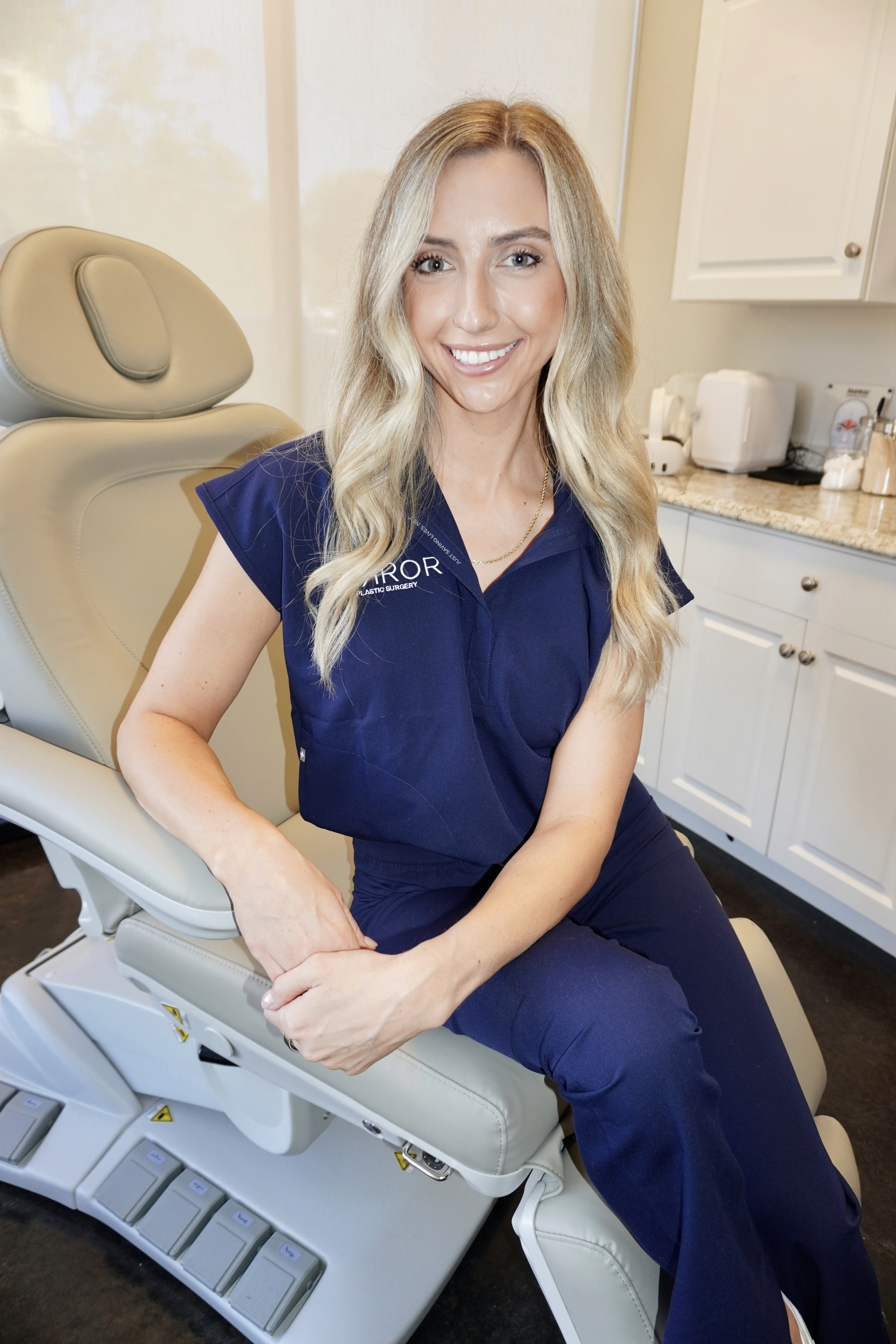
Written by: Ellie Pranckevicius, FNP-BC, Aesthetic Nurse Practitioner & Aesthetic Injector | Facial Restoration & Regenerative Injectable Specialist, Mirror Plastic Surgery
Key Takeaways
- Surgical BBL results stabilize after 3–6 months with about 60–80% fat survival and can last 5–10+ years with stable weight.1
- Non-surgical BBL using Radiesse and AlloClae builds gradual collagen and structural tissue and needs periodic maintenance sessions.1
- Long-term BBL durability depends on provider expertise, weight stability, natural aging, and consistent habits like exercise and nutrition.
- Board-certified plastic surgeons and experienced injectors in accredited facilities reduce risks and improve long-term outcomes for both approaches.
- Schedule your personalized consultation at Mirror Plastic Surgery to explore the safest, most effective BBL option for your goals.
3–6 Months After BBL: Fat Survival and Stabilization
The first three to six months after a surgical Brazilian butt lift are the most critical for long-term results. Transferred fat cells must establish a new blood supply within the recipient tissue, and cells that do not vascularize are reabsorbed by the body. On average, 60–80% of transferred fat survives long-term when an experienced board-certified plastic surgeon uses careful harvesting, purification, and injection techniques.1
During this window, weight stability is non-negotiable. Significant fluctuations in either direction stress the newly vascularizing fat and can reduce the final survival percentage. Patients are typically advised to avoid direct pressure on the buttocks, limit strenuous lower-body exercise, and maintain consistent nutrition to support tissue integration. This careful management protects the fat during its most vulnerable phase. Once the fat has established its blood supply, the surviving cells behave like any other fat in the body, responding to caloric balance and hormonal changes just as native fat does.
1 Year After BBL: Settled Results and Lifestyle Impact
By the one-year mark, swelling has fully resolved and results are considered settled.1 This stage becomes the baseline for measuring long-term durability. Lifestyle now becomes the dominant variable. Maintaining a stable weight is ideal for preserving results, because the transferred fat cells respond to caloric surplus and deficit the same way fat elsewhere in the body does.
Significant weight loss reduces buttock volume as transferred fat cells shrink. Significant weight gain can increase size, but sometimes in an unpredictable or disproportionate way compared with the rest of the body. Regular moderate exercise, balanced nutrition, proper hydration, and avoiding smoking support long-term BBL durability by maintaining body composition and blood flow to transferred fat. Patients who enter surgery close to a sustainable goal weight consistently achieve the most stable one-year outcomes.
5 Years After BBL: Aging, Gravity, and Maintenance Realities
Between years one and five, the cumulative effects of natural aging begin to interact with surgical results. Skin elasticity decreases, collagen production slows, and gravitational forces act on soft tissue continuously. Natural aging gradually decreases skin elasticity, subjects tissues to gravity, and alters muscle tone, which can subtly change contours over 5–10+ years even when the fat cells themselves remain permanent.
Muscle tone in the gluteal region also shifts with age and activity level. The metabolic responsiveness described at one year remains constant, but muscle tone becomes an additional variable. Patients who maintain consistent resistance training tend to preserve projection and shape more effectively than those who are sedentary, because underlying muscle volume supports the overlying fat graft. Around the five-year mark, some patients begin exploring touch-up options, such as a secondary fat transfer or a non-surgical biostimulatory treatment, to address subtle volume loss or skin laxity that has developed since their original procedure.
10 Years After BBL: Decade-Long Changes and Maintenance
By the ten-year mark, the maintenance considerations discussed at five years become even more relevant. The fat cells that survived the initial grafting period are still present and do not disappear on a fixed timeline. However, the surrounding tissue environment has changed considerably. The aging effects noted at five years have progressed, so skin laxity is more pronounced, the gluteal crease may descend slightly, and cumulative body composition shifts affect how the grafted volume is distributed and supported.
BBL results can appear less lifted over time because the skin and connective tissue envelope follow their natural aging path. The fat itself does not sag independently, but the tissues around it do, similar to what would happen without surgery. Patients who achieved the most stable long-term outcomes started surgery close to a sustainable goal weight and maintained that stability over the decade that followed. Patients who experienced significant weight cycling report the most visible changes at the ten-year mark. For many, a combination of lifestyle maintenance and periodic non-surgical biostimulatory treatment offers a practical way to preserve shape without returning to the operating room.
Non-Surgical BBL Longevity and Maintenance with Radiesse and AlloClae
Non-surgical BBL at Mirror Plastic Surgery uses Radiesse and AlloClae, which are biostimulatory agents that trigger the body’s own collagen and structural tissue production rather than simply adding temporary volume. This mechanism produces results that persist beyond the initial treatment period and improve gradually as new tissue forms.
Radiesse provides immediate volume with ongoing collagen stimulation, so it suits patients who want both an immediate contour improvement and a longer-term structural benefit. AlloClae introduces an adipose matrix that encourages the body to generate its own structural tissue over time. Most patients require a series of two to three initial sessions spaced 4–6 weeks apart, then transition to annual or periodic maintenance to sustain results.
Ellie Pranckevicius tailors each non-surgical BBL protocol to the individual’s anatomy, goals, and skin quality, whether the objective is meaningful volume, hip-dip correction, cellulite smoothing, stretch mark reduction, or symmetry refinement. Because biostimulatory treatments work with the body’s own regenerative processes, results evolve naturally and avoid the abrupt appearance changes associated with dissolving temporary fillers.
Surgical vs. Non-Surgical BBL Longevity Comparison
| Aspect | Surgical Fat-Graft BBL | Non-Surgical Injectable BBL (Radiesse / AlloClae) | Key Consideration |
|---|---|---|---|
| Initial result stabilization | 3–6 months for fat vascularization | Gradual volume improvement as collagen builds over 2–6 months | Surgical results require a longer stabilization window before final shape is visible |
| Fat / tissue survival rate | Survival rate of about 60–80% of transferred fat (see above) | Collagen and adipose matrix stimulation; no fat transfer involved | Surgical survival depends on technique and weight stability, while non-surgical builds endogenous tissue |
| Maintenance frequency | Results typically last 5–10 years with proper maintenance, even when weight remains stable.1 | Annual or periodic sessions to sustain collagen-stimulated results | Non-surgical requires planned maintenance, while surgical requires lifestyle discipline |
| Primary safety risk | Pulmonary fat embolism if fat enters gluteal veins, although modern subcutaneous-only technique with ultrasound guidance significantly reduces this risk | Risks include injection-site bruising, asymmetry, vascular complications, infection, and potential serious injury, while avoiding surgical and anesthesia risks | Surgical risk is substantially mitigated by board-certified surgeons in accredited facilities using current ASPS guidelines |
Choosing the Right Provider for Long-Term BBL Results
Provider selection is the single most consequential decision in any BBL journey, surgical or non-surgical. Board certification by the American Board of Plastic Surgery is the only ABMS-recognized credential that confirms proper training for safe BBL performance.
Mirror Plastic Surgery’s philosophy inverts the typical volume-driven model. The practice limits itself to one to two surgical procedures per day, which ensures that every patient receives the team’s full attention before, during, and after their procedure. The guiding principle, safety first, function second, aesthetics third, means that no treatment recommendation is made without a thorough anatomical assessment and honest discussion of long-term implications.
For non-surgical BBL, Ellie Pranckevicius brings esthetician training and advanced nursing expertise, including four years in a Neuroscience ICU, to every injection appointment. Her top-to-bottom assessment process, which can extend up to an hour, identifies the precise combination of Radiesse and AlloClae that fits each patient’s anatomy, skin quality, and long-term goals. She is known for advising patients when a treatment is not yet necessary, a transparency that builds the kind of trust required for long-term aesthetic planning.
When non-surgical options reach their limits, Ellie’s work can be complemented by Dr. Akash Chandawarkar, MD, a Harvard-educated physician, Johns Hopkins-trained plastic surgeon, and fellowship-trained aesthetic surgeon, who performs surgical BBL following current ASPS subcutaneous-only, ultrasound-guided standards of care.
Frequently Asked Questions
How long does a Brazilian butt lift last if I maintain a stable weight?
For surgical BBL, the fat cells that survive the initial 3–6 month vascularization period are considered permanent residents of the gluteal tissue.1 If you maintain a stable weight near your post-procedure baseline and support your results with consistent exercise and nutrition, the core shape established by surgery can remain recognizable for many years, often a decade or more. Skin laxity and muscle tone changes associated with natural aging will gradually alter the appearance of results over time, but the underlying fat volume itself does not disappear on a fixed schedule. For non-surgical BBL with Radiesse and AlloClae, periodic maintenance sessions, typically annual, are a planned part of the long-term strategy and allow for adjustments as your anatomy evolves.
What happens to BBL results after significant weight loss or gain?
Transferred fat cells respond to caloric changes exactly as native fat does. Significant weight loss causes the grafted cells to shrink, which reduces buttock volume and can alter the shape achieved at surgery. Significant weight gain can increase volume in the treated area, but the distribution may be unpredictable and disproportionate relative to the rest of the body. This pattern explains why weight stability is emphasized both before and after a surgical BBL. For non-surgical BBL patients, weight changes affect the surrounding tissue but have less dramatic impact on biostimulatory results, since those treatments work by encouraging the body’s own structural tissue production rather than transplanting fat cells.
Am I a better candidate for surgical or non-surgical BBL?
Candidacy depends on your anatomy, health history, volume goals, risk tolerance, and lifestyle. Surgical BBL suits patients seeking significant volume augmentation who are close to a sustainable goal weight, are medically cleared for general anesthesia, and are prepared for a structured recovery period. Non-surgical BBL with Radiesse and AlloClae suits patients seeking subtle enhancement, hip-dip correction, cellulite smoothing, stretch mark reduction, or symmetry refinement without surgical risk or downtime. It is also a practical option for patients who want to maintain results incrementally over time. A comprehensive top-to-bottom assessment with Ellie at Mirror Plastic Surgery is the most reliable way to determine which path aligns with your anatomy and goals.
How often will I need maintenance treatments for a non-surgical BBL?
The maintenance cadence for non-surgical BBL at Mirror Plastic Surgery depends on the specific agents used, the volume of initial treatment, and how your body responds to biostimulation. Most patients complete an initial series of sessions and then transition to annual or periodic touch-ups to sustain collagen and structural tissue production. Because Ellie’s approach is grounded in honest, anatomy-first assessment, she will not recommend maintenance treatments before they are clinically indicated. Your maintenance plan is built around your individual response to treatment and your long-term aesthetic goals, not a fixed schedule.
What safety standards should I look for when choosing a surgical BBL provider?
Current standards established by the American Society of Plastic Surgeons (ASPS), ISAPS, and the ASERF BBL Task Force require subcutaneous-only fat injection. Florida law mandates ultrasound guidance for all BBL procedures under HB 1471, enacted in July 2023. Verifying that your surgeon is board-certified by the American Board of Plastic Surgery, the only ABMS-recognized credential for this procedure, is the most important single step in provider vetting. At Mirror Plastic Surgery, Dr. Akash Chandawarkar performs surgical BBL in full compliance with current ASPS and ISAPS guidelines.
Conclusion and Next Step
Brazilian butt lift longevity, surgical or non-surgical, is not a fixed number. It reflects technique, provider expertise, weight stability, natural aging, and planned maintenance. Surgical BBL delivers about 60–80% fat survival that stabilizes by six months and can persist for a decade or more with disciplined lifestyle management. Non-surgical BBL with Radiesse and AlloClae offers a lower-risk, periodically maintainable path to gluteal contouring that evolves with your anatomy over time.
Mirror Plastic Surgery exists for patients who want the full picture before making a decision, including honest timelines, real risk data, and a provider who will recommend what they actually need rather than what generates the highest transaction. Whether your next step is a non-surgical injectable protocol with Ellie or a surgical consultation with Dr. Akash, the process begins with a thorough, unhurried assessment of your anatomy and goals.
Disclaimer: Results may vary from person to person. Editorial content, before and after images, and patient testimonials do not constitute a guarantee of specific results.
1 Results may vary from person to person. Editorial content, before and after images, and patient testimonials do not constitute a guarantee of specific results.