Written by: Ellie Pranckevicius, FNP-BC, Aesthetic Nurse Practitioner & Aesthetic Injector | Facial Restoration & Regenerative Injectable Specialist, Mirror Plastic Surgery | Last updated: July 9, 2026
Key Takeaways
- Florida law (HB 1471) now requires real-time ultrasound guidance and limits BBL procedures to three per surgeon per day to reduce fat-embolism risk.
- High-volume “mill” clinics are linked to 92% of BBL deaths in South Florida, while low-volume concierge practices show consistently safer outcomes.
- Patients without enough donor fat or who want minimal downtime can achieve subtle gluteal enhancement with non-surgical biostimulatory fillers such as Radiesse and AlloClae.1
- Choosing a board-certified ABPS plastic surgeon who performs only one to two cases daily and provides a full anatomical consultation offers the safest path to natural-looking results.1
- Schedule your personalized consultation at Mirror Plastic Surgery to review both surgical and non-surgical BBL options with a safety-first team.
Florida BBL Safety Rules You Should Know
Florida’s HB 1471 legally mandates ultrasound guidance for every BBL procedure performed in the state. The law formalizes what the 2022 multi-society Practice Advisory from ASPS, ASAPS, and ISAPS already defined as the standard of care. The impact is clear. A published series of nearly 2,000 ultrasound-guided BBL procedures reported zero fat embolism and zero mortality, compared to the 2017 ASERF Task Force mortality rate of 1 in 3,448.
Review the checklist below before you book any BBL consultation in Tampa.
| Requirement | What to Verify | Legal / Advisory Basis | Red Flag |
|---|---|---|---|
| Ultrasound guidance | Real-time intraoperative ultrasound guidance | Florida HB 1471 (2023) | Surgeon cannot describe their ultrasound protocol |
| Daily volume limit | No more than 3 BBL procedures per surgeon per day | 2022 ASPS/ASAPS/ISAPS Practice Advisory | Clinic schedules 5–10 cases daily |
| Subcutaneous-only injection | Fat placed above the gluteal muscle fascia, never intramuscularly | Florida Board of Medicine rules | Surgeon cannot explain injection plane |
| Facility accreditation | AAAASF, AAAHC, Joint Commission, or state-licensed ASC | ABPS board requirements | Procedure performed in unaccredited office |
| Board certification | ABPS certification verifiable at abplasticsurgery.org | ABMS recognition standard | Certification from non-ABMS board only |
How Practice Type Affects BBL Safety
Meeting Florida’s legal requirements sets the baseline for safety, but the practice model determines how well those rules protect you. A 2023 study by Pazmiño and Garcia found that 92% of BBL deaths in South Florida occurred at high-volume, budget clinics, which links aggressive scheduling and financial pressure to weaker safety protocols. The table below compares that model with a low-volume concierge approach.
| Factor | High-Volume “Mill” Practice | Low-Volume Concierge Practice | Why It Matters |
|---|---|---|---|
| Daily surgical volume | High daily case volumes documented at high-fatality clinics | 1–2 surgeries per day | Fatigue and time pressure are documented risk factors above 3–4 cases per day |
| Consultation depth | Brief, quota-driven assessment | Up to one hour, top-to-bottom anatomical evaluation | Anatomy-driven planning reduces asymmetry and revision risk |
| Surgeon focus | Divided across multiple simultaneous cases | Entire team dedicated to one patient before, during, and after | Undivided attention supports intraoperative decision-making |
| Supplier neutrality | Often tied to volume-based supplier agreements | Evidence-based, supplier-neutral product selection | Removes quota-driven upselling and supports product choice based on anatomy |
Book a consultation to experience the concierge model in person.
Non-Surgical BBL Options in Tampa
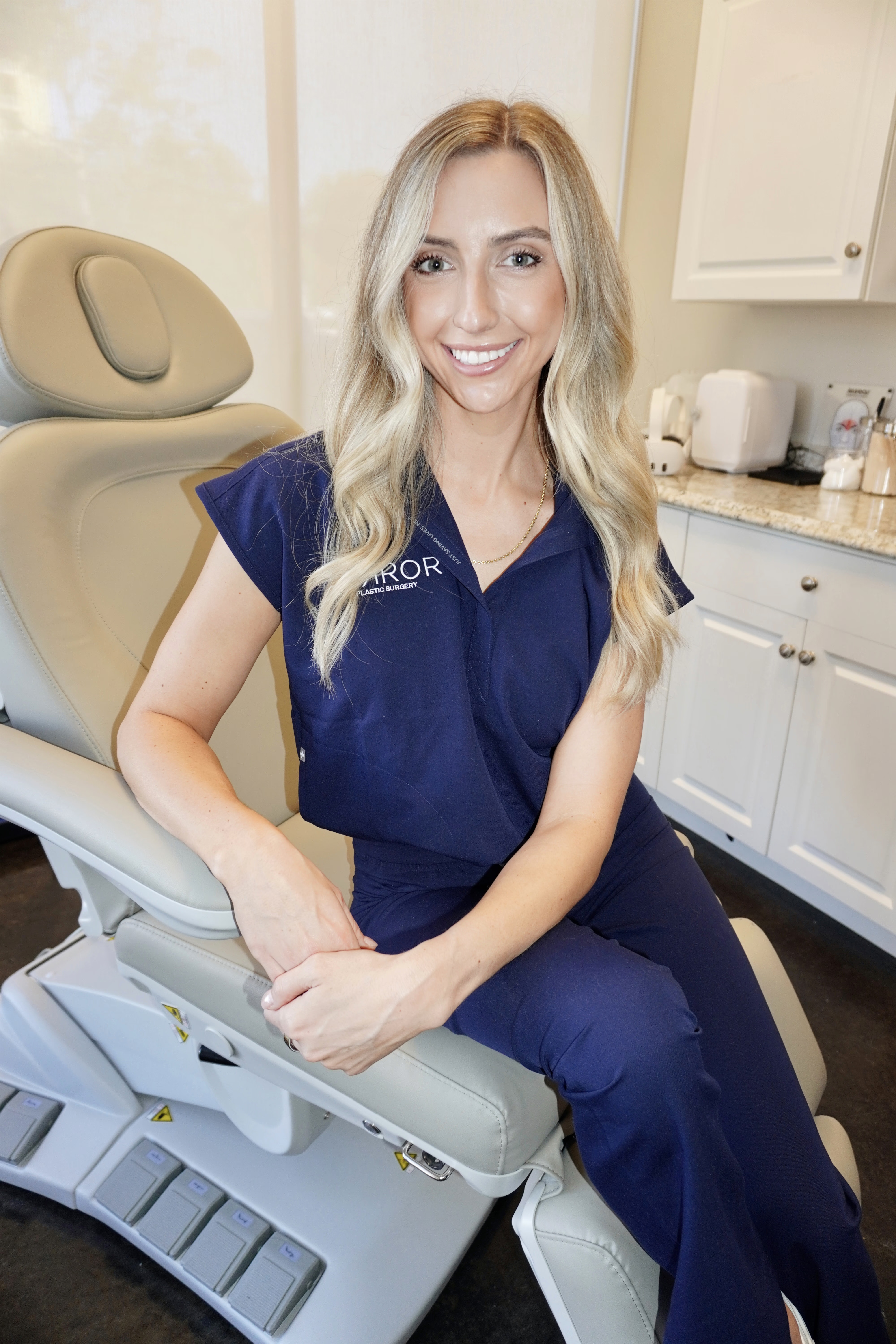
Surgical BBL requires enough donor fat, weeks of recovery, and general anesthesia. Many patients who ask about surgical BBL do not have sufficient harvestable fat and match better with non-surgical liquid BBL, the only injectable option that can create meaningful volume.1 Mirror Plastic Surgery offers a non-surgical BBL pathway for these patients and for those who want subtle, progressive improvement with little to no downtime. This program is led by Ellie Pranckevicius, FNP-BC.
Ellie uses biostimulatory fillers, including Radiesse and AlloClae, to refine gluteal shape, smooth cellulite, soften stretch marks, and correct hip dips. Biostimulatory injectables build results gradually, with changes developing over several weeks and lasting up to two years.1 AlloClae, a purified donor-derived adipose matrix, provides immediate structural volume, integrates with the patient’s tissue, and involves minimal downtime.1
Ellie’s clinical background builds a strong foundation for safe, precise gluteal injections. She holds a Bachelor’s in Health Science from Boston University, which supported 600 hours of hands-on aesthetics licensure training. That early esthetic focus led her to pursue formal nursing education, earning both her Bachelor’s and Master’s in Nursing from the University of South Florida to expand her clinical scope. Four years in the Neuroscience ICU at Tampa General Hospital then sharpened her judgment and deep understanding of human physiology. She began her career at a high-end Boston medical spa and advanced from esthetician to medical esthetician before moving into advanced nursing practice. This combined esthetician and nursing experience gives her a layered view of surface and subdermal anatomy that guides every injection decision.
How to Evaluate a BBL Surgeon in Tampa
Choosing a BBL surgeon in Tampa works best when you follow a clear, stepwise evaluation process. Any surgeon who deflects, becomes vague, or cannot answer direct questions about subcutaneous-only injection and real-time ultrasound guidance is not meeting the current standard of care.
- Start with training and board status by verifying ABPS certification directly at abplasticsurgery.org. Physicians from non-surgical specialties including OB/GYN, emergency medicine, and family practice have performed BBLs with fatal outcomes.
- Confirm that the surgeon uses real-time intraoperative ultrasound guidance as required by Florida HB 1471.
- Ask how many BBL procedures the surgeon performs per day and look for a schedule of three or fewer cases.
- Check that the facility holds AAAASF, AAAHC, or Joint Commission accreditation.
- Request a direct discussion of the surgeon’s personal complication rates and review before-and-after photos.
- Evaluate the consultation itself and expect a full-body anatomical review, not a quick look at only the buttocks.
Mirror Plastic Surgery’s surgical BBL procedures are performed by Dr. Akash Chandawarkar, MD, a Harvard-educated physician and Johns Hopkins-trained plastic surgeon. He also completed aesthetic fellowship training at the Manhattan Eye Ear & Throat Hospital (MEETH)/Lenox Hill Hospital and additional medical innovation training at Stanford University. His guiding philosophy, stated as safety first, function second, aesthetics third, shapes every part of the practice. Consultations can last up to one hour and follow a structured top-to-bottom anatomical assessment so that each recommendation reflects evidence and your specific anatomy and goals.
Book a consultation to discuss your non-surgical BBL candidacy with a provider who prioritizes your anatomy over a treatment quota.
Surgical vs. Non-Surgical BBL: Matching Candidacy and Results
The right BBL pathway depends on anatomy, goals, and recovery capacity, not on price or social media trends.
Surgical BBL candidates usually have enough donor fat in the abdomen, flanks, lower back, or thighs. Fat graft survival rates for BBL range from 50–80% (most commonly 60–70%) depending on technique, patient factors, and aftercare, with final results stabilizing between three and six months.1 The procedure also contours donor sites through liposuction, which reshapes the overall silhouette. Recovery typically involves 2–6 weeks of sitting restrictions, compression garment use, and gradual return to activity.
Non-surgical BBL candidates include lean or athletic patients with limited donor fat, people seeking subtle “skinny BBL” style enhancement, and individuals who cannot commit to surgical recovery. Non-surgical treatments do not require donor fat and can work for a wider range of body types. Results build over time, with visible volume improving for 2–4 months through collagen stimulation and lasting up to 2 years before maintenance.1
Clear expectations sit at the center of Mirror Plastic Surgery’s approach. Neither pathway works best for everyone. The right choice comes from a detailed anatomical assessment, an honest review of risks and benefits, and a shared understanding of your long-term goals. Ellie and Dr. Akash coordinate across both pathways so that you receive continuous care whether you start non-surgically or move forward with surgery.
Frequently Asked Questions
What are Florida’s current BBL volume limits and ultrasound requirements?
Florida’s HB 1471, effective July 2023, legally mandates ultrasound guidance for every BBL procedure performed in the state. Surgeons must use real-time intraoperative ultrasound to confirm that the cannula stays in the subcutaneous layer above the gluteal muscle throughout the procedure. The same law requires surgeons to follow a documented ultrasound protocol and maintain records that can be reviewed by regulators. The 2022 multi-society Practice Advisory from ASPS, ASAPS, and ISAPS, which helped shape Florida’s rules, also recommends a maximum of three BBL procedures per surgeon per day. Practices that cannot clearly describe how they comply with both ultrasound use and volume limits should be avoided.
How do complication rates compare between high-volume and low-volume practices?
The difference in risk between practice types is significant. The Pazmiño and Garcia study referenced earlier showed that high-volume clinics accounted for the vast majority of fatalities, while accredited low-volume practices that followed current protocols had near-zero mortality. The 2017 ASERF Task Force survey documented a BBL mortality rate of 1 in 3,448, at that time the highest of any cosmetic procedure, with deaths concentrated in practices performing 10–12 cases per day. After adoption of subcutaneous-only fat grafting and ultrasound guidance, the 2019 ASERF follow-up survey reported a mortality rate of 1 in 14,921, which represents more than a fourfold improvement. Low-volume, accredited practices that follow these updated safety measures now represent the safest standard of care.
Who is a candidate for non-surgical BBL in Tampa?
Non-surgical BBL suits patients who lack sufficient donor fat for surgery, those who want subtle or gradual enhancement rather than dramatic structural change, and individuals who cannot commit to the 2–6 week recovery associated with surgical BBL. It also works well for patients who want to address hip dips, mild volume loss, cellulite, or stretch marks without surgery. At Mirror Plastic Surgery, Ellie Pranckevicius performs a comprehensive assessment before recommending any injectable plan. Her protocols combine biostimulatory fillers, including Radiesse and AlloClae, and are tailored to each patient’s anatomy and goals. Patients who start with non-surgical treatment and later qualify for surgery can move smoothly into a consultation with Dr. Akash Chandawarkar.
What credentials should I verify before choosing a BBL surgeon?
Begin with board certification from the American Board of Plastic Surgery (ABPS), the only ABMS-recognized board for plastic surgery. Verify certification directly at abplasticsurgery.org instead of relying on marketing claims. Confirm that the surgeon holds active hospital privileges at an accredited facility, which ABPS requires. Ask whether the surgeon uses real-time intraoperative ultrasound guidance, which is now Florida law under HB 1471 and part of the 2022 multi-society advisory standard of care. Fellowship training in aesthetic surgery beyond residency, such as Dr. Akash Chandawarkar’s training at MEETH/Lenox Hill Hospital, signals additional focused expertise. Finally, ask how many BBL procedures the surgeon performs per day and request their personal complication rates.
The Right Tampa BBL Practice Makes the Difference
Selecting a Brazilian butt lift surgeon in Tampa carries real clinical stakes. Florida law now sets a minimum standard that includes ultrasound guidance, subcutaneous-only injection, and volume limits, but legal compliance represents the floor rather than the ceiling. Practices that deliver the safest outcomes and the most natural results treat each patient as their primary focus. They provide thorough anatomical assessment, evidence-based planning, honest communication about risks and benefits, and a team that is not stretched across a crowded surgical schedule.
Mirror Plastic Surgery limits surgical procedures to one to two per day, and consultations can last up to one hour. Dr. Akash Chandawarkar brings training from Harvard, Johns Hopkins, MEETH, and Stanford to every surgical case. Ellie Pranckevicius contributes ICU-level clinical judgment and dual esthetician-nursing expertise to every non-surgical BBL treatment. Both follow the same principle: safety first, function second, aesthetics third.
Disclaimer: Results may vary from person to person. Editorial content, before and after images, and patient testimonials do not constitute a guarantee of specific results.
1 Results may vary from person to person. Editorial content, before and after images, and patient testimonials do not constitute a guarantee of specific results.