
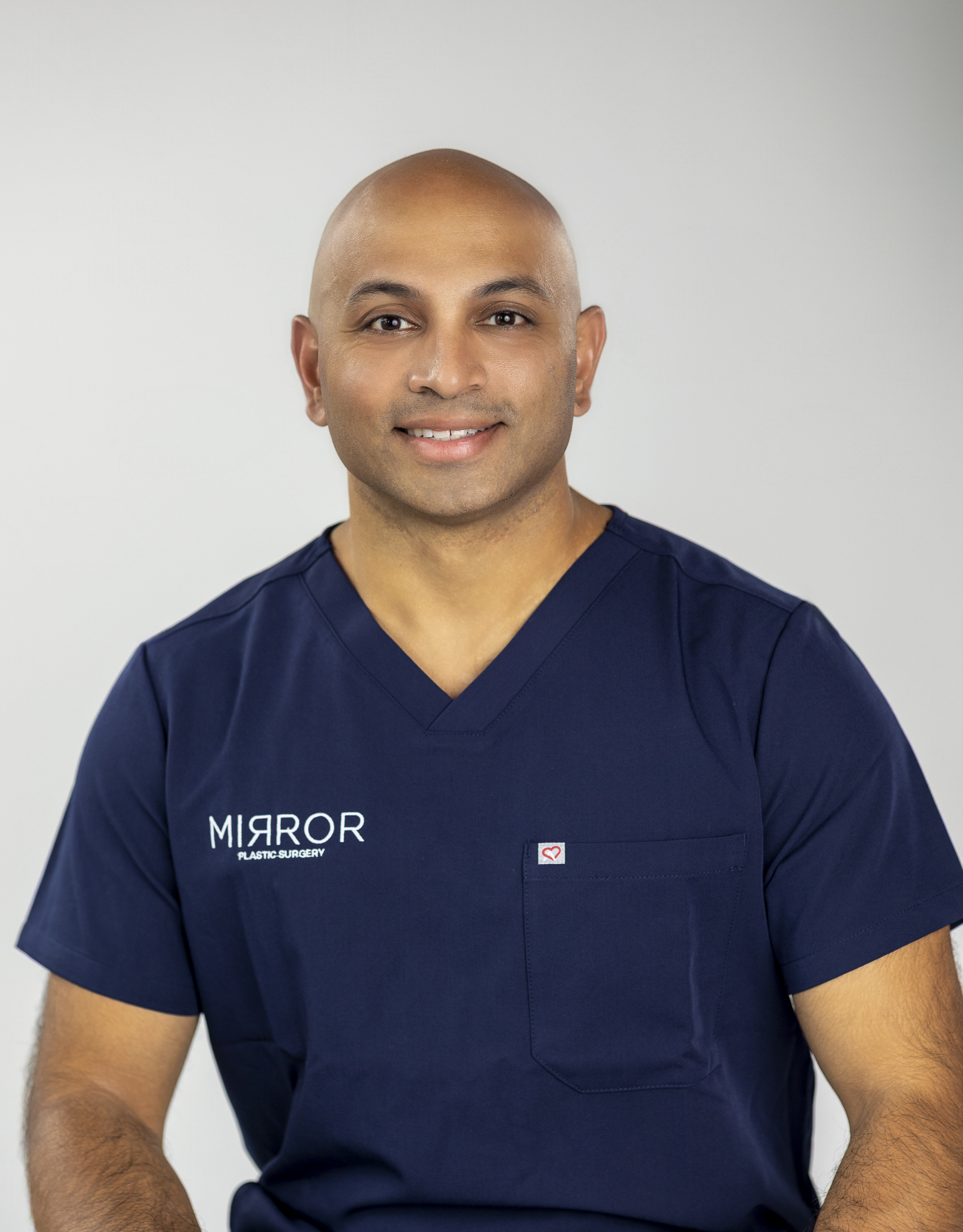
Written by: Dr. Akash Chandawarkar, Board Certified Plastic Surgeon, Mirror Plastic Surgery | Last updated: June 25, 2026
Key Takeaways for Slim BBL Patients
-
Patients with BMI 18–23 usually qualify for a realistic 500–800 cc fat transfer per buttock that creates modest projection, hip-dip correction, and a more defined waist-to-hip ratio rather than dramatic enlargement.1
-
Candidacy hinges on donor-site fat availability, and ultrasound assessment at Mirror Plastic Surgery objectively measures subcutaneous thickness to confirm whether a single-session transfer will create a worthwhile change.
-
Long-term fat survival on slim frames averages 50–70 %, and final contour stabilization typically occurs between 3 and 6 months when weight stays stable.1
-
Consistent lighting, posture, and camera angles in before-and-after photos are essential for judging real outcomes and avoiding marketing distortions.
-
Schedule your anatomy-specific assessment at Mirror Plastic Surgery to determine your candidacy and design a personalized plan for your skinny BBL.
Skinny BBL Candidacy and Donor Fat Requirements
Candidacy depends primarily on donor-site fat availability, meaning the harvestable fat present in the abdomen, flanks, and thighs. Many surgeons look for enough donor fat to create a noticeable result, and very lean patients sometimes lack sufficient fat for meaningful augmentation.
If your total harvestable volume falls below this threshold, a single-session fat transfer may not produce a worthwhile change. In these cases, a composite approach that combines a smaller implant with whatever fat can be safely harvested often becomes the more appropriate option.
A suitable candidate at a low BMI typically has localized fat deposits in at least two donor zones, a waist-to-hip ratio that benefits from lateral hip filling, and stable body weight. An unsuitable candidate has uniformly minimal subcutaneous fat across all zones, which leaves no viable harvest sites.
Ultrasound-assisted pre-operative assessment, part of Mirror Plastic Surgery’s standard protocol, provides an objective measurement of subcutaneous fat thickness before any surgical plan is finalized.
How a Skinny BBL Looks on a Slim Frame
As little as 500 cc of fat per side can create noticeable improvement on a slim patient, with outcomes focused on an athletic, perky projection and smoothed hip dips rather than exaggerated curvature.1 On a low-BMI frame, visible changes after a 500–800 cc transfer include correction of lateral hip indentations, mild upper-buttock fill that improves projection in profile, and a more defined waist-to-hip ratio from the back view.1
The result does not resemble the high-volume outcomes common in social-media content.1 Specialized slim or mini BBL procedures for patients with BMI between 18.5 and 24 focus on improving body proportion and subtle contour refinements such as fixing hip dips or asymmetry rather than adding massive volume.1
Typical Fat Transfer Volumes and Survival Rates
The following data connects these visible changes to specific volume ranges and long-term retention benchmarks for slim-frame patients. The table below summarizes published volume ranges, survival rates, and stabilization timelines relevant to slim BBL candidates, and every figure is cited inline.
|
Patient Profile |
Fat Transferred Per Side |
Long-Term Fat Survival |
Result Stabilization |
|---|---|---|---|
|
Slim / Mini BBL (BMI 18–24) |
500–800 cc |
50–70% |
3–6 months |
|
Traditional BBL (higher BMI) |
500–1,000 cc |
60–80% |
3–6 months |
|
Minimum threshold for noticeable result |
Varies by patient |
— |
— |
Surgeons typically over-correct during BBL by transferring more volume than the final target to account for expected absorption, and volume then stabilizes within the 3–6 month window.1 Some very lean patients may need a second session to reach their desired volume when fat stores are limited.
Safety Standards and Choosing a BBL Provider
BBL safety has improved substantially with modern technique standardization. A 2025 systematic review and meta-analysis of 22,151 gluteal fat-grafting patients reported a pooled minor-complication rate of 3.58%.
The ASPS and Aesthetic Society Multi-Society Gluteal Fat Grafting Task Force recommends injecting fat only into the subcutaneous space above the gluteal fascia to reduce complications. These guidelines function as non-negotiable technical standards rather than optional enhancements.
Mirror Plastic Surgery follows a safety-first philosophy that prioritizes safety, then function, then aesthetics for every BBL. Dr. Akash, recognized on Newsweek’s America’s Best Plastic Surgeons list for two consecutive years including 2025, trained at Harvard-MIT, completed a seven-year integrated plastic surgery residency at Johns Hopkins, and holds a specialized aesthetic surgery fellowship from the Manhattan Eye, Ear and Throat Hospital (MEETH).
The practice performs one to two surgeries per day, which ensures that each patient receives the full attention of the surgical team before, during, and after the procedure, in clear contrast to high-volume practices that perform five to ten procedures daily.
Board certification by the American Board of Plastic Surgery also means Dr. Akash maintains privileged hospital access in the rare event of a complication.
Discuss your safety-focused BBL plan with Dr. Akash and review how Mirror Plastic Surgery’s protocols and subcutaneous injection technique apply to your specific anatomy.
Long-Term Outlook for Slim BBL Results
The transferred fat cells that survive the initial resorption period behave like native fat, so they shrink with weight loss and expand with weight gain.1
For slim patients, postoperative weight stability matters even more, because a loss of only a few pounds on a low-BMI frame represents a proportionally larger percentage of total body fat and directly affects retained graft volume. Patients receive counseling to maintain their weight within a narrow range to preserve the contour achieved once stabilization is complete.
At 10 years, patients who maintain stable weight and avoid significant hormonal changes usually retain the proportional improvement established after the initial stabilization period.1 The hip-dip correction and waist-to-hip ratio improvement achieved with a 500–800 cc transfer remain durable outcomes when the anatomical conditions that made them possible, such as stable donor-site fat and consistent body weight, stay in place.1
Patients who experience significant weight fluctuation, pregnancy, or hormonal shifts may see contour changes that reflect those systemic changes rather than graft failure.
Spotting Red Flags in BBL Before-and-After Photos
Before-and-after images used in BBL marketing vary widely in reliability, so objective criteria help separate credible documentation from misleading content. Lighting changes between before and after photos, especially shadows that accentuate projection in the after image, can create the appearance of volume that does not reflect surgical outcome.
Posture differences, including anterior pelvic tilt in the after photo, artificially increase apparent buttock projection. Camera angle and distance inconsistencies between before and after shots also distort proportion comparisons.
Credible documentation uses consistent lighting, identical camera distance and angle, neutral posture, and multiple views including posterior, lateral, and oblique.
Time-stamped photos taken at 6–12 months post-operatively, when fat survival has stabilized, provide a more representative view than images taken at 6–8 weeks when residual swelling may still be present. Patients reviewing any provider’s portfolio should apply these criteria uniformly before drawing conclusions about expected outcomes.
Frequently Asked Questions
Can a slim patient with very little body fat get a BBL?
Candidacy depends on the total harvestable fat across all donor sites. Patients with BMI between 18 and 23 may have enough localized fat in the abdomen, flanks, or thighs for a 500–800 cc transfer per side, which produces meaningful contour refinement. Patients with uniformly minimal subcutaneous fat across all zones may not have enough donor tissue for a single-session fat transfer to create a worthwhile result.
In those cases, a composite approach using a small implant combined with available fat, or a staged procedure, may be more appropriate. A thorough pre-operative assessment, including ultrasound measurement of subcutaneous fat thickness, provides the only reliable way to determine candidacy.
How long does it take to see final BBL results on a slim frame?
Initial swelling resolves within the first few weeks, but fat survival and volume stabilization take 3–6 months. Most patients see their representative final result between 6 and 12 months after surgery. During this window, 20–40% of the transferred fat is reabsorbed by the body, which explains why surgeons slightly overfill the target area at the time of surgery. The contour visible at 6–12 months becomes the baseline from which long-term durability is measured.
What is the recovery like for a slim patient after a BBL?
Slim patients undergoing 500–800 cc transfers generally experience moderate downtime with less swelling than patients who receive higher-volume transfers. The standard post-operative restriction, which involves avoiding direct pressure on the buttocks for a minimum of two weeks, applies regardless of volume transferred.
Compression garments are worn to support the donor sites and reduce swelling. Maintaining stable body weight during recovery is particularly important for slim patients because even modest weight changes affect a proportionally larger share of their total fat volume.
How do I evaluate whether a BBL surgeon is following current safety guidelines?
Current task-force guidelines from the ASPS and The Aesthetic Society specify that fat must be injected only into the subcutaneous space above the gluteal fascia to reduce complications.
A surgeon who can explain these technical standards, demonstrate board certification by the American Board of Plastic Surgery, and describe a policy of limiting daily surgical volume, rather than performing five to ten procedures per day, is operating within an evidence-based safety framework.
Asking directly about injection technique, daily case volume, and facility accreditation provides objective information for evaluating any provider.
Will a 500–800 cc BBL look natural on a slim frame?
A 500–800 cc transfer per side can look natural on a slim frame when volume is matched to the patient’s existing anatomy.1 On a low-BMI frame, this range usually produces hip-dip correction, mild upper-buttock projection, and a more defined waist-to-hip ratio, which read as proportionate and natural rather than obviously augmented.1
The outcome reflects an athletic contour improvement, not a dramatic size increase. Patients whose goal involves a large-volume change from a slim starting point are advised that their donor-site fat availability may not support that outcome in a single session, and that staged procedures or a composite approach may be necessary.
Making an Informed Skinny BBL Decision
Realistic BBL outcomes for slim patients are defined by anatomy rather than aspiration. A 500–800 cc fat transfer on a low-BMI frame delivers measurable improvement in hip-dip contour, waist-to-hip ratio, and subtle projection, and these outcomes stay durable when body weight remains stable and align with the proportions of a lean physique.
The gap between those outcomes and the high-volume results common in social-media content does not reflect a failure of technique. It reflects donor-site fat availability and the basic physics of fat survival. Knowing that distinction before surgery often separates a satisfying outcome from an unmet expectation.
Mirror Plastic Surgery’s concierge approach, which includes hour-long consultations, limited daily case volume, ultrasound-guided pre-operative assessment, and Dr. Akash’s Harvard-MIT, Johns Hopkins, and MEETH training, is designed to give slim patients the anatomical clarity they need to make that decision with confidence.
Dr. Akash, whose credentials and safety-first approach have earned national recognition, applies the same evidence-based standard to every BBL evaluation regardless of the patient’s starting volume.
Take the next step and book your consultation at Mirror Plastic Surgery in St. Petersburg, FL, for a complete, anatomy-specific assessment of your BBL candidacy, realistic volume expectations, and long-term contour plan.
1 Results may vary from person to person. Editorial content, before and after images, and patient testimonials do not constitute a guarantee of specific results.